Cash could be almost gone in Australia in a decade – but like cheques, who'll miss it?
- Written by: Peter Martin, Visiting Fellow, Crawford School of Public Policy, Australian National University
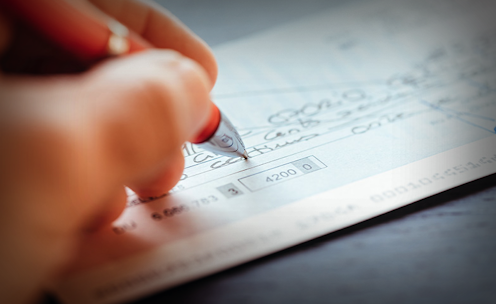
Late last year, the Reserve Bank gave 1,000 Australians diaries and asked them to record every payment they made over the course of a week. Of the 13,000 payments, only 17 were with cheques.
It’s been an astounding collapse. Back in 1980 at the start of the credit card era, 85%[1] of non-cash payments were made with cheques. Today it’s less than 0.1%[2].
Earlier this month, the government announced it was following New Zealand[3], Denmark, the Netherlands and others[4], closing our cheque system down by 2030[5].
Meanwhile, New Zealand is already on to the next thing. Having phased out cheques[6], it’s now looking at winding down the use of cash[7].
So how close is Australia now to becoming a cash-free nation?
The hidden costs of cheques and cash
Cheques are horrendously expensive to process. The average cost of everything that had to happen to process a cheque exceeds $5[8] per payment, mostly borne by banks.
But cash is expensive in its own way. The average cost of creating, sorting and trucking all those sheets of plastic and coins exceeds 50 cents[9] per payment, mostly passed on to banks and retailers, and it is soaring as the number of payments plummets.
As recently as 2007, the vast bulk of consumer payments – 69% – were in cash. By 2019 only 27% were in cash. By 2022, after two years of COVID, it was only 13%[10].
At this rate, it’s hard to be certain how long cash will last.
What made cheques so slow and costly
For those who’ve never had to write one, cheques are bank-issued pieces of paper on which the owner writes the name of the person they want the bank to pay and the amount. They they hand it to that person, who then hands it to their bank, which then tries to get the money from the payer’s bank.
Behind the scenes, until recently when the electronic transmission of digital images changed things, each bank would collect all the cheques that had been presented to its branches each day and sort them into bags, one for each originating bank.
Then, late at night, its “bag man” would travel to a nondescript city location with a bag for each bank, hand the correct one to each of the other bagmen, and be given bags in return, which the bagman would take back to the bank for signature checking.
When each bank worked out what it owed the other bank, they would usually discover the flows largely cancelled each other out, and then make net payments which would be reflected in the cheque-writer’s account, up to five business days later.
Always expensive, the cost per cheque grew and grew as the number of Australians paying with cheques dwindled to a fraction of what it had been.
How moving cash became a loss-making business
It’s the same sort of story with cash. Although we don’t often think about it, cash costs an awful lot to move, sort and restock.
Printing the notes still makes money – it costs about 32 cents to make each note, whether it’s worth $5 or $100, although making some coins now loses money[12].
The real expense is in moving notes and coins around, keeping them nearby and restocking banks and cash registers. Aside from payments the Reserve Bank makes to banks for returning damaged notes, the banks (and, through them, the retailers) are expected to pay for the lot.
Read more: The Mint and Note Printing Australia make billions for Australia – but it could be at risk[13]
Until recently that gave the two firms that dominate the business (Linfox Armaguard, and Prosegur, which owns Chubb Security) a pretty good deal.
Except that the volume of cash they’ve carried has dived 47%[14] over the past ten years, 30% of it during COVID.
Both firms say their money-moving arms are incurring “heavy financial losses” and that if they increase their prices much more, retailers might move even further away from cash[15], pushing their costs even higher.
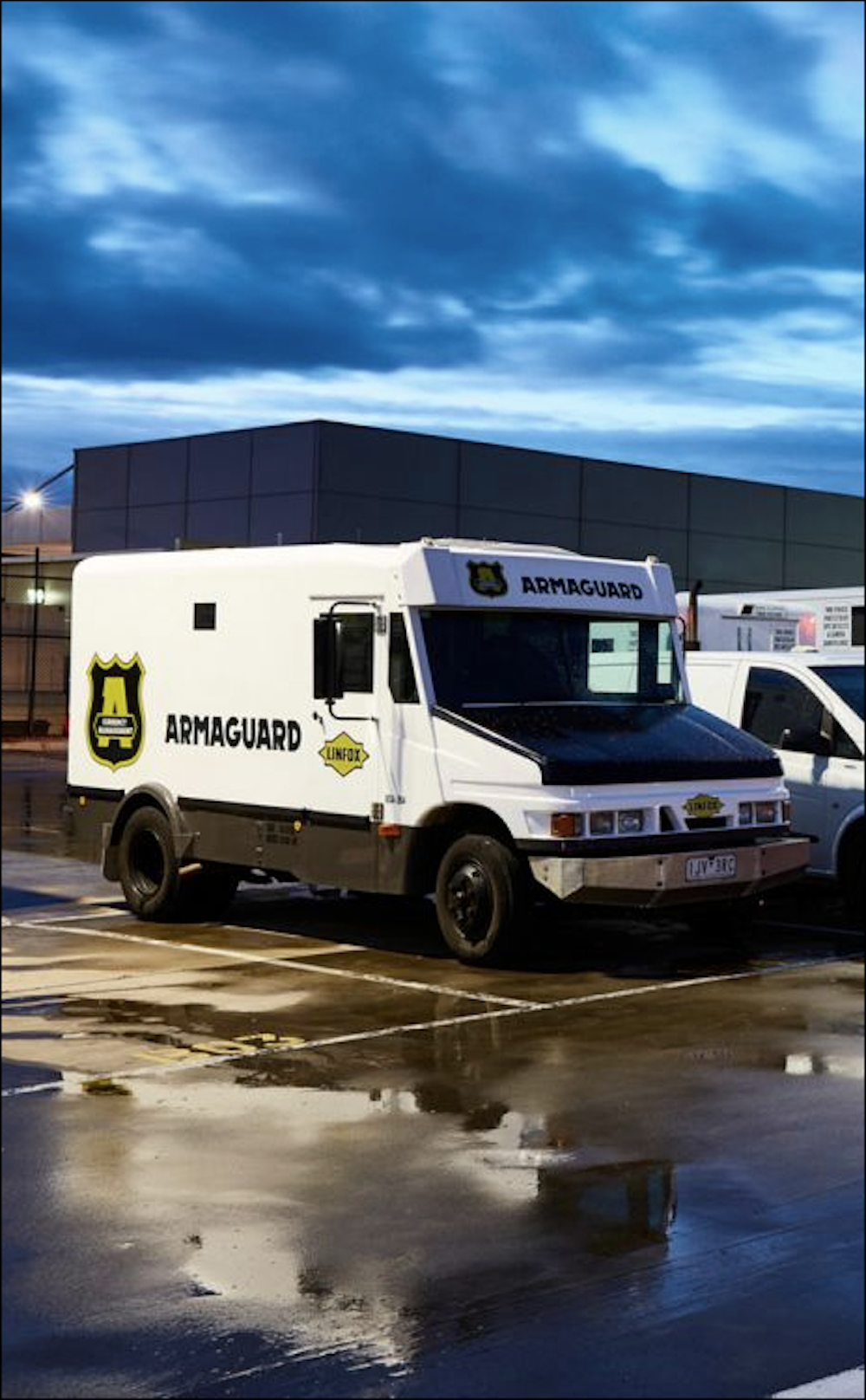
Last week, the Competition and Consumer Commission allowed them to merge[16] on the condition that they limit their price increases to the consumer index plus 7.5% per year. That increase is so steep as to suggest a death spiral[17]: the more they charge, the less retailers will use cash, the more they’ll have to charge.
The only way out, unless they can make really big efficiencies, or unless the decline in the use of cash stops, would be for the government to return to subsidising the use of cash. It’s hard to see how it could make the case to do that when there are cheaper emerging technologies.
Bank transfers cost a mere fraction[18] of using cash, and pretty soon we’ll be able to use them for everything, via things such as QR codes[19].
So when will cash go the way of cheques?
A previous federal government has already tried to eliminate the use of cash for transactions worth more than $10,000, as part of its attack on the black economy.
Announced in 2016 by the Turnbull Coalition government, the ban was due to come into force in 2019[20]. But, after delays, in 2020 the Morrison-led Coalition government backed down[21].
If Australia wants to ban cash (and ban it for small transactions too – cash is now used less than cards for transactions of all sizes[22]) the easiest solution might be simply to wait.
Cards are now the dominant means of exchanging money, and electronic transfers are growing from a small base.
Pure extrapolation would suggest cash has less than a decade to go, but it will probably hang around for longer as an (expensive, little-used) backup that maintains privacy.
Like cheques, cash will probably die gradually, then suddenly[23]. By the time it does, there will be few users left who care.
References
- ^ 85% (www.rba.gov.au)
- ^ 0.1% (www.rba.gov.au)
- ^ New Zealand (www.justice.govt.nz)
- ^ others (www.sbs.com.au)
- ^ 2030 (ministers.treasury.gov.au)
- ^ phased out cheques (www.stuff.co.nz)
- ^ cash (www.rbnz.govt.nz)
- ^ $5 (www.rba.gov.au)
- ^ 50 cents (www.rba.gov.au)
- ^ 13% (www.rba.gov.au)
- ^ cottonbro/pexels (www.pexels.com)
- ^ loses money (theconversation.com)
- ^ The Mint and Note Printing Australia make billions for Australia – but it could be at risk (theconversation.com)
- ^ 47% (www.accc.gov.au)
- ^ further away from cash (images.theconversation.com)
- ^ merge (www.accc.gov.au)
- ^ death spiral (www.energynetworks.com.au)
- ^ mere fraction (www.rba.gov.au)
- ^ QR codes (www.mobiletransaction.org)
- ^ 2019 (ministers.treasury.gov.au)
- ^ backed down (www.abc.net.au)
- ^ of all sizes (www.rba.gov.au)
- ^ gradually, then suddenly (quoteinvestigator.com)
Authors: Peter Martin, Visiting Fellow, Crawford School of Public Policy, Australian National University