Working from home immoral? A lesson in ethics, and history, for Elon Musk
- Written by: Dale Tweedie, Senior lecturer, Macquarie University
Elon Musk doesn’t like people working from home. A year ago he declared the end of remote work[1] for employees at car maker Tesla. Now he has called the desire of the “laptop classes” to work from home “immoral”.
“You’re gonna work from home and you’re gonna make everyone else who made your car come work in the factory?” he said in an interview on US news network CNBC[2]:
It’s a productivity issue, but it’s also a moral issue. People should get off their goddamn moral high horse with that work-from-home bullshit. Because they’re asking everyone else to not work from home while they do.
There’s a superficial logic to Musk’s position. But scrutinise it closer and the argument falls apart. While we have a duty to share workload with others, we have no duty to suffer for no reason. And for most of human history, working from home has been normal. It’s the modern factory and office that are the oddities.
Read more: How many days a week in the office are enough? You shouldn't need to ask[3]
Working from home and the industrial revolution
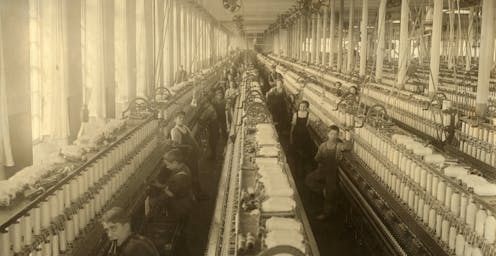
Prior to the industrial revolution, which historian date to the mid-1700s to mid-1800s, working from home, or close to home, was commonplace for most of the world’s population. This included skilled manufacturing workers, who typically worked at home or in small workshops nearby.
For the skilled craftsperson, work hours were what we might call “flexible”. British historian E.P. Thompson records[4] the consternation among the upper class about the notorious “irregularity” of labour.
Conditions changed with the rapid growth and concentration of machines in the industrial revolution. These changes began in England, which also saw the most protracted and tense conflicts over the new work hours and discipline factory owners and managers demanded.
Judgements of conditions for workers prior to industrialisation vary. Thompson’s masterpiece study The Making of the English Working Class[5] (published in 1963) recounts bleak tales of families of six or eight woolcombers, huddled working around a charcoal stove, their workshop “also the bedroom”.
But it also mentions the stocking maker with “peas and beans in his snug garden, and a good barrel of humming ale”, and the linen-weaving quarter of Belfast, with “their whitewashed houses, and little flower gardens”.
Either way, working from home is not a novel invention of the “laptop classes”. Only with the industrial revolution were workers required under one roof and for fixed hours.
Read more: Meet the matchstick women — the hidden victims of the industrial revolution[6]
Misapplying a concept of justice
Musk’s moral argument against working from home says that because not all workers can do it, no workers should expect it.
This has some resemblance to the “categorical imperative” articulated by 18th century philosopher Immanuel Kant: “Act only according to that maxim whereby you can at the same time will that it should become a universal law.”
But acting according to the same principle does not mean we all have the same options. We can, for example, want all workers to have the maximum freedom their tasks allow.
The wider error Musk appears to be making is misapplying what ethics researchers call distributive justice.
Simply put, distributive justice concerns how we share benefits and harms. As the philosopher John Rawls explains in his book Justice as Fairness[7], in distributive justice we view society as a cooperative activity, where we “regulate the division of advantages that arises from social cooperation over time”.
Research on distributive justice at work typically concerns how to pay workers fairly and also share the suffering or “toil” work requires. But there is no compelling moral case to share the needless suffering that work creates.
How to share more fairly
Clearly, professionals benefit from work in many ways we might argue are unjust. As economist John Kenneth Galbraith observed satirically in The Economics of Innocent Fraud[8], those who most enjoy their work are generally the best paid. “This is accepted. Low wage scales are for those in repetitive, tedious, painful toil.”
If Musk wanted to share either the pay or toil at Tesla more equally, he has the means to do something about it. He could pay his factory workers more, for example, instead of taking a pay package likely to pay him US$56 billion[9] in 2028. (This depends on Tesla’s market capitalisation being 12 times what it was in 2018; it’s now about 10 times.)
To share the “toil” of work more fairly, he wouldn’t just be sleeping at work[10]. He’d be on the production line, or down a mine in central Africa, dragging out the cobalt electric vehicle batteries need, for a few dollars a day[11].
Elon, the floor is yours
Instead, Musk’s idea of fairness is about creating unnecessary work, shaming workers who don’t need to be in the office to commute regardless. There is no compelling moral reason for this in the main Western ethics traditions.
The fruits and burdens of work should be distributed fairly, but unnecessary work helps no one. Commuting is the least pleasurable, and most negative, time of a workers’ day, studies show[12]. Insisting everyone has to do it brings no benefit to those who must do it. They’re not better off.
Denying some workers’ freedom to work from home because other workers don’t have the same freedom now is ethically perverse.
Musk’s hostility towards remote work is consistent with a long history of research that documents managers’ resistance to letting workers out of their sight.
Working from home, or “anywhere working[13]”, has been discussed since the 1970s[14], and technologically viable since at least the late 1990s. Yet it only became an option for most workers when managers were forced to accept it during the pandemic.
While this enforced experiment of the pandemic has led to the “epiphany[15]” that working from home can be as productive, the growth of surveillance systems[16] to track workers at home proves managerial suspicions linger.
Read more: 3 ways 'bossware' surveillance technology is turning back the management clock[17]
There are genuine moral issues for Musk to grapple with at Tesla. He could use his fortune and influence to do something about issues such as modern slavery in supply chains[18], or the inequity of executive pay[19].
Instead, he’s vexed about working from home. To make work at Tesla genuinely more just, Musk’s moral effort would better be directed towards fairly distributing Tesla’s profit, and mitigating the suffering and toil that industrial production systems already create.
References
- ^ remote work (www.theguardian.com)
- ^ on US news network CNBC (www.cnbc.com)
- ^ How many days a week in the office are enough? You shouldn't need to ask (theconversation.com)
- ^ E.P. Thompson records (doi.org)
- ^ The Making of the English Working Class (www.bard.edu)
- ^ Meet the matchstick women — the hidden victims of the industrial revolution (theconversation.com)
- ^ Justice as Fairness (books.google.com.au)
- ^ The Economics of Innocent Fraud (www.amazon.com.au)
- ^ likely to pay him US$56 billion (www.bbc.com)
- ^ sleeping at work (www.businessinsider.com)
- ^ for a few dollars a day (www.npr.org)
- ^ studies show (www.tandfonline.com)
- ^ anywhere working (books.google.com.au)
- ^ since the 1970s (theconversation.com)
- ^ epiphany (www.cambridge.org)
- ^ growth of surveillance systems (theconversation.com)
- ^ 3 ways 'bossware' surveillance technology is turning back the management clock (theconversation.com)
- ^ modern slavery in supply chains (www.forbes.com)
- ^ executive pay (www.bbc.com)
Authors: Dale Tweedie, Senior lecturer, Macquarie University