The housing wealth gap between older and younger Australians has widened alarmingly in the past 30 years. Here's why
- Written by: Rachel Ong ViforJ, ARC Future Fellow & Professor of Economics, Curtin University
The housing wealth gap between younger and older Australians is undeniably growing.
Our newly published study[1] attempts to find out how much it has grown by estimating the gap in the home equity of older people (Australians in their 50s) and younger people (Australians in their 30s) in 1997–98 and 2017–18.
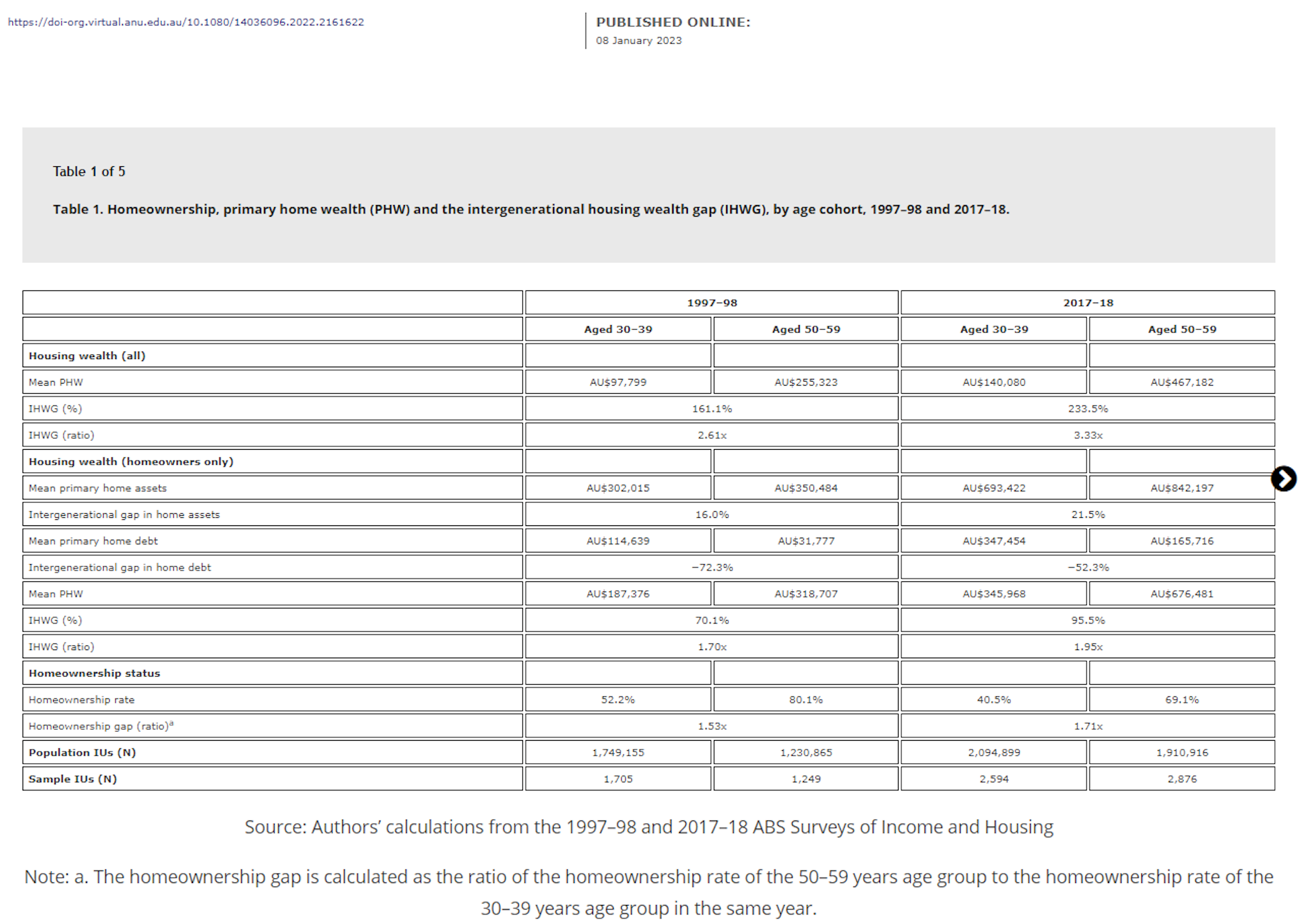
Adjusted for inflation, we find that in 1997-98 the younger group had mean housing equity of A$97,799 compared to the older group’s $255,323 – meaning the older group had 161% more equity home equity than the younger group: 2.6[2] times as much.
By 2017–18 the younger group had mean equity of $140,080 but the older group’s mean equity had increased more to $467,182 – meaning the older group had 234% more equity than the younger group: 3.3 times as much.
The housing wealth gap between the old and young had grown from 161% to 234% – making it almost half as big again.
The increase in the gap between those we describe as the income-poor young and the income-rich old was even more alarming – a doubling from 532% to 1230%.
Two things have widened the divide
Our study draws on the 1997-98 and 2017-18 Bureau of Statistics surveys of income and housing and identifies two forces widening the gap.
The first relates to home ownership. While ownership rates for both groups have fallen, the decline has been steeper among the young (from 52% to 40%) than the old (80% to 69%).
The second relates to the different trajectories in the growth of home equity among those who do own homes. In 1997-98, the average equity in the primary home of owners in the older group was 1.7 times that of owners in the younger group. By 2017-18 it was twice that of the younger owners.
The increasing ownership gap turns out to have mattered more than the increasing gap in equity among those who do have homes.
We find that if the ownership gap had not widened, the overall intergenerational housing wealth gap would have been smaller at 200%, rather than 234%.
If the gap in home equity among those who owned homes had not widened, the gap would have been smaller at 215% rather than 234%.
It’s not just age – there are other divides
Housing inequality exists across other divides. In the table below we identify gaps across gender, location and income divides:
comparing single women to single men, we find the advantage enjoyed by single women has shrunk from 72% to 42%
comparing Australians in regional and urban areas we find the advantage enjoyed by those in cities has climbed from 46% to 93%
comparing Australians in the bottom and top thirds of income (adjusted for family size) we find the housing wealth gap has widened from 94% to 191%.
The age-based housing wealth gap is much greater than these other divides. But it becomes greater still when it interacts with those divides.
The greatest combined divide is between people who are both younger and income-poor and people who are both older and income-rich.
In 1997-98, the housing wealth gap between these two groups was an outsized 532%. Over the following decades, it more than doubled to 1230%.
Action is becoming urgent
Our findings put beyond doubt that younger people are falling further behind older people in terms of home ownership.
While some of this might reflect a shift in young people’s investment preferences toward non-housing assets, we find young non-owners also have less non-property wealth than owners.
It makes urgent the need to act on both the affordability of housing and the security of tenure for renters.
Read more: The rent crisis is set to spread: here's the case for doubling rent assistance[3]
Our finding that older Australians enjoy higher growth in home values than young Australians provides support for encouraging the use of equity-release[4] (“reverse mortgage”) schemes to unlock their housing wealth, relieving younger Australians of some of the tax burden of supporting them.
Although obstacles remain[5], the benefits to both older Australians and less well-off younger taxpayers would be considerable.
In the past 30 years the housing wealth gap between income-poor young Australians and income-rich older Australians has doubled to more than 1000%. Our society will hold together better if we do what we can to wind it back.
References
- ^ study (dx.doi.org)
- ^ 2.6 (images.theconversation.com)
- ^ The rent crisis is set to spread: here's the case for doubling rent assistance (theconversation.com)
- ^ equity-release (theconversation.com)
- ^ obstacles remain (www.cambridge.org)
Authors: Rachel Ong ViforJ, ARC Future Fellow & Professor of Economics, Curtin University