Cruise ships are coming back to NZ waters – should we really be welcoming them?
- Written by: Timothy Welch, Senior Lecturer in Urban Planning, University of Auckland
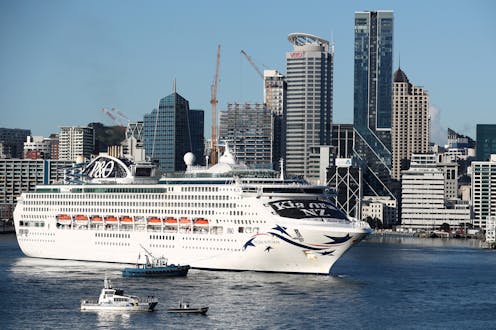
The return this month[1] of the first cruise liner to Auckland’s Waitematā Harbour was accompanied by the sort of fanfare normally reserved for visiting foreign dignitaries: a tug boat decked out in bunting, a circling helicopter, even the mayor on hand to welcome the ship.
Coming after a two year hiatus due to the pandemic and border closures, it was undoubtedly a momentous occasion. But it’s also an opportunity to examine the environmental and economic impacts of these massive ships, and to ask how welcome they really are.
Criticism of the cruise industry is not new, and there have been calls for global monitoring[2] and effective legislation because of its impact on environmental and human health. Climate change has only amplified this.
Individual cruise liners emit more CO2[3] than any other kind of ship. Per passenger mile, they produce at least twice the CO2 emissions[4] of a long-haul flight.
A single ship can use up to 150 tonnes[5] of low-grade heavy fuel oil (HFO)[6] every day of its voyage. Combusted in a ship’s huge engines, this produces particulate matter (PM) – microscopic particles that can be inhaled and lodge in lung tissue or be carried in a bloodstream.
PM is linked to various environmental harms and health problems, including reduced lung function and worsening asthma and heart disease. A single cruise ship can produce the same daily PM emissions as a million cars[7], with the global cruise fleet producing the emission equivalent of 323 million cars (but with passenger capacity of only about 581,200[8] single-occupancy cars).
Environmental impact
And it’s not just the oceans the ships cross or the ports where the vessels dock that are affected. A recent study found that standing on the deck of a cruise ship exposed passengers to air quality equivalent to a city like Beijing[9].
Cruise ship fuel also contains sulphur. When combusted it creates sulphur oxide, a direct contributor to smog at ground level, acid rain at the atmospheric level, and a host of health impacts for those who breathe in the pollutant.
Read more: Without stricter conditions, NZ should be in no hurry to reopen its border to cruise ships[10]
Pressure from environmentalists and modern technology eventually led to the installation of “scrubbers” on cruise liner smokestacks which remove most sulphur from the ship’s exhaust.
However, some or all of the collected sulphur is often later disposed of into the ocean[11], potentially harming reefs and marine life, and contributing to ocean acidification.
Cruise ships are also allowed to dump untreated sewage and heavily contaminated grey water. Billions of litres of this wastewater is discharged into the oceans each year.
Industry under scrutiny
There will always be the argument that fuel can be made cleaner, engines more efficient, or older ships replaced with battery and solar-powered vessels. However, even moderate attempts at curbing ship emissions have reportedly been opposed[12] by industry lobbyists.
Meanwhile, the ability to re-flag a vessel to countries with lower environmental standards, access to an abundance of cheap fuel, and the cost of replacing a single ship (upwards of NZ$2.6 billion), all mean the current fleet is probably around for some time.
Read more: Can the cruise industry really recover from coronavirus?[13]
Environmental impact isn’t the only reason the cruise industry has come under scrutiny in the past. It has been cited for poor labour practices[14], including low wages and bad conditions, and contributing to over-tourism[15].
But despite having been responsible for higher rates of disease transmission[16] at the outset of the COVID-19 pandemic, the industry appears to be bouncing back[17] after reducing vaccination requirements for passengers.
Read more: Cruise lines promise big payouts, but the tourist money stays at sea[18]
Economic doubts
The common argument, particularly in the case of a port city like Auckland, is that cruise ships bring valuable tourist dollars to a struggling CBD. But past studies of tourist spending behaviour show cruise tourists contribute little to local economies[19].
Cruise ships typically spend between five and nine hours in a port, giving tourists little time to shop or dine. Rather, they are often whisked away by bus to major tourist destinations. They don’t hire hotel rooms or eat at restaurants.
According to the NZ Cruise Association, 321,590 tourists spent around $368 million[20] nationwide (about $1,144 each) during the last pre-pandemic season from 2018 to 2019. Overall, cruise passengers contributed about 2% of the total $17.5 billion spent[21] that season by international tourists.
Beginning in October, the cruise season will kick into high gear, with ships arriving in Auckland every few days. Given the significant questions around their environmental and health impacts, and their relatively small contribution to the economy, are lavish welcomes like what we saw earlier this month really justified?
References
- ^ return this month (www.nzherald.co.nz)
- ^ calls for global monitoring (www.sciencedaily.com)
- ^ emit more CO2 (www.transportenvironment.org)
- ^ twice the CO2 emissions (theicct.org)
- ^ 150 tonnes (en.nabu.de)
- ^ low-grade heavy fuel oil (HFO) (www.independent.co.uk)
- ^ a million cars (en.nabu.de)
- ^ capacity of only about 581,200 (cruisemarketwatch.com)
- ^ equivalent to a city like Beijing (www.stand.earth)
- ^ Without stricter conditions, NZ should be in no hurry to reopen its border to cruise ships (theconversation.com)
- ^ into the ocean (www.science.org)
- ^ reportedly been opposed (www.nzherald.co.nz)
- ^ Can the cruise industry really recover from coronavirus? (theconversation.com)
- ^ poor labour practices (www.tandfonline.com)
- ^ over-tourism (theconversation.com)
- ^ higher rates of disease transmission (www.bbc.com)
- ^ bouncing back (www.reuters.com)
- ^ Cruise lines promise big payouts, but the tourist money stays at sea (theconversation.com)
- ^ little to local economies (theconversation.com)
- ^ spent around $368 million (newzealandcruiseassociation.com)
- ^ $17.5 billion spent (www.tia.org.nz)
Authors: Timothy Welch, Senior Lecturer in Urban Planning, University of Auckland