Weekend Times


The Times

Business News

the enterprise bargaining system is broken, and in terminal decline

  • Written by Anthony Forsyth, Distinguished Professor of Workplace Law, RMIT University
the enterprise bargaining system is broken, and in terminal decline

Real wages in Australia have been stagnating for the better part of a decade. Now, with higher inflation, they’re declining. So what can the new Albanese government, having campaigned hard on the previous government’s failures, do about it?

Making a submission to Australia’s industrial relations umpire, the Fair Work Commission, to lift the minimum hourly wage from A$20.33 to A$21.36, is one thing. If that push is successful, it would help the 2% of workers paid the minimum wage, as well as the 23% (about 2.2 million workers) on awards, whose rates would also lift.

Read more: Lifting the minimum wage is anything but reckless – it's what low earners need[1]

But there’s a bigger systemic problem the Albanese government needs to address – a flaw designed and implemented by a previous Labor government. Enterprise bargaining, the mechanism introduced 30 years ago for workers to collectively negotiate better wages and conditions, is broken.

It’s failing low-paid workers lacking bargaining power in particular, and is a big part of the reason for such poor wages in female-dominated professions such as aged care and child care.

Origin of enterprise bargaining agreements

Enterprise bargaining was introduced during the Hawke-Keating Labor era in the early 1990s, in partnership with the Australian Council of Trade Unions and the support of employer groups.

The Business Council of Australia had lobbied strongly for an enterprise focus for negotiating employment conditions, on the basis it`was the best way to tie wage claims to gains in productivity.

Prime Minister Paul Keating extols enterprise bargaining in parliament on June 24 1992.

After 30 years, though, enterprise bargaining is in terminal decline, with ten years of shrinking agreement coverage in line with stagnant wages growth.

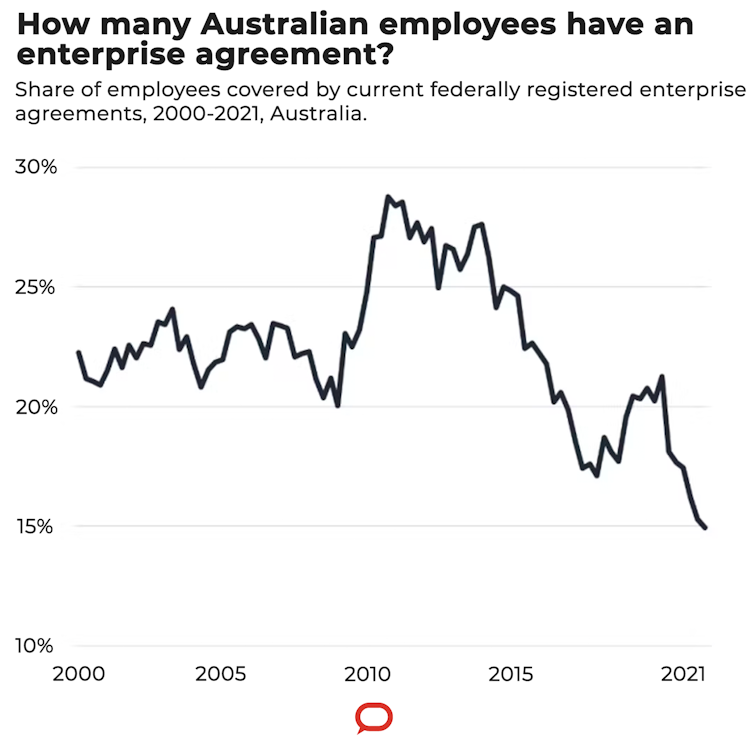
Research by labour law and policy experts Andrew Stewart, Jim Stanford and Tess Hardy published in May[2] shows the total number of enterprise agreements fell by more than half between 2013 and 2021 (from 23,500 agreements to 10,000).

Worse, the share of employees covered by a current enterprise agreement declined from an average of 27% in 2012 to just 15% by late 2021. This is shown in the following graph.

Australia Institute, The Wages Crisis Revisited, CC BY-ND[3] The Australian Industry Group and other business representatives blame this on the Fair Work Commission’s strict approach to the “better off overall test” and other statutory protections of employees’ interests in agreement-making. Unions see it differently. In their view, the reason enterprise bargaining is in free-fall is because of design flaws in the current laws, meaning workers have very limited negotiating power and employers can “game” the system to avoid their obligation to bargain. The main problem: enterprise bargaining was designed for an economy that no longer exists. Read more: Cabinet papers 1992-93: the rise and fall of enterprise bargaining agreements[4] Workplaces have changed Allowing employees and unions to only bargain and take industrial action for an agreement with a single business, or part of a business, works fine with large worksites, such as factories, with hundreds or thousands of workers with the same employer. But these types of workplaces are increasingly rare. Now, many employers in sectors such as food production, logistics, warehousing, building management and “big box” retail stores have hived off large parts of their operations, and workers, to other entities. They’ve used labour hire, independent contracting and outsourcing to distance themselves from responsibility for minimum employment standards – and collective bargaining. To lift wages, workers need the boost to bargaining power that comes from being able to negotiate – and strike – across entire industries. Labour hire workers must be able to bargain not just with the agency that technically employs them, but with the business for whom they are working – such as Amazon[5], which has relied heavily on outsourced labour in its Australian operations. Workers who clean and provide security services in commercial buildings need to have the capacity to pursue pay increases from the lead firms that ultimately control labour’s share of profits. What Labor has promised to do Federal Labor’s 2021 national policy platform[6] contains a commitment to “improve access to collective bargaining, including where appropriate through multi-employer collective bargaining”. It notes this access is a particular issue for low-paid employees lacking industrial power, and that the Fair Work Act does not adequately facilitate it. These points, however, were not mentioned in the run-up to the election. Nor did the Australian Council of Trade Unions make an issue of it, in contrast to its “Change the Rules” campaign between 2017 and 2019[7]. ACTU general secretary Sally McManus addresses a 'Change the Rules' rally in Brisbane, November 20 2018.
ACTU general secretary Sally McManus addresses a ‘Change the Rules’ rally in Brisbane, November 20 2018. Glenn Hunt/AAP

Instead, Labor pledged to address other problems in the enterprise bargaining system: the weak requirements for employers to negotiate in “good faith”, and the ease with which employers can have agreements terminated.

However, the Albanese government may well be pushed to “go bolder” – not just by unions but also the Australian Greens, whose 2022 election policy[8] states:

Workers should be free to collectively bargain at whatever level they consider appropriate and with whoever has real control over their work, whether at a workplace, industry, sector or other level.

The Greens’ platform also states:

Workers should have the right to engage in industrial action, including the right to strike, consistent with international law and not limited to artificially restricted bargaining periods.

The government may not need Greens’ support to pass legislation in the House of Representatives, but it will need it in the Senate.

So expect the future of enterprise bargaining, along with properly tackling insecure work, to be a hot topic for the government’s planned jobs summit.

With employers already talking up the need for productivity gains to underpin any changes, we’ll have to wait and see how serious the new government is about fixing a broken bargaining system.

References

  1. ^ Lifting the minimum wage is anything but reckless – it's what low earners need (theconversation.com)
  2. ^ published in May (australiainstitute.org.au)
  3. ^ CC BY-ND (creativecommons.org)
  4. ^ Cabinet papers 1992-93: the rise and fall of enterprise bargaining agreements (theconversation.com)
  5. ^ such as Amazon (www.theguardian.com)
  6. ^ national policy platform (alp.org.au)
  7. ^ between 2017 and 2019 (www.tandfonline.com)
  8. ^ 2022 election policy (greens.org.au)

Authors: Anthony Forsyth, Distinguished Professor of Workplace Law, RMIT University

Read more https://theconversation.com/theres-one-big-reason-wages-are-stagnating-the-enterprise-bargaining-system-is-broken-and-in-terminal-decline-183818

The Weekend Times Magazine

Northern New South Wales may be facing a schoolies invasion

Northern New South Wales may be facing a “schoolies invasion” and unit, apartment and townhouse owners need to prepare – or be left with a potentially large clean-up bill. ...

Ensuring a consistent Australian foreign policy - Scott Morrison

The Morrison Government will introduce new legislation to ensure the arrangements states, territories, councils and universities have with foreign governments are consistent with Australian foreign policy.   The Commonwealth Government has exclusive...

Who Can Install A Private Power Pole?

Private power poles provide property owners with the freedom to choose where electricity will enter the building. It also offers protection from hazards associated with being directly connected to the...

How to Care for Your Dental Veneers: Tips from Experts

Dental veneers are a popular cosmetic dentistry solution that enhances smiles by covering imperfections such as discoloration, chips, or gaps. Among the different types available, porcelain veneers stand out for...

CHECK.CHECK.CHECK. The new ‘Slip, Slop, Slap,’ for a night out campaign

CHECK.CHECK.CHECK. The new ‘Slip, Slop, Slap,’ for a night out launched by the Night Time Industries Association A new campaign Check. Check. Check. encouraging punters to do their...

Republicans have used a ‘law and order’ message to win elections before. This is why Trump could do it again

In 1991, Donald Trump’s mother, Mary, was mugged on a New York street. As Trump’s niece recounts in her new book, the young assailant slammed Mary’s head into her Rolls...

Planting The Seed To Health Living Top tips on planting for wellbeing

With the family home full time and a need to keep everyone busy, it is the ideal time to plant a seed to a healthier lifestyle. Tuscan Path Product Manager...

Discover the Benefits of Lifestyle Awnings for Your Home

Image by evening_tao on Freepik Adding shade and style to your outdoor space is easier than ever with Lifestyle Awnings. Whether you want to enjoy your backyard comfortably, protect your...

Alcohol and your brain: study finds even moderate drinking is damaging

It’s a well-known fact that drinking too much alcohol can have a serious impact on your health, including damaging your liver. But how much is too much? For conditions such...