Are Russia's elite really using cryptocurrency to evade sanctions?
- Written by: Dr Paul Mazzola, Lecturer Banking and Finance, Faculty of Business and Law, University of Wollongong
Fearing Russia’s elite will evade economic sanctions by converting their wealth to cryptocurrency, high-profile US Democratic senator Elizabeth Warren has introduced a bill[1] into US Congress to stymie Russian crypto transactions.
Warren warned[2] a Senate committee hearing:
So no one can argue that Russia can evade all sanctions by moving all its assets into crypto. But for Putin’s oligarchs who are trying to hide, you know, a billion or two of their wealth, crypto looks like a pretty good option.
The bill does not seek to impose a blanket ban on all Russian cryptocurrency transactions. But it would give the US government the authority to ban US companies from processing cryptocurrency transactions connected to sanctioned Russian accounts, and to apply secondary sanctions to foreign cryptocurrency exchanges doing business with sanctioned Russian individuals, companies or government agencies.
But is it even necessary?
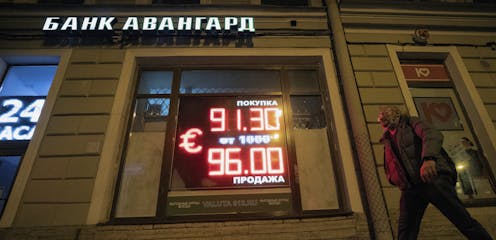
Even though the evidence shows that Russian cryptocurrency transactions have been increasing in both number and value in the past month, the scale suggests buyers are ordinary Russians seeking to hold on to their savings as the value of the ruble crashes.
Read more: During the cold war, US and Europe were just as divided over Russia sanctions – here's how it played out[3]
Targeting sanctions
The economic sanctions imposed on Russia for invading Ukraine are naturally hurting the entire Russian economy. Their intended target, though, is to hit Putin and the billionaire oligarchs who support his rule where it hurts most.
A cornerstone of this strategy is stopping these individuals from using or moving their wealth around by freezing the assets they hold overseas and blocking financial transactions.
But the continued operation of cryptocurrency exchanges in Russia, such as Binance, Yobit and Local Bitcoins, has been worrying US officials for some time. Even before Russia’s latest invasion of Ukraine, the US Treasury Department warned cryptocurrencies could undermine the sanctions[4] already imposed on Russia over its 2014 annexation of Crimea.
Ruble’s falling value
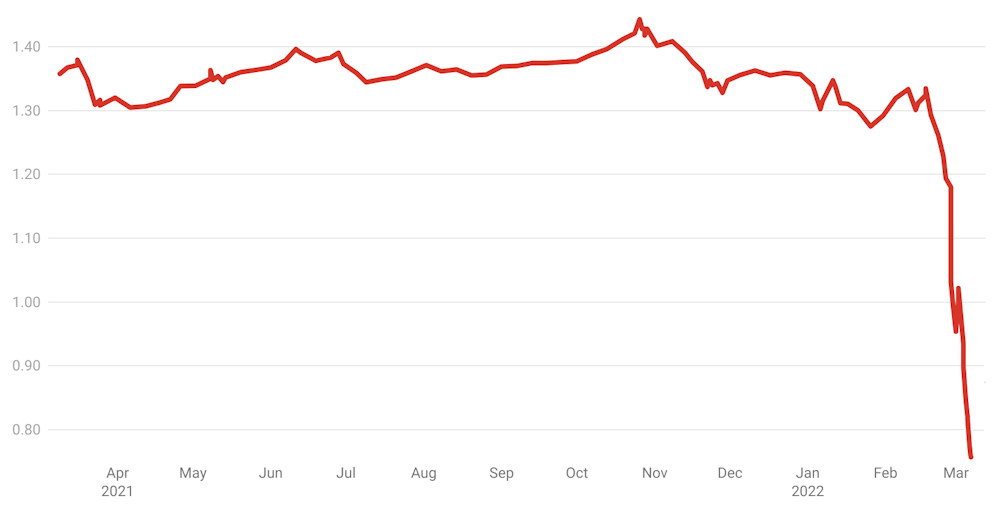
Our first graph below shows why ordinary Russians have good reason to buy cryptocurrency.
Since the February 24 invasion of Ukraine, the ruble’s value against the US dollar has fallen by as much as 40%, from $US1 being worth 76 rubles to 132 rubles. At the time of publication, $US1 was worth about 109 rubles.
The ruble falls off a cliff
More rubles going into Bitcoin
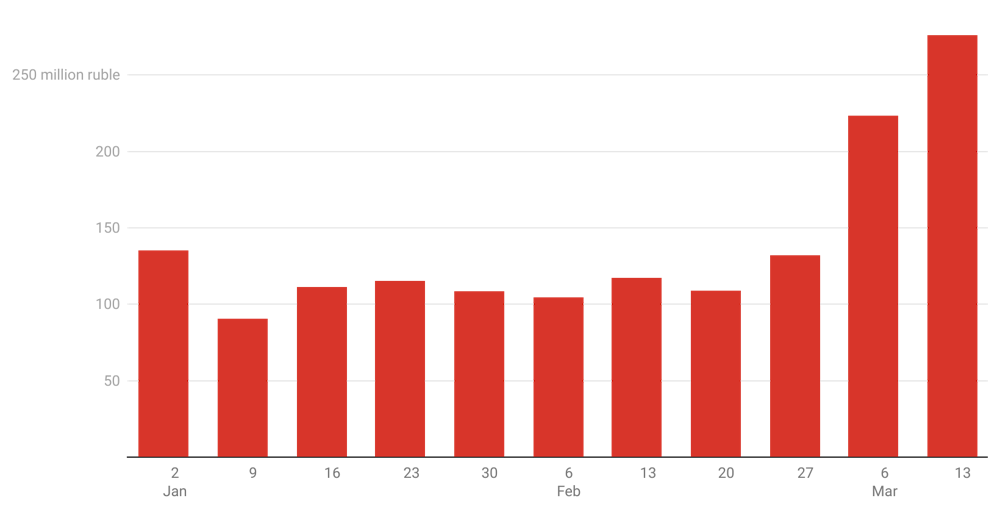
The next graph shows the value of Bitcoin transactions by Russian accounts in rubles.
Bitcoin is not the only cryptocurrency Russians could buy, but it is by far the most traded and trusted of all cryptocurrency offerings, so is a useful proxy for the market. This data comes from Coin Dance[6], a leading Bitcoin statistics and services company.
Since the war began on February 24 until time of publication, spending on Bitcoin using rubles has increased by 260%.
Bitcoin trading volumes by Russian accounts in rubles (weekly)
 Coindance[7]
This is an impressive rise, but less impressive when the devaluation of the ruble is factored in. The weekly value of rubles being converted into Bitcoin was about $US28 million last week, compared with about $US14 million in mid-February. That's a 100% rise.
In global terms, this is still a tiny percentage of the money going into Bitcoin. According to cryptocurrency data provider Kaiko[8], each week between $US20 billion to US$40 billion is spent on Bitcoin. So the Bitcoin-ruble trade represents less than 0.14% of the total.
Small transaction size
It is also important to consider the number of accounts and size of average transactions.
According to Glassnode, another cryptocurrency data service, the number of Russian Bitcoin accounts has increased from 39.9 million to 40.7 million since the February invasion. (The Russian population is about 144 million.)
The daily average size of each Bitcoin-ruble transaction – based on data from the the largest exchange in Russia, Binance – has risen to $US580 by mid-February. This compares to the average value of American transactions being $US2,198 at the same time.
Read more:
Bitcoin is helping both sides in Ukraine conflict, but it won't wreck Russian sanctions[9]
The capacity to put large amounts of rubles through crypto exchanges operating in Russia is also heavily constrained by the relatively low liquidity in Russian crypto trade.
Liquidity refers to the ease with which an asset or security – in this case Bitcoin – can be converted from or into cash without affecting its market price. When a market has more buyers and sellers, it becomes easier to complete a transaction, and the less impact there is on the exchange rate. With fewer buyers and sellers, it is harder.
A measure of the liquidity of the Russian Bitcoin exchanges is the value of orders submitted by buyers and sellers at any given time. This is about US$200,000, compared with $US22 million for US-based crypto exchanges – a volume 110 times larger.
These statistics suggest anyone wishing to trade large volumes of Bitcoin against the ruble will have difficulties.
Small-time investors
The evidence therefore points to most of the uptick in Russian cryptocurrency trading being dominated by small-time investors.
It is possible that Putin and his cronies could be using hundreds or thousands of accounts to perform many small-scale transactions to move their fortunes around.
But it’s more likely their wealth is mostly invested through shell companies in assets in places like Monaco, the British Virgin Islands, Ireland or even the US district of Delaware[10].
Read more:
The next Pandora Papers exposé is inevitable – unless governments do more on two key reforms[11]
There is little argument against the strategy of using economic sanctions to combat recalcitrant regimes. Other than direct military intervention, there are few other meaningful weapons available. But a detailed analysis of any proposed sanction beforehand is needed so as to not overestimate its likely effectiveness.
References^ introduced a bill (www.bostonglobe.com)^ warned (www.warren.senate.gov)^ During the cold war, US and Europe were just as divided over Russia sanctions – here's how it played out (theconversation.com)^ undermine the sanctions (www.nytimes.com)^ Trading Economics (tradingeconomics.com)^ Coin Dance (coin.dance)^ Coindance (coin.dance)^ Kaiko (www.kaiko.com)^ Bitcoin is helping both sides in Ukraine conflict, but it won't wreck Russian sanctions (theconversation.com)^ US district of Delaware (finance.yahoo.com)^ The next Pandora Papers exposé is inevitable – unless governments do more on two key reforms (theconversation.com)Authors: Dr Paul Mazzola, Lecturer Banking and Finance, Faculty of Business and Law, University of Wollongong
Coindance[7]
This is an impressive rise, but less impressive when the devaluation of the ruble is factored in. The weekly value of rubles being converted into Bitcoin was about $US28 million last week, compared with about $US14 million in mid-February. That's a 100% rise.
In global terms, this is still a tiny percentage of the money going into Bitcoin. According to cryptocurrency data provider Kaiko[8], each week between $US20 billion to US$40 billion is spent on Bitcoin. So the Bitcoin-ruble trade represents less than 0.14% of the total.
Small transaction size
It is also important to consider the number of accounts and size of average transactions.
According to Glassnode, another cryptocurrency data service, the number of Russian Bitcoin accounts has increased from 39.9 million to 40.7 million since the February invasion. (The Russian population is about 144 million.)
The daily average size of each Bitcoin-ruble transaction – based on data from the the largest exchange in Russia, Binance – has risen to $US580 by mid-February. This compares to the average value of American transactions being $US2,198 at the same time.
Read more:
Bitcoin is helping both sides in Ukraine conflict, but it won't wreck Russian sanctions[9]
The capacity to put large amounts of rubles through crypto exchanges operating in Russia is also heavily constrained by the relatively low liquidity in Russian crypto trade.
Liquidity refers to the ease with which an asset or security – in this case Bitcoin – can be converted from or into cash without affecting its market price. When a market has more buyers and sellers, it becomes easier to complete a transaction, and the less impact there is on the exchange rate. With fewer buyers and sellers, it is harder.
A measure of the liquidity of the Russian Bitcoin exchanges is the value of orders submitted by buyers and sellers at any given time. This is about US$200,000, compared with $US22 million for US-based crypto exchanges – a volume 110 times larger.
These statistics suggest anyone wishing to trade large volumes of Bitcoin against the ruble will have difficulties.
Small-time investors
The evidence therefore points to most of the uptick in Russian cryptocurrency trading being dominated by small-time investors.
It is possible that Putin and his cronies could be using hundreds or thousands of accounts to perform many small-scale transactions to move their fortunes around.
But it’s more likely their wealth is mostly invested through shell companies in assets in places like Monaco, the British Virgin Islands, Ireland or even the US district of Delaware[10].
Read more:
The next Pandora Papers exposé is inevitable – unless governments do more on two key reforms[11]
There is little argument against the strategy of using economic sanctions to combat recalcitrant regimes. Other than direct military intervention, there are few other meaningful weapons available. But a detailed analysis of any proposed sanction beforehand is needed so as to not overestimate its likely effectiveness.
References^ introduced a bill (www.bostonglobe.com)^ warned (www.warren.senate.gov)^ During the cold war, US and Europe were just as divided over Russia sanctions – here's how it played out (theconversation.com)^ undermine the sanctions (www.nytimes.com)^ Trading Economics (tradingeconomics.com)^ Coin Dance (coin.dance)^ Coindance (coin.dance)^ Kaiko (www.kaiko.com)^ Bitcoin is helping both sides in Ukraine conflict, but it won't wreck Russian sanctions (theconversation.com)^ US district of Delaware (finance.yahoo.com)^ The next Pandora Papers exposé is inevitable – unless governments do more on two key reforms (theconversation.com)Authors: Dr Paul Mazzola, Lecturer Banking and Finance, Faculty of Business and Law, University of WollongongRead more https://theconversation.com/are-russias-elite-really-using-cryptocurrency-to-evade-sanctions-179559