Google AI

Weekend Times


The Times

Business News

top economists say we need more migrants

  • Written by: Peter Martin, Visiting Fellow, Crawford School of Public Policy, Australian National University
top economists say we need more migrants

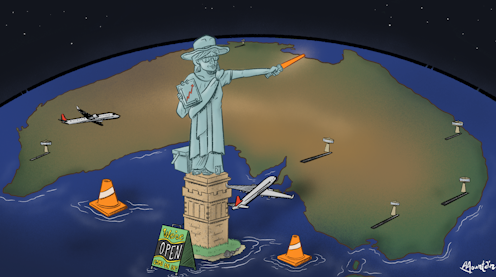
Australia’s leading economists have overwhelmingly endorsed a return to the highest immigration intake on record, saying Australia should aim for at least 190,000 migrants per year as it opens its borders, up from the target of 160,000 per year set ahead of COVID.

More than a third of those surveyed believe 190,000 isn’t enough, arguing that a “catch up” will show Australia is open to the world.

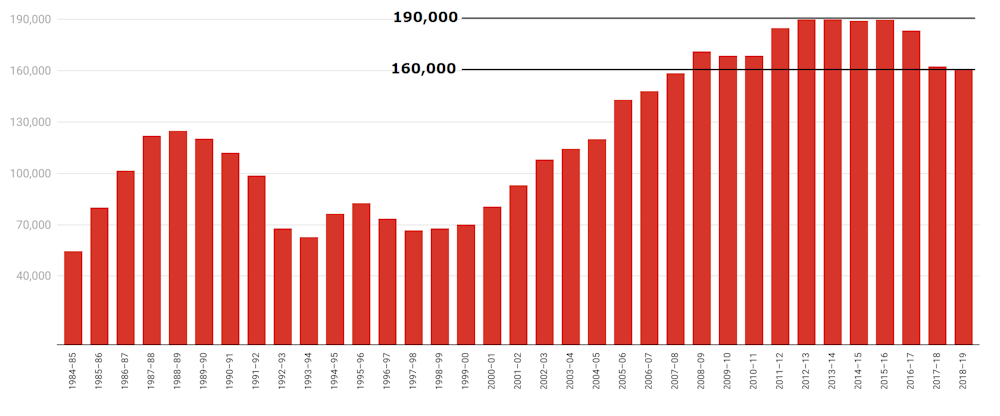
Economic Society of Australia/The Conversation, CC BY-ND[1] Prime Minister Scott Morrison cut Australia’s migration ceiling from 190,000 to 160,000 places per year in March 2019, in order to “tackle the impact of increasing population in congested cities[2]”. The 49 economists who took part in the Economics Society of Australia poll[3] were selected by their peers for their expertise in macroeconomics, microeconomics and economic modelling. One is a member of the Reserve Bank board. Ahead of COVID, Australia’s permanent intake has only been as high as 190,000 on five occasions, during the five years 190,000 was the official target. Annual migrant intake in the years leading up to COVID
Parliamentary Library 2021[4] The government’s intergenerational report) released mid last year assumed a return[5] to an intake of 190,000 per year in 2023-24. Only four of the 49 economists surveyed by The Economic Society and The Conversation wanted less migration than Australia had going into COVID. Their concerns were that growing population numbers put pressure on “fragile resources and infrastructure”. Slower population growth would “ease pressures on the environment, housing prices, infrastructure and emissions”. Adelaide University labour market specialist Sue Richardson said there was no evidence high levels of migration raised GDP per person, as opposed to GDP. Congestion and the environment matter “In terms of living standards, it is the per capita measure that matters,” she said. “And it should be adjusted for increased traffic congestion, urban density and pressures on the health and other important social systems.” The six economists who thought an annual intake of 160,000 was about right made the point that what mattered more was the composition of the intake. There should be less unskilled migration, more skilled migration and a “decent humanitarian program”. The 19 economists who went for 190,000 argued less would show a “lack of ambition” for lifting economic growth. Helen Silver, chief general manager at Allianz Australia and a former head of Victoria’s Department of Premier and Cabinet said a higher target would be both a “catch up” and would act to symbolise Australia was more open to the world. Australia benefits from being open Any target would need to be flexible and responsive to the capacity of Australia’s heath and other systems given the ongoing pandemic. Melbourne University economist John Freebairn said a larger population would enable Australia to capture economies of scale and fill gaps in high skill and low skill jobs caused by labour market rigidities and failures in training systems. It would increase the government’s tax take net of spending and help build a more dynamic and interesting society, as it had in the past. The 18 economists (37.5% of the total) who said 190,000 was not enough argued that Australia’s status as a nation of immigrants gave it a formidable advantage. 190,000 could be considered a floor UNSW economist Gigi Foster said in the wake of Australia’s responses to COVID its challenge was not so much what target to set, but rather how to convince immigrants to come here. Melbourne University ‘s Chris Edmond said if Australia had the same per capita target as Canada it would have a permanent intake of 250,000 per year. The University of Sydney’s James Morely said 190,000 was less than 1% of the population and was in any event not a target for net migration as that would be determined by the number of Australians who left and returned, and the number who came in temporarily under other schemes. Given low birth rates and a need for a balanced age profile Australia should probably target permanent visas of 320,000 - 1.25% of the current population. Read more: A myth that won't die: stopping migration did not kickstart the economy[6] RMIT’s Leonora Risse said what mattered was that the migration intake was accompanied by policies designed to ensure migrants reached their potential. When considering an upper limit on migration, we should keep in mind that 30% of all Australians were born overseas. For 20% of Australians, one or both parents were born overseas. Australia would not be what it was were it not for migration. Notably absent from most of the 49 responses was discussion of the impact of migration on wages and the employment of locals. The experts surveyed seemed to regard these impacts as not particularly big in either direction compared to the impacts of migration on dynamism, Australia’s place in the world, and its environment, infrastructure and social cohesion. Detailed responses: Read more: Top economists say cutting immigration is no way to boost wages[7] References^ CC BY-ND (creativecommons.org)^ tackle the impact of increasing population in congested cities (www.pm.gov.au)^ Economics Society of Australia poll (theconversation.com)^ Parliamentary Library 2021 (www.aph.gov.au)^ return (treasury.gov.au)^ A myth that won't die: stopping migration did not kickstart the economy (theconversation.com)^ Top economists say cutting immigration is no way to boost wages (theconversation.com)Authors: Peter Martin, Visiting Fellow, Crawford School of Public Policy, Australian National University

Read more https://theconversation.com/when-we-open-up-lets-open-up-big-top-economists-say-we-need-more-migrants-177359

The Weekend Times Magazine

Turning fashion into power - Beauty with Brains

During this unfortunate time of our lives there’s a hidden gem business which keeps the hopes up for many lives of women of all walks of life. Fashion...

The Quiet Drive Home: Why Weekends Away Can Leave Us Feeling Empty

There is a curious emotional moment that arrives at the end of a wonderful weekend. The bags are packed, the holiday house is tidied, the final coffees are finished, and...

Tips for Choosing a Caravan for Australian Conditions

Australia's landscapes are unlike anywhere else in the world. From scorching outback heat and corrugated dirt tracks to coastal humidity and alpine cold, the demands placed on a caravan can...

Building a Custom Home on a Narrow Lot in Mandurah: What the Block Size Is Not Telling You

Property listings in Mandurah's established suburbs increasingly include lots that look modest on paper. Widths of 8, 10, or 12 metres. Street frontages that seem to leave little room for...

Top Photographers in Sydney: A Comprehensive Guide

When it comes to documenting Sydney rich cultural heritage and varied landscapes photographer is essential. Sydney distinctive blend of urban environments and scenic beauty presents countless chances for imaginative photography. Numerous photographers focus...

Who Can Install A Private Power Pole?

Private power poles provide property owners with the freedom to choose where electricity will enter the building. It also offers protection from hazards associated with being directly connected to the...

Catering Boxes: Practical Packaging That Supports Food Quality and Presentation

Reliable Catering boxes are essential for food businesses that need to transport, store, and present meals safely and professionally. From cafés and bakeries to large-scale caterers and event organisers, catering boxes...

Why Probiotics for Dogs Are Important for Digestive and Overall Health

Maintaining a healthy digestive system is essential for a dog's wellbeing, and probiotics for dogs have become increasingly popular among pet owners looking to support their pet’s health naturally. The digestive...

How to work from home and not get divorced

Covid has triggered life-changing decisions for some people and has put a lot of relationship strain on couples. The stress of working from home and having to home school the...