Peace in our time? Why NZ should resist Trump’s one-sided plan for Ukraine
- Written by: Robert G. Patman, Professor of International Relations, University of Otago
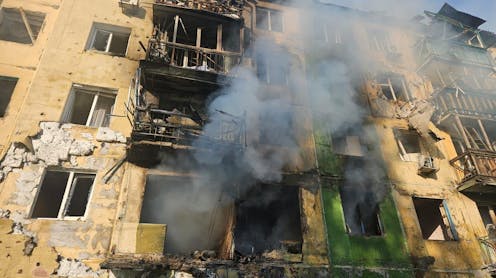
Is it possible to reconcile increased international support for Ukraine with Donald Trump’s plan to end the war? At their recent meeting in London[1], Christopher Luxon and his British counterpart Keir Starmer seemed to think so.
Starmer thanked New Zealand[2] for its “support” for a “coalition of the willing” that would safeguard the implementation of a potential peace deal concluded by the Trump administration.
But unless something drastically changes in the near future, all the signs point to the US president envisaging a Ukraine peace settlement on Russian president Vladimir Putin’s terms[3].
According to that view, peace can only be achieved if Ukraine is prepared to accept that territories wholly or partially annexed by Russia now belong to Moscow.
In 2014, Russia seized Crimea on the Black Sea. Following the illegal 2022 invasion, Russia claimed four parts of eastern and southern Ukraine as its own – Donetsk, Luhansk, Kherson and the Zaporizhzhia region.
At the same time, Trump’s peace deal includes a provision that rules out NATO membership[4] for Ukraine. This meets a key Russian demand that seeks to deny Ukraine’s sovereign right to choose its own security arrangements.
According to Trump, Putin’s major concession is the promise that Russia will not annex the rest of Ukraine – something Moscow has been trying to do for the past three years.
To accept this, however, liberal democracies such as New Zealand and Britain would be tacitly signalling they share common values and interests with the Trump administration and its apparent enthusiasm for a geopolitical partnership with Putin’s dictatorship.
And in some ways, Trump’s Ukraine peace initiative is a bigger challenge for New Zealand than it is for Britain.
Lessons of the past
Like Britain, New Zealand fought in two world wars in the 20th century to advance, among other things, certain key international principles. These included state sovereignty and a prohibition on the use of force to change borders, principles subsequently enshrined in the United Nations Charter.
But unlike Britain, New Zealand is a relatively small state that does not have a veto in the UN Security Council to protect its interests. Consequently, it is even more dependent on an international rules-based order for its security and prosperity.
For New Zealand, Trump’s current Ukraine peace plan is a clear and present danger because it would set such a terrible precedent.
Under the 1994 Budapest Memorandum[6], Ukraine gave up its nuclear weapons (left over from when it was part of the Soviet Union) in return for assurances from Russia, the US and UK that recognised Ukrainian independence and the inviolability of its existing borders.
The Trump administration’s plan, however, insists Ukraine must accept the illegal and partial dismemberment of its territory to attain peace with Russia.
Rewarding Russian aggression in this way is tantamount to a failure to learn the historical lessons of the 20th century. In particular, it seems to forget the period during the 1930s when Britain tried in vain to appease an expansionist Nazi regime in Germany.
Trump’s peace plan basically endorses the idea that “might is right” and that it is fine for great powers or big countries to steal land from smaller countries.
Adjusting NZ foreign policy
In Trump’s top-down world view, multilateral institutions and international law are regarded as superfluous at best and an enemy at worst.
In such a world, relatively small powers such as New Zealand, with “no cards to play” at the top table, must either submit to the dominance of great powers (including the US) or suffer the consequences.
Moreover, there is a real risk that Trump’s stance toward Putin’s regime will be viewed as weakness by China, Russia’s most important backer. This could embolden Beijing to increasingly assert itself in the Indo-Pacific, including the Pacific Islands region, where New Zealand has core strategic interests.
Trump’s plan for Ukraine brings into sharp focus what has already been evident from other recent trends: a domestic slide toward autocracy[7] in Washington, the unilateral imposition of tariffs, and territorial threats against close allies Canada and Denmark.
As European Union Commission President Ursula von der Leyen put it[8], “The West as we knew it no longer exists.”
The transactional nature of Trump’s leadership – including that peace in Ukraine can be bought with mineral rights[9] and territorial trade-offs – suggests the US can no longer be relied on to provide a security guarantee for liberal democracies in Europe or elsewhere.
The current New Zealand government needs to find the self-confidence and resolve to admit Trump is backing Putin’s imperial project in Ukraine. And it needs to adjust its foreign policy accordingly.
This does not mean Wellington should weaken its traditional friendship with the US.
On the contrary, many Americans might expect and welcome the prospect of New Zealand clearly and publicly standing against their president’s dangerous alignment with an authoritarian regime at Ukraine’s expense.
References
- ^ recent meeting in London (www.rnz.co.nz)
- ^ thanked New Zealand (www.news.com.au)
- ^ Russian president Vladimir Putin’s terms (www.axios.com)
- ^ rules out NATO membership (slate.com)
- ^ Getty Images (www.gettyimages.co.nz)
- ^ Budapest Memorandum (theconversation.com)
- ^ slide toward autocracy (www.npr.org)
- ^ Ursula von der Leyen put it (www.euronews.com)
- ^ mineral rights (www.csis.org)
Authors: Robert G. Patman, Professor of International Relations, University of Otago