what is corporate social responsibility or CSR – and what do investors need to know?
- Written by: Limin Fu, Lecturer in Management, University of Newcastle

With the world facing an ever-growing number of environmental and social challenges, investors are increasingly expecting corporations[1] to “do the right thing” and contribute positively to the community.
This is known as corporate social responsibility or CSR.
Investors play an important role pushing firms towards becoming better corporate citizens.
So, what do investors (including those of us with superannuation invested in companies) need to know about corporate social responsibility? And why does it matter?
Read more: Brands backing Black Lives Matter: it might be a marketing ploy, but it also shows leadership[2]
What is CSR anyway?
US writer and economist Howard Bowen is often described[3] as the “founding father” of CSR. He wrote[4] in 1953 that business have a social responsibility, defined as:
the obligations of businessmen to pursue those policies, to make those decisions, or to follow those lines of action that are desirable in terms of the objectives and values of our society.
The concept was popularised in the US in the 1970s, especially after US think tank the Committee for Economic Development in 1971 noted[5] there is a “social contract” between business and society, saying:
Business is being asked to assume broader responsibilities to society than ever before and to serve a wider range of human values. Business enterprises, in effect, are being asked to contribute more to the quality of American life than just supplying quantities of goods and services.
In other words, there was growing acceptance of the idea it was not enough for companies just to pay taxes. To gain a “social licence to operate”, firms should also actively “do good” in society.
In the mid-1990s, the term “triple bottom line” was brought to prominence by US author and advisor John Elkington, which he describes[6] as
a sustainability framework that examines a company’s social, environment, and economic impact.
CSR and ESG investing
More recently, the term environmental, social and governance (ESG[7]) has grown more common.
Although ESG and similar obligations are not necessarily legally compulsory for most companies, many investors see good policies in this area as a sign the firm is well positioned for the future.
Some common issues many investors care about include:
For many investors, ESG is fundamentally about how a company serves the environment, workers, communities, customers, and shareholders.
Why do some firms pursue some CSR goals while neglecting others?
We recently completed a study[8] pondering the question: why do some firms ignore some stakeholders while courting others?
We categorised companies into six distinct “types”: the CSR vanguard, the opportunist, the generalist, the minimalist, the specialist and the laggard. Vanguards proactively pursue a wide range of CSR goals that address an array of stakeholder concerns, even without much pressure from investors. A generalist has genuine commitment to CSR goals but doesn’t really favour one area over another.
But if the company only pursues CSR goals on some issues while others are all below the industry or country average, this company might be what we termed a CSR “opportunist”.
Read more: Getting out of liquor, pokies will cost Woolworths, but deliver lasting benefits[9]
Big superannuation companies and investment professionals often have specialist[10] research teams dedicated to identifying which companies have a good record on CSR.
They have access to search tools such as Refinitiv[11], MSCI KLD[12], Sustainalytics[13], Bloomberg ESG[14], and RepRisk AG[15] to help them sort the wheat from the chaff.
So there’s a limit to how much an individual investor can expect to find out on their own about the firms they invest in.

How do I research companies and their CSR record?
Expecting individuals to expertly navigate this topic on their own is unrealistic.
But you can try. Look in your investment platform[16] (meaning the website or app through which you manage your investments) for ESG information about various firms.
Search online for more detail. Has media coverage revealed any scandals linked to companies you invest in, around issues such as environmental protection, Indigenous rights, social justice, employees’ rights, human rights or corporate governance?
Who runs the company? Who is on the board? Search their names and see if you’re happy with what you find.
Have a look through the company’s recent annual reports. Look for chapters with titles such as sustainability report, social impact report or corporate social responsibility report. Thanks to many years of pressure from investors, most companies will detail their efforts to some degree.
But beware greenwashing[17] and slick marketing. Some companies can be quite deceptive in the way they talk about corporate social responsibility. For example, they may have improved their environmental record but continue to have a poor record of how they treat workers.
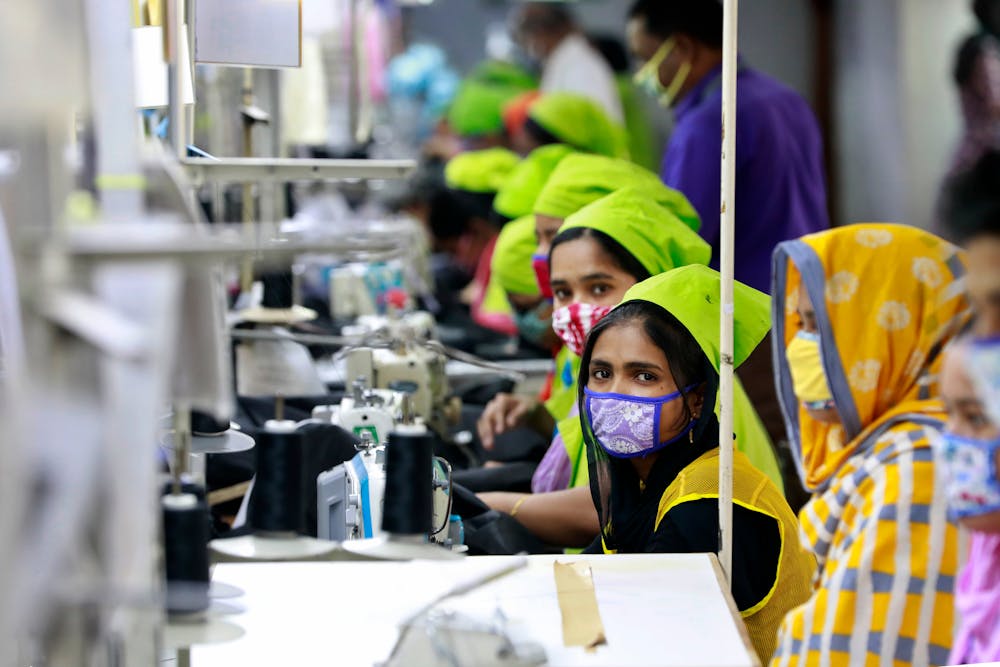 You might consider factors such as the company’s workers’ rights record.
Shutterstock
You might consider factors such as the company’s workers’ rights record.
Shutterstock
Our research has identified causes[18] and consequences[19] of such inconsistent CSR practices. An inconsistent record on CSR could pose risk to your money in the long run. Think carefully about how a firm’s irresponsible practices in one area can cancel out corporate social responsibility gains in another.
And if you see room for improvement, let the company know. You can do that by posting questions and comments on its social media platform and using their “contact us” option on its website.
Or, in the worst scenario, you can inform your investor community and collectively sell your shares to keep the company in check – share prices can convey your dissatisfaction.
Your voice may be one of many building to a groundswell and exerting pressure on the company to do better.
References
- ^ increasingly expecting corporations (www.sciencedirect.com)
- ^ Brands backing Black Lives Matter: it might be a marketing ploy, but it also shows leadership (theconversation.com)
- ^ described (www.researchgate.net)
- ^ wrote (www.grinnell.edu)
- ^ noted (jcsr.springeropen.com)
- ^ describes (hbr.org)
- ^ ESG (www.forbes.com)
- ^ study (www.sciencedirect.com)
- ^ Getting out of liquor, pokies will cost Woolworths, but deliver lasting benefits (theconversation.com)
- ^ specialist (www.cfainstitute.org)
- ^ Refinitiv (www.refinitiv.com)
- ^ MSCI KLD (www.msci.com)
- ^ Sustainalytics (www.sustainalytics.com)
- ^ Bloomberg ESG (www.bloomberg.com)
- ^ RepRisk AG (www.reprisk.com)
- ^ investment platform (www.bridges.com.au)
- ^ greenwashing (theconversation.com)
- ^ causes (www.sciencedirect.com)
- ^ consequences (journals.sagepub.com)
Authors: Limin Fu, Lecturer in Management, University of Newcastle