Google AI

Weekend Times


The Times

Business News

Like most of the fashion industry, there's a blind spot in Country Road's ethical focus

  • Written by: Harriette Richards, Research Associate, Cultural Studies, The University of Melbourne
Like most of the fashion industry, there's a blind spot in Country Road's ethical focus

Amid the catwalk shows and millinery workshops, a key theme of this year’s Melbourne Fashion Week[1] was sustainablity, “offering designers with strong ethical foundations an opportunity to join our runways, or opening up dialogue on sustainability into our talks program”.

Events during the week included industry representatives discussing “shifting the status quo[2]” and moving “beyond greenwashing[3]”. On the panel at the latter event was Eloise Bishop, head of sustainability at Country Road Group, one of Australia’s largest specialty fashion retailers.

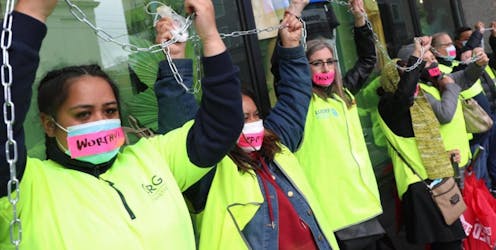
Meanwhile workers from the company were on strike, chaining themselves together and staging other protests outside Country Road stores in pursuit of better wages and working conditions.

Among the complaints of these workers, mostly women from the company’s distribution warehouse in Melbourne’s west, was being paid an average of A$23 an hour[4], compared to about A$30 for workers doing similar work at the Pacific Brands warehouse across the road.

On Monday the workers returned to work after reaching an agreement with the company that includes improved job security, union recognition and a 13.3% pay rise over four years. That’s about an extra $3 an hour.

While this has brought the strike to a celebratory end, questions remain. How could a company so highly regarded for its commitment to sustainability have provoked staff to strike for almost a fortnight?

Lower marks for worker empowerment

Country Road Group is a subsidiary of South Africa’s Woolworths Holdings Ltd[5] (which also owns David Jones). The company’s clothing brands include Country Road, Witchery, Trenery, Politix and Mimco. Despite the pandemic, in the past fiscal year Country Road Group’s sales grew by 13.5% to A$1.05 billion[6].

The company is considered by many an industry leader on ethics and sustainability. The 2021 Ethical Fashion Guide[7] compiled by Baptist World Aid, for example, awarded it an overall “A” grade. It did well on four of five rating criteria, scoring an “A+” on its policies and governance, “A+” for trading and risk, “A” for supplier relationships and human rights monitoring, and another “A” for environmental sustainability.

On worker empowerment, however, it scored just a “C”.

These results suggest the company has a blind spot in addressing concerns about labour conditions in its supply chain.

Country Road Group scores better on environmental sustainability than worker empowerment.
Country Road Group scores better on environmental sustainability than on worker empowerment. Nick-D/Wikimedia, CC BY[8][9]

Supply-chain blind spots

In part because of the disparities between how the fashion industry markets its products and the way workers are treated, the global fashion industry is a notorious example of exploitation engendered by opaque supply chains.

Questions about ethics become divided across asymmetrical lines: the global North as fashion consumer and the global South as fashion producer.

Read more: Why the fashion industry keeps failing to fix labour exploitation[10]

Country Road Group's Modern Slavery Statement
Modern Slavery Statements Register[11] Attempts to bring greater transparency[12] and accountability to these supply chains include Australia’s Modern Slavery Act. This requires large companies to submit an annual statement to a public registry outlining efforts to identify and eliminate the risk of exploitative labour practices. Country Road Group’s 2020 Modern Slavery statement[13] states the company is “committed to upholding the highest social, ethical and environmental standards in its supply chains”. But commitment to ethics is arguably easier when the “problem” of labour rights is far away and things like modern slavery statements (which rely on third party auditing) can help to conceal unethical practices. What happens when the issue is on our doorstep? Read more: At last, Australia has a Modern Slavery Act. Here's what you'll need to know[14] Fair pay for all We often think about the concept of a “living wage[15]” in relation to garment workers overseas. But these warehouse workers told their union representatives they could not afford to live on the wages paid by Country Road Group, much less clothe themselves or their children in the very garments they pick and pack at the warehouse. According to industry body the Australian Fashion Council[16], 77% of the 489,000 workers employed in Australia’s fashion and textile industry’s workforce are female. This makes fair pay and conditions in the industry an important driver of women’s economic advancement. Industrial action is about more than money; it is about respect and recognition. Responsibility for change in the fashion industry is frequently feminised[17]. Women are not only the primary workforce; they are at the front lines of sustainable action, consumer activism and labour rights movements. It was a proposed strike by members of the International Ladies Garment Workers Union in New York in 1909 that led to the establishment of International Women’s Day[18]. The move towards sustainability and ethical production in the fashion industry is necessary. But if action does not extend to the realities of all workers across the supply chain, the rhetoric is empty. Note: co-author Lauren Kate Kelly is a researcher with the United Workers’ Union, which covers Country Road warehouse employees.

References

  1. ^ Melbourne Fashion Week (mfw.melbourne.vic.gov.au)
  2. ^ shifting the status quo (mfw.melbourne.vic.gov.au)
  3. ^ beyond greenwashing (mfw.melbourne.vic.gov.au)
  4. ^ A$23 an hour (www.news.com.au)
  5. ^ Woolworths Holdings Ltd (www.woolworthsholdings.co.za)
  6. ^ A$1.05 billion (www.smh.com.au)
  7. ^ 2021 Ethical Fashion Guide (baptistworldaid.org.au)
  8. ^ Nick-D/Wikimedia (commons.wikimedia.org)
  9. ^ CC BY (creativecommons.org)
  10. ^ Why the fashion industry keeps failing to fix labour exploitation (theconversation.com)
  11. ^ Modern Slavery Statements Register (modernslaveryregister.gov.au)
  12. ^ transparency (www.google.com)
  13. ^ 2020 Modern Slavery statement (modernslaveryregister.gov.au)
  14. ^ At last, Australia has a Modern Slavery Act. Here's what you'll need to know (theconversation.com)
  15. ^ living wage (oxford.universitypressscholarship.com)
  16. ^ Australian Fashion Council (ausfashioncouncil.com)
  17. ^ feminised (www.tandfonline.com)
  18. ^ International Women’s Day (www.harpersbazaar.com)

Authors: Harriette Richards, Research Associate, Cultural Studies, The University of Melbourne

Read more https://theconversation.com/like-most-of-the-fashion-industry-theres-a-blind-spot-in-country-roads-ethical-focus-172295

The Weekend Times Magazine

Farmers Calling on Aussies and Restaurateurs to Help Save the Sydney Rock Oyster

The future of Sydney Rock Oyster farming in NSW is under extreme threat and a group of NSW farmers are urging restaurateurs and chefs to support the native Australian Sydney...

What to do in Canada during your holiday?

Canada has over 1.6 million square kilometers of protected natural land offering a world-class national park system. The country is one of the first in the world to establish a...

What Happens During a Rental Property Inspection?

The rental property inspection is one main factor that sometimes leaves tenants wondering a lot of things. Though it might occasionally feel like a scary procedure, it is a lot...

Why Sydney Never Stops Welcoming the World

Every weekend, Australia's harbour city reminds us why international tourism matters. Walk through Circular Quay on a Saturday morning and you'll hear dozens of languages before you've finished your coffee. Families photograph...

Why Rainwater Tanks Are Becoming Essential For Australian Homes

Water conservation has become increasingly important across Australia due to changing weather conditions, rising utility costs, and growing environmental awareness. Many homeowners are now investing in Rainwater Tanks to collect and...

The 29-year-old Australian Revolutionising The Edible Collagen Market

Known as ‘Nature’s Botox’, scientific research shows collagen is not only anti-ageing and good for skin, but also optimises health, ligaments, muscle recovery, the gut, and helps heal the digestive...

Why Pigmentation Removal Melbourne Treatments Help Restore Even Skin Tone

Skin pigmentation concerns are common among individuals of all ages. Dark spots, uneven skin tone, and sun damage can affect the appearance of the skin and often develop due to...

Smart Lock: The Future of Home Security and Convenience

A smart lock has revolutionized the way people think about home security. Moving beyond traditional keys and mechanical locks, smart locks bring technology and convenience together, offering homeowners and businesses a new...

Let's talk about nits!

My daughter struggled with nits for 8 years until I found this miracle cure Nits. The one-word granted to strike fear into mums everywhere … and have them immediately scratching their...