Qantas fights on against court ruling it unlawfully sacked 2,000 workers
- Written by: Anthony Forsyth, Professor of Workplace Law, RMIT University
Qantas has tugged at many Australians’ heart strings with its advertising campaign about reuniting family and friends. It dangles the prospect of travelling overseas, and of thousands of Australians still stranded overseas coming home.
But the airline is fighting hard to not bring back thousands of jobs it unlawfully outsourced during the pandemic. After losing a Federal Court case over sacking of 2,000 ground crew in 2020, it continues to vigorously oppose reinstating the workers, with an appeal in the works.
Its marketing may be heartwarming, but its approach to its workforce is hardheaded.
Granted, its business has been clobbered by border closures and travel restrictions. Last month it announced a loss for 2020-21 of A$1.73 billion[1]. Just as it was getting its domestic operations back into gear, most interstate travel was halted by the Delta outbreak.
But many businesses have faced similar dilemmas since the pandemic began 18 months ago. Few have been as harsh as Qantas in dealing with employees.
A confrontational approach
Since standing down 20,000 of its 30,000 staff[2] in March 2020, Qantas has taken a typically confrontational approach[3] to wages and entitlements.
For example, it precluded stood-down workers from accessing their sick leave, even if they had contracted coronavirus while working, and then vigorously defended this decision in the courts.
It adopted a narrow interpretation of its payment obligations to employees under the JobKeeper scheme. It has also taken a top-down approach to mandating COVID-19 vaccinations for staff[4], in contrast to the more consultative approach of rival Virgin Australia[5].
Read more: Qantas has grounds to mandate vaccination, but most blanket policies won't fly[6]
But its most grievous action has been to use the opportunity of the pandemic to permanently shed itself of about 2,000 mostly unionised workers.
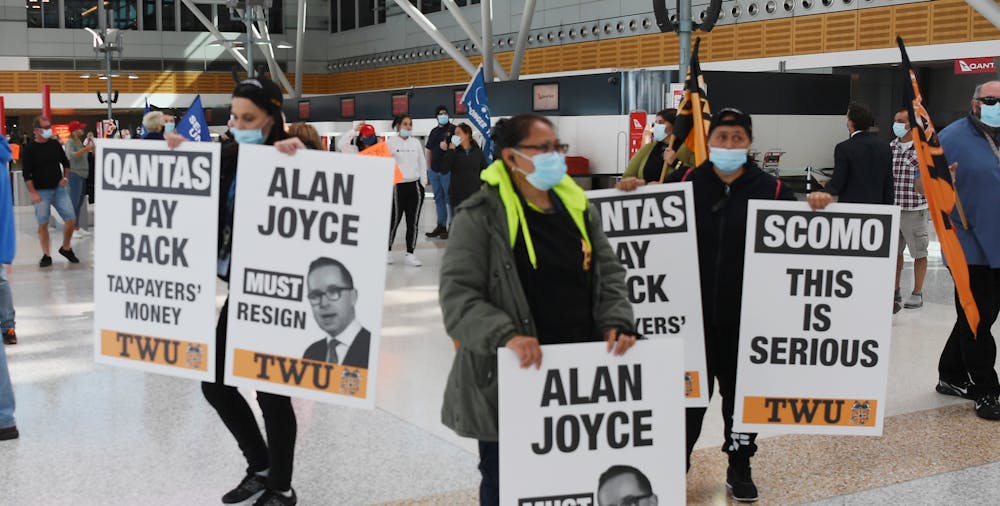 Unionists demonstrate against Qantas’ staff cuts at Sydney’s domestic terminal on August 27 2020.
Dean Lewins/AAP
Unionists demonstrate against Qantas’ staff cuts at Sydney’s domestic terminal on August 27 2020.
Dean Lewins/AAP
This move came in the context of making 8,500 jobs[7] redundant. In the case of the 2,000 jobs carried out by baggage handlers, tug drivers and cleaners, however, their work wasn’t disappearing; it was being outsourced to third-party providers at ten Australian airports.
The fact Qantas undertook these mass sackings while receiving JobKeeper, a program designed to ensure businesses retained their employees, ensured controversy would attend its decision.
Read more: Qantas cutbacks signal hard years before airlines recover[8]
Breach of the Fair Work Act
On behalf of the 2,000 employees who lost their jobs, the Transport Workers Union challenged the airline’s decision to outsource ground-handling staff in the Federal Court.
To make its case, the union hired Maurice Blackburn employment lawyer Josh Bornstein, who helped the Maritime Union of Australia[9] win the waterfront dispute of 1998, when stevedoring company Patrick Corporation locked out and sacked union members en masse.
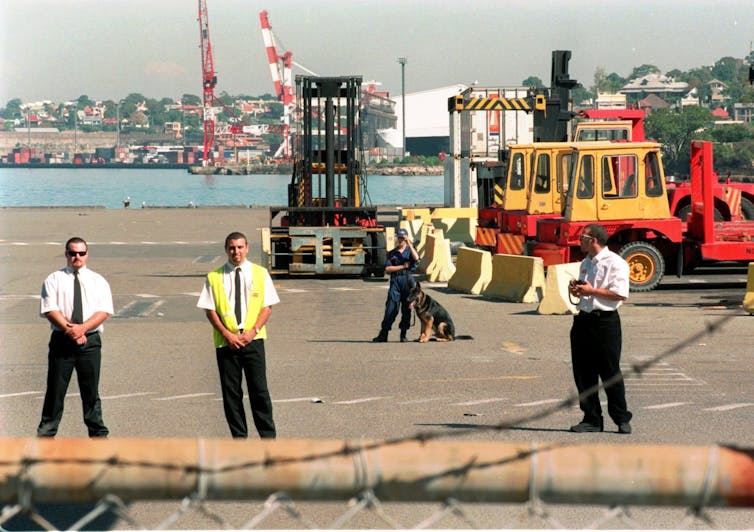 Private security guards and dogs keep watch at Patrick Corporation’s dock at Sydney’s Darling Harbour on April 8 1998, the day after the company fired all its 1,400 dock workers.
Rick Rycroft/AP
Private security guards and dogs keep watch at Patrick Corporation’s dock at Sydney’s Darling Harbour on April 8 1998, the day after the company fired all its 1,400 dock workers.
Rick Rycroft/AP
Relying on statutory provisions similar to those used to great effect in the waterfront dispute, the union argued Qantas had seized a “vanishing window of opportunity” provided by the pandemic to outsource all ground staff.
The Federal Court’s ruling, made on July 30[10], largely agreed with the union. It found a reason for the airline’s decision to outsource the workers was to prevent them from exercising important workplace rights; namely the right to engage in collective bargaining and to take protected industrial action.
This placed Qantas in breach of the Fair Work Act.
Opposing reinstatement
The legal battle is far from over. The Transport Workers’ Union has asking the Federal Court to order the reinstatement of the 2,000 ground crew employees and compensate them for losses suffered as a result of Qantas’s unlawful conduct.
Qantas has other ideas. At a case hearing on Wednesday, Qantas continued to vigorously oppose reinstatement. It also lodged an application for leave to appeal the Federal Court’s July decision, and wants the court to halt any further consideration of reinstatement until an appeal is determined.
This makes the prospect of the sacked workers getting their jobs back in the near future unlikely.
But even though this case has a long way to play out, the Federal Court’s ruling against Qantas represents an important and overdue check on decades of business outsourcing initiatives that have undermined workers’ job security and driven down wages. Such business strategies eliminate the need for management to negotiate wages with workers.
Read more: The airline industry hasn't collapsed, but that's the only good news for overseas travel[11]
Through outsourcing, a company can unilaterally set the price it is willing to pay for the work. It can advise a labour hire provider that, if the price isn’t acceptable, it will seek competitive tenders. The downward pressure is ultimately borne by the workers.
We’ll have to wait to see if the Qantas workers get their jobs back. But in the meantime the ruling should give any other employer tempted to take advantage of COVID reason to think again.
References
- ^ 2020-21 of A$1.73 billion (www.abc.net.au)
- ^ 20,000 of its 30,000 staff (www.abc.net.au)
- ^ confrontational approach (labourlawdownunder.com.au)
- ^ COVID-19 vaccinations for staff (www.theguardian.com)
- ^ rival Virgin Australia (www.afr.com)
- ^ Qantas has grounds to mandate vaccination, but most blanket policies won't fly (theconversation.com)
- ^ 8,500 jobs (www.abc.net.au)
- ^ Qantas cutbacks signal hard years before airlines recover (theconversation.com)
- ^ Maritime Union of Australia (australianaviation.com.au)
- ^ made on July 30 (www.abc.net.au)
- ^ The airline industry hasn't collapsed, but that's the only good news for overseas travel (theconversation.com)
Authors: Anthony Forsyth, Professor of Workplace Law, RMIT University