making Google and Facebook pay won't save journalism
- Written by: Amanda Lotz, Professor of Media Studies, Queensland University of Technology
The federal government is talking tough about making Google and Facebook pay Australian news businesses for linking to, or featuring, these publishers’ content.
The digital platforms have been talking equally tough. Facebook is threatening to remove Australian news stories[1] and Google says it will shut off search to Australia[2] if the government pushes ahead with its “mandatory bargaining code[3]”.
The code is meant to help alleviate the revenue crisis facing news publishers. Over the past two decades they have made deep cuts to newsrooms. Scores of local print papers have become “digital only” or been shut down completely.
Read more: Digital-only local newspapers will struggle to serve the communities that need them most[4]
If legislated, the code will require the platforms to negotiate payments to news publishers, as well as disclose changes in algorithms affecting traffic to news sites.
But the code is unlikely to do much to fix the crisis faced by journalism in the internet age. It isn’t even a band-aid on the problem.
The traditional commercial news business model is broken beyond repair. If the government wants to save the social benefit of public-interest journalism, it must look elsewhere.
Newspapers didn’t sell news, but readers
To understand why the commercial news model is so broken, we first need to recognise what the primary business of commercial news media has been: attracting an audience that can be sold to advertisers.
Newspapers attracted readers with news and feature journalism that provided public value, but also information of interest such as weather forecasts, sports scores, stock prices, TV and radio guides and comics. Readers even sought out papers for their advertisements – in particular the “classifieds” for jobs, cars and real estate.
Before the internet the newspaper was the only place to access much of this information. This broad bundle of content attracted a wide range of readers, which the economics of newspapers – particularly the cost of producing the journalism – required.
Why the business model is broken
Internet technologies introduced two changes that have dismantled the newspaper business model.
They offered new and better ways to connect buyers and sellers, pulling advertiser spending away from newspapers. More than 70% of revenue[5] for a typical daily newspaper came from advertising. Before 2000 print media attracted nearly 60% of Australian advertiser dollars, according to an analysis for the Australian Competition and Consumer Commission’s Digital Platforms Inquiry[6]. By 2017 it was just 12%.
Australian advertising expenditure by media format and digital platform
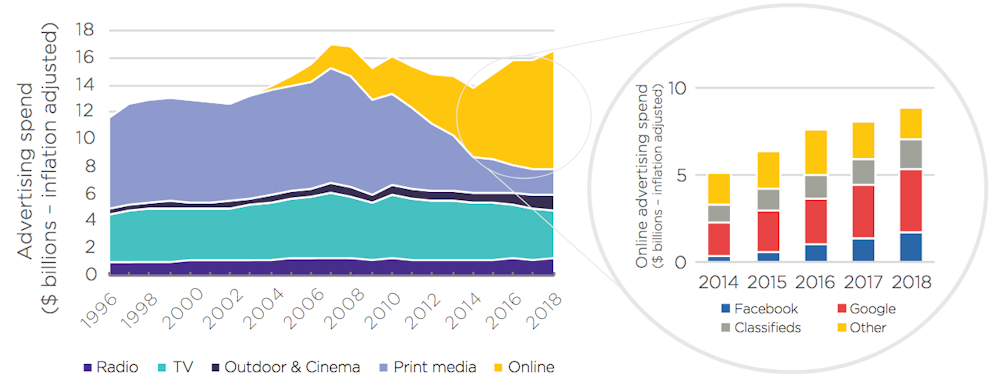 ACCC estimates of spend relating to Australian customers based on data from the Commercial Economic Advisory Service of Australia and information provided by market participants. Amounts are in 2018 Australian dollars.
Digital Platforms Inquiry final report, July 2019
ACCC estimates of spend relating to Australian customers based on data from the Commercial Economic Advisory Service of Australia and information provided by market participants. Amounts are in 2018 Australian dollars.
Digital Platforms Inquiry final report, July 2019
Internet technologies also provided better ways to access the non-journalism information that had made the bundled paper valuable to a mass of readers.
Readers also now access news in many other places, through news apps, aggregators and social media feeds such as Twitter, Reddit, Apple News, Flipboard and many others, including Facebook and Google. Research by the University of Canberra’s News and Media Research Centre published in 2019[7] found just 30% of Australian news consumers accessed online news directly from news publishers’ websites.
The bargaining code doesn’t solve the main problem
If Google and Facebook are “to blame” for news publishers’ malaise, it is not in the way the bargaining code suggests. Separate from their linking to, or featuring, these publishers’ content, the digital platforms are just more effective vehicles for advertisers seeking to buy consumers’ attention. They serve ads based on consumer interests or in relation to a specific search.
The simple fact is news publishers’ core content is not that important to the platforms’ profitability.
Research by the Reuters Institute for the Study of Journalism during the 2019 UK general election[8] – tracking 1,711 people aged 18-65 across mobile and desktop devices for six weeks – found news took up just 3% of their time online (about 16 minutes and 22 visits to news sites a week).
So if stories from Australian news outlets disappeared from Facebook or Google search results, it would barely make a scratch on their appeal to advertisers.
Read more: It's not 'fair' and it won't work: an argument against the ACCC forcing Google and Facebook to pay for news[9]
Save journalism, not commercial publishers
The Australian Competition and Consumer Commission’s Digital Platforms Inquiry has rightly noted the revenue crisis has crippled commercial provision of public-interest journalism[10] “that performs a critical role in the effective functioning of democracy at all levels of government”.
But the core of the problem is that funding such journalism through advertising is no longer viable. Other solutions are needed – locally and nationally – to ensure its survival.
Read more: Web's inventor says news media bargaining code could break the internet. He's right — but there's a fix[11]
Commercial news organisations no longer offer value to advertisers. Instead of searching for ways to make an obsolete business solvent, efforts should focus on alternative ways to fund public-interest journalism.
More funding for independent public broadcasters is one solution, and incentives for philanthropic funding and non-profit journalism organisations are proving successful in other countries.
It’s a global problem. To solve the crisis in Australia will require focusing on the core problem and thinking bigger than a bargaining code.
For transparency, please note The Conversation has also made a submission to the Senate inquiry[12] regarding the News Media and Digital Platforms Mandatory Bargaining Code.
References
- ^ remove Australian news stories (www.theaustralian.com.au)
- ^ shut off search to Australia (www.smh.com.au)
- ^ mandatory bargaining code (www.aph.gov.au)
- ^ Digital-only local newspapers will struggle to serve the communities that need them most (theconversation.com)
- ^ More than 70% of revenue (www.abc.net.au)
- ^ Digital Platforms Inquiry (www.accc.gov.au)
- ^ published in 2019 (apo.org.au)
- ^ 2019 UK general election (reutersinstitute.politics.ox.ac.uk)
- ^ It's not 'fair' and it won't work: an argument against the ACCC forcing Google and Facebook to pay for news (theconversation.com)
- ^ public-interest journalism (www.asc.upenn.edu)
- ^ Web's inventor says news media bargaining code could break the internet. He's right — but there's a fix (theconversation.com)
- ^ submission to the Senate inquiry (theconversation.com)
Authors: Amanda Lotz, Professor of Media Studies, Queensland University of Technology