Why the Morrison government's 'double-dipping’ gambit fails the pub test
- Written by: Joo-Cheong Tham, Professor, Melbourne Law School, University of Melbourne
It’s almost unimaginable: an Australian government proposes a law that would wipe out billions of dollars of employers’ entitlements.
Even more unimaginable: it does so on the basis of mistakes made by employees.
Yet right now a “Black Mirror” scenario lies before Australia’s federal parliament, in the form of the Morrison government’s “ominbus” industrial relations bill.
It proposes to extinguish entitlements owed to workers due to the mistakes made by employers. If passed, thousands of low-paid workers[1] stand to lose billions of dollars in entitlements.
But that’s not even the worst thing that can be said of the bill. Worse still is the cynicism of its premise, the need to “fix” a problem that does not really exist.
To appreciate the depth of that cynicism, let’s recap the smoke and mirrors that have made “double-dipping” – the “horror scenario” of paying workers misclassified as casual employees both a 25% casual loading and paid leave entitlements – a hot-button issue.
Read more: So much for consensus: Morrison government's industrial relations bill is a business wish list[2]
Paying the costs of employer mistakes
Action is needed, the government claims, to address the “uncertainty[3]” over employers incurring up to A$39 billion liabilities because of a Federal Court decision in May 2020.
Known as Rossato v Workpac[4], the case was unusual because the defendant, labour-hire company WorkPac – with the federal government’s support[5] – funded the legal action against it by former mine worker Robert Rossato.
Rossato argued Workpac should have employed him as a permanent worker, rather than a casual worker, given his regular work roster. Workpac wanted the Federal Court to hear the case so its lawyers could try some arguments not used in Workpac’s unsuccessful defence of a 2018 court case (involving similar claims by fly-in-fly-out worker Paul Skene).
One of Workpac’s new defences was that Rossato (and workers in similar situations), even if misclassified as casual employees, had been paid a casual loading that should be “set off” against leave entitlements now accrued to them.
As Andrew Stewart summarised at the time[6]: “In other words, if he was entitled to the benefits he claimed, he had already been paid for them.”
The Federal Court rejected this argument comprehensively.
In finding for Rossato, it ruled the casual loading paid any worker wrongly classified as a “casual employee” did not offset their separate entitlement to paid leave, as guaranteed to all permanent employees under the Fair Work Act.
 CC BY-NC-ND[7]
Read more:
The truth about much 'casual' work: it's really about permanent insecurity[8]
Different entitlement types
Presumably the Federal Court must have had its reasons – and indeed it did. It laid them out in terms so clear it is hard to see where uncertainty arises.
The key distinction, said the court, was that casual loading and paid leave are two different kinds of entitlements.
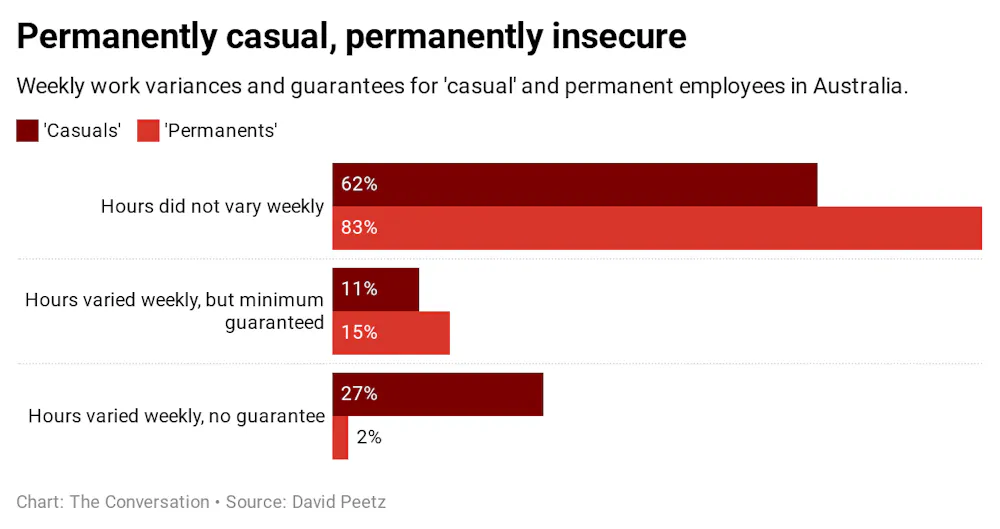
The casual loading is a monetary entitlement supposed to compensate casual employees for the downsides of being casuals. Casual employees are meant to get 25% more than what a permanent employee would be paid, though research suggests in reality the loading is often neglible[9].
Does the loading cover casual employees not accruing annual and other leave? That is a matter of confusion, with differing approaches taken by courts and industrial tribunals. It some cases, the casual loading might be framed as compensating for the disadvantages of casual employment. Sometimes the loading might simply be paid due to prevailing “market rates”, as a wage premium to attract workers to jobs with few other benefits.
Whatever the circumstances, the Federal Court stressed that paid leave was not just another monetary entitlement when it came to permanent employees (including those wrongly classified as casuals).
As the judges put in their Rossato ruling, there is a “temporal dimension” to paid leave.
That is, it was an entitlement to an absence from work “in order to facilitate rest and recreation[10]”. This made it qualitatively different to a cash entitlement.
So the Federal Court’s ruling was clear. There was no uncertainty. It saw no double-dipping. Its ruling did not require employers to pay twice. It required them to honour different types of employee entitlements.
Read more:
What defines casual work? Federal Court ruling highlights a fundamental flaw in Australian labour law[11]
Return of a living dead argument
Now the federal government is arguing what WorkPac (with the government’s backing) argued unsuccessfully to the court. Its industrial relations bill proposes making that losing argument the law.
If passed, courts will be required to deduct the value of any casual loading paid to misclassified casual employees from any claim they now have to compensation for not being being given the leave entitlements owed to permanent employees.
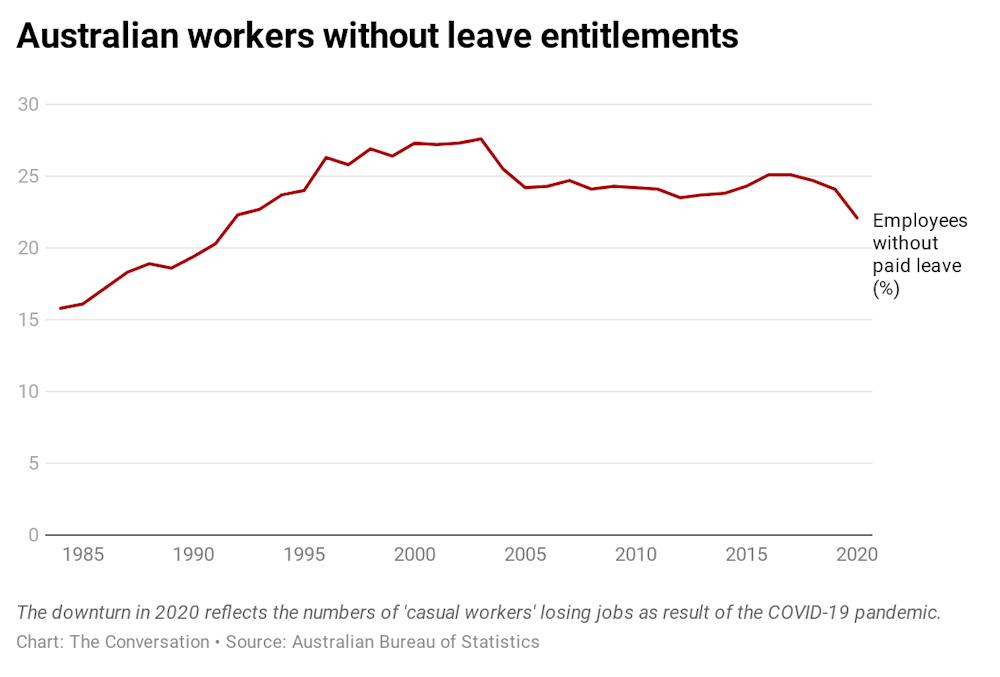
It creates a “back door” for employers to cash out paid leave obligations, leaving even more workers in the “employees without leave entitlement” category.
CC BY-NC-ND[7]
Read more:
The truth about much 'casual' work: it's really about permanent insecurity[8]
Different entitlement types
Presumably the Federal Court must have had its reasons – and indeed it did. It laid them out in terms so clear it is hard to see where uncertainty arises.
The key distinction, said the court, was that casual loading and paid leave are two different kinds of entitlements.
The casual loading is a monetary entitlement supposed to compensate casual employees for the downsides of being casuals. Casual employees are meant to get 25% more than what a permanent employee would be paid, though research suggests in reality the loading is often neglible[9].
Does the loading cover casual employees not accruing annual and other leave? That is a matter of confusion, with differing approaches taken by courts and industrial tribunals. It some cases, the casual loading might be framed as compensating for the disadvantages of casual employment. Sometimes the loading might simply be paid due to prevailing “market rates”, as a wage premium to attract workers to jobs with few other benefits.
Whatever the circumstances, the Federal Court stressed that paid leave was not just another monetary entitlement when it came to permanent employees (including those wrongly classified as casuals).
As the judges put in their Rossato ruling, there is a “temporal dimension” to paid leave.
That is, it was an entitlement to an absence from work “in order to facilitate rest and recreation[10]”. This made it qualitatively different to a cash entitlement.
So the Federal Court’s ruling was clear. There was no uncertainty. It saw no double-dipping. Its ruling did not require employers to pay twice. It required them to honour different types of employee entitlements.
Read more:
What defines casual work? Federal Court ruling highlights a fundamental flaw in Australian labour law[11]
Return of a living dead argument
Now the federal government is arguing what WorkPac (with the government’s backing) argued unsuccessfully to the court. Its industrial relations bill proposes making that losing argument the law.
If passed, courts will be required to deduct the value of any casual loading paid to misclassified casual employees from any claim they now have to compensation for not being being given the leave entitlements owed to permanent employees.
It creates a “back door” for employers to cash out paid leave obligations, leaving even more workers in the “employees without leave entitlement” category.
 CC BY-NC-ND[12]
In doing so, the bill doesn’t just strip rights from wrongly classified casual workers. It undermines a fundamental principle in Australia’s national employment standards – reflected by the Fair Work Act having limits on cashing out paid leave.
These limits recognise leave entitlements aren’t just a personal benefit. The the whole community benefits; and 2020 has shown the community costs of failing to ensure all workers have paid leave entitlements.
Workers in risky jobs – such as aged care and meat processing[13] – without sick leave or other entitlements have been clear transmission vectors for COVID-19 outbreaks such as that which enveloped Melbourne.
Read more:
Workplace transmissions: a predictable result of the class divide in worker rights[14]
These limits have safeguarded low-paid workers signing away these rights out of financial need in lop-sided bargains.
If there’s only lesson one to be learned in the months since the Federal Court handed down its ruling, it’s this. Further impoverishing the value of leave entitlements is just about the last thing any COVID-inspired industrial relations reform should being doing.
CC BY-NC-ND[12]
In doing so, the bill doesn’t just strip rights from wrongly classified casual workers. It undermines a fundamental principle in Australia’s national employment standards – reflected by the Fair Work Act having limits on cashing out paid leave.
These limits recognise leave entitlements aren’t just a personal benefit. The the whole community benefits; and 2020 has shown the community costs of failing to ensure all workers have paid leave entitlements.
Workers in risky jobs – such as aged care and meat processing[13] – without sick leave or other entitlements have been clear transmission vectors for COVID-19 outbreaks such as that which enveloped Melbourne.
Read more:
Workplace transmissions: a predictable result of the class divide in worker rights[14]
These limits have safeguarded low-paid workers signing away these rights out of financial need in lop-sided bargains.
If there’s only lesson one to be learned in the months since the Federal Court handed down its ruling, it’s this. Further impoverishing the value of leave entitlements is just about the last thing any COVID-inspired industrial relations reform should being doing.
References
- ^ low-paid workers (www.smh.com.au)
- ^ So much for consensus: Morrison government's industrial relations bill is a business wish list (theconversation.com)
- ^ uncertainty (www.afr.com)
- ^ Rossato v Workpac (www.austlii.edu.au)
- ^ federal government’s support (www.smh.com.au)
- ^ summarised at the time (theconversation.com)
- ^ CC BY-NC-ND (creativecommons.org)
- ^ The truth about much 'casual' work: it's really about permanent insecurity (theconversation.com)
- ^ often neglible (www.smh.com.au)
- ^ in order to facilitate rest and recreation (www.austlii.edu.au)
- ^ What defines casual work? Federal Court ruling highlights a fundamental flaw in Australian labour law (theconversation.com)
- ^ CC BY-NC-ND (creativecommons.org)
- ^ aged care and meat processing (theconversation.com)
- ^ Workplace transmissions: a predictable result of the class divide in worker rights (theconversation.com)
Authors: Joo-Cheong Tham, Professor, Melbourne Law School, University of Melbourne