Australia's world-first repository of 'modern slavery statements' a step in the right direction
- Written by: Fiona McGaughey, Senior Lecturer in International Human Rights Law, University of Western Australia
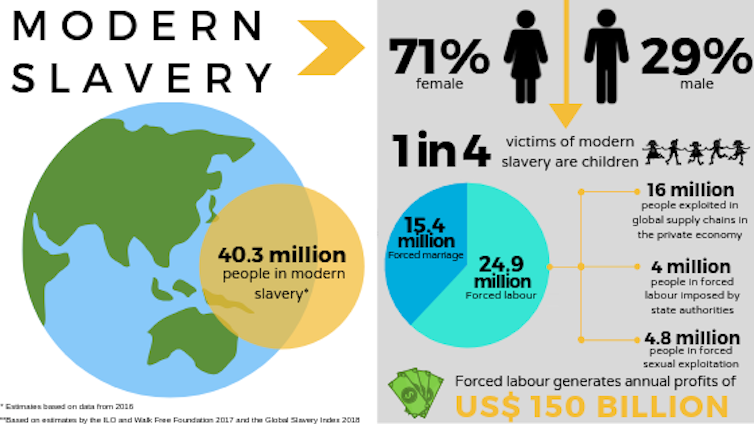
From “fast fashion” to tinned tuna to the components in your mobile phone, what guarantee do you have the goods you buy are slave-free?
The Australian government has taken a step forward by just publishing the first batch[1] of statements from Australian companies outlining their efforts to ensure their supply chains do not involve modern slavery.
The reports are the first substantial fruits of Australia’s Modern Slavery Act, passed in December 2018, requiring all businesses with an annual turnover of A$100 million to publish “modern slavery statements” each year.
Businesses must report on the risks of modern slavery in their operations and supply chains, and on the actions they have taken to address these.
There are 121 statements in the repository so far. This includes 19 that are voluntary statements from businesses not required do so, but which have done so anyway to demonstrate their commitment to tackling modern slavery.
With the deadline for submitting reports extended due to COVID-19, the remainder will come by December 31 or March 31 next year (depending on the company’s financial year).
The repository is a world first. Although there are repositories of statements made under similar laws such as the UK Modern Slavery Act[2] and the French Duty of Vigilance Act, these were established by non-government organisations (NGOs) in the absence of a government repository.
 Anti-Slavery Australia
What’s in the repository so far?
Among those to have their statements published in this first tranche are major companies such as Coles Group[3] and Wesfarmers[4] (which owns Bunnings, Kmart and Officeworks).
Coles’ statement reports on “risks or indicators” of modern slavery, based on each country in its supply chain. For example, for China it identifies risks of forced or bonded labour, deceptive recruitment, exploitation of migrant workers, child labour, underpayment of wages and excessive working hours.
Wesfarmers’ statement is relatively detailed and transparent and reports “critical breaches” including allegations of excessive overtime, transparency (record keeping and documentation), safety (building and fire safety) and unauthorised subcontracting and bribery.
Don’t expect to see widespread disclosures of modern slavery in any statements. The Modern Slavery Act requires reporting on risks and the actions to address these. So the content of the statements tends to cover risk assessment, policies, training and, to a lesser extent, remedies.
Read more:
Four Corners’ forced labour exposé shows why you might be wearing slave-made clothes[5]
Most of the reports so far come from companies headquartered in Australia. Japan, the United States and the United Kingdom are home to six reporting entities each. Four are based in New Zealand.
The statements submitted vary widely in the length and level of detail provided. The 16 statements in the industry category “mining, metals, chemicals and resources” range from three pages to 22 pages. Unsurprisingly, the longer – and glossier – statements come from the larger companies who often find their social and environmental practices under scrutiny, such as Santos, South 32 and BHP.
Anti-Slavery Australia
What’s in the repository so far?
Among those to have their statements published in this first tranche are major companies such as Coles Group[3] and Wesfarmers[4] (which owns Bunnings, Kmart and Officeworks).
Coles’ statement reports on “risks or indicators” of modern slavery, based on each country in its supply chain. For example, for China it identifies risks of forced or bonded labour, deceptive recruitment, exploitation of migrant workers, child labour, underpayment of wages and excessive working hours.
Wesfarmers’ statement is relatively detailed and transparent and reports “critical breaches” including allegations of excessive overtime, transparency (record keeping and documentation), safety (building and fire safety) and unauthorised subcontracting and bribery.
Don’t expect to see widespread disclosures of modern slavery in any statements. The Modern Slavery Act requires reporting on risks and the actions to address these. So the content of the statements tends to cover risk assessment, policies, training and, to a lesser extent, remedies.
Read more:
Four Corners’ forced labour exposé shows why you might be wearing slave-made clothes[5]
Most of the reports so far come from companies headquartered in Australia. Japan, the United States and the United Kingdom are home to six reporting entities each. Four are based in New Zealand.
The statements submitted vary widely in the length and level of detail provided. The 16 statements in the industry category “mining, metals, chemicals and resources” range from three pages to 22 pages. Unsurprisingly, the longer – and glossier – statements come from the larger companies who often find their social and environmental practices under scrutiny, such as Santos, South 32 and BHP.
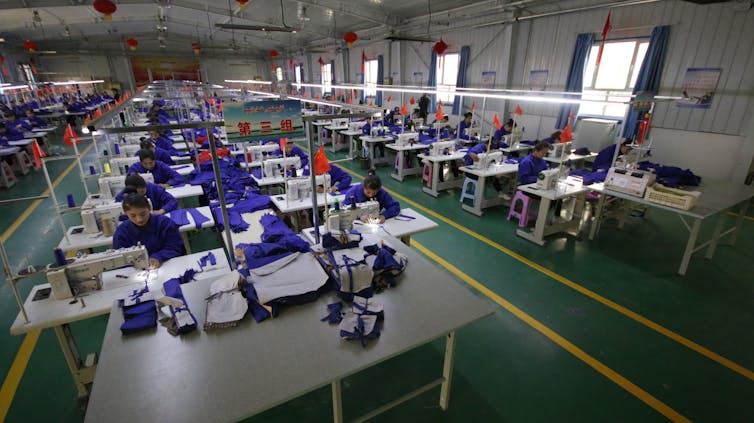 Uyghur women work in a clothing factory in Hotan prefecture, Xinjiang province, China in April 2019. The Chinese regime has allegedly to put up to a million detained Uyghurs to work.
Azamat Imanaliev/Shutterstock
Why the repository is important
Internationally, a key criticism of business reporting laws such as Australia’s Modern Slavery Act is the lack of penalties for non-compliance. Critics argue that non-compliance with a range of other corporate laws, from Occupational Health and Safety to tax laws, result in penalties. The Law Council[6] and others have called for penalties.
Others disagree[7] and suggest the Modern Slavery Act has been introduced with significant good will on the part of businesses and that reputational risks from poor (or no) reporting are sufficient to keep businesses on track.
Of course, both a carrot and a stick approach could work. Issuing a fine also carries reputational risk, for example. Another way of driving compliance is to limit government tenders to those businesses complying with the Modern Slavery Act, such as is included in the WA Government’s proposed[8] “procurement debarment regime”.
A three-year review of the Modern Slavery Act should take place in 2021. It is likely the question of enforcement and penalties will be raised again.
What this mean for consumers
In the lead-up to Christmas, a key question for consumers is how the repository can help inform ethical purchasing.
The repository is not designed for this purpose and doesn’t offer “performance scorecards[9]”, for example.
Scrutiny of the statements is an important informal regulatory measure. But it is likely to be carried out by academics and non-government organisations, rather than individual consumers. This is the government’s expectation[10]. But a shortcoming of this approach is that the non-government sector is chronically underfunded in Australia, particularly for advocacy work.
Consumers can already access ethical purchasing information, such as Oxfam’s report[11] published last week on the manufacturing practices behind leading clothing brands in Australia.
Highlighting concerns from garment factories in Bangladesh, the report examined well-known stores including Best & Less, Big W, Cotton On, H&M, Zara, Kmart, Myer, Target, Rockmans, Rivers, Noni B, Just Jeans and Portmans. The repository could be further developed to inform reports and scorecards that would be more accessible to consumers.
Read more:
At last, Australia has a Modern Slavery Act. Here's what you'll need to know[12]
A societal shift in corporate accountability?
The Modern Slavery Act is just one of a number of recent developments that signal a move towards strengthening corporate accountability. These include the Banking Royal Commission[13] and the Australian Law Reform Commission report on Corporate Criminal Responsibility[14].
These developments, together with the modern slavery reporting regime can be used to drive better human rights standards among Australian businesses.
Uyghur women work in a clothing factory in Hotan prefecture, Xinjiang province, China in April 2019. The Chinese regime has allegedly to put up to a million detained Uyghurs to work.
Azamat Imanaliev/Shutterstock
Why the repository is important
Internationally, a key criticism of business reporting laws such as Australia’s Modern Slavery Act is the lack of penalties for non-compliance. Critics argue that non-compliance with a range of other corporate laws, from Occupational Health and Safety to tax laws, result in penalties. The Law Council[6] and others have called for penalties.
Others disagree[7] and suggest the Modern Slavery Act has been introduced with significant good will on the part of businesses and that reputational risks from poor (or no) reporting are sufficient to keep businesses on track.
Of course, both a carrot and a stick approach could work. Issuing a fine also carries reputational risk, for example. Another way of driving compliance is to limit government tenders to those businesses complying with the Modern Slavery Act, such as is included in the WA Government’s proposed[8] “procurement debarment regime”.
A three-year review of the Modern Slavery Act should take place in 2021. It is likely the question of enforcement and penalties will be raised again.
What this mean for consumers
In the lead-up to Christmas, a key question for consumers is how the repository can help inform ethical purchasing.
The repository is not designed for this purpose and doesn’t offer “performance scorecards[9]”, for example.
Scrutiny of the statements is an important informal regulatory measure. But it is likely to be carried out by academics and non-government organisations, rather than individual consumers. This is the government’s expectation[10]. But a shortcoming of this approach is that the non-government sector is chronically underfunded in Australia, particularly for advocacy work.
Consumers can already access ethical purchasing information, such as Oxfam’s report[11] published last week on the manufacturing practices behind leading clothing brands in Australia.
Highlighting concerns from garment factories in Bangladesh, the report examined well-known stores including Best & Less, Big W, Cotton On, H&M, Zara, Kmart, Myer, Target, Rockmans, Rivers, Noni B, Just Jeans and Portmans. The repository could be further developed to inform reports and scorecards that would be more accessible to consumers.
Read more:
At last, Australia has a Modern Slavery Act. Here's what you'll need to know[12]
A societal shift in corporate accountability?
The Modern Slavery Act is just one of a number of recent developments that signal a move towards strengthening corporate accountability. These include the Banking Royal Commission[13] and the Australian Law Reform Commission report on Corporate Criminal Responsibility[14].
These developments, together with the modern slavery reporting regime can be used to drive better human rights standards among Australian businesses.
References
- ^ the first batch (modernslaveryregister.gov.au)
- ^ Modern Slavery Act (www.modernslaveryregistry.org)
- ^ Coles Group (modernslaveryregister.gov.au)
- ^ Wesfarmers (modernslaveryregister.gov.au)
- ^ Four Corners’ forced labour exposé shows why you might be wearing slave-made clothes (theconversation.com)
- ^ Law Council (www.lawcouncil.asn.au)
- ^ Others disagree (www.aph.gov.au)
- ^ proposed (www.wa.gov.au)
- ^ performance scorecards (www.ukrn.org.uk)
- ^ expectation (www.aph.gov.au)
- ^ Oxfam’s report (whatshemakes.oxfam.org.au)
- ^ At last, Australia has a Modern Slavery Act. Here's what you'll need to know (theconversation.com)
- ^ Banking Royal Commission (financialservices.royalcommission.gov.au)
- ^ Australian Law Reform Commission report on Corporate Criminal Responsibility (www.alrc.gov.au)
Authors: Fiona McGaughey, Senior Lecturer in International Human Rights Law, University of Western Australia