As Brazil prepares to vote for a new leader, can Latin American democracies withstand US pressure?
- Written by: Weekend Times
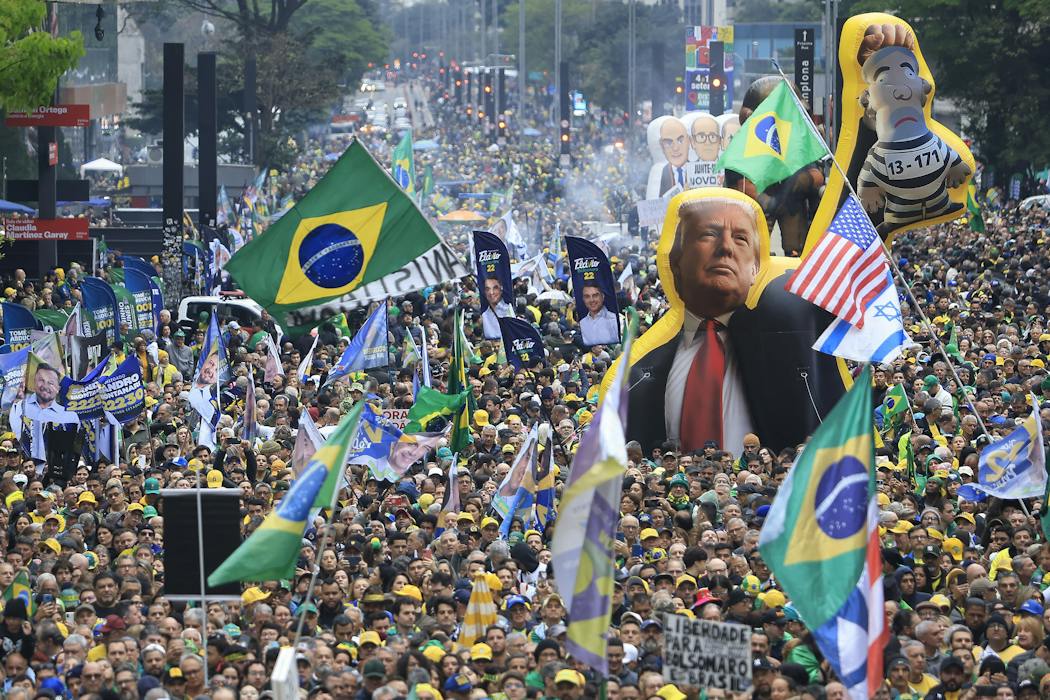
On Sunday, Brazilians will head to the polls for the first round of the 2026 general elections. President Luiz Inácio Lula da Silva faces a major challenge
from a right-wing candidate, Senator Flávio Bolsonaro, son of former president Jair Bolsonaro.
US President Donald Trump will be watching the outcome closely. In the wake of Lula’s return to power in 2023, his administration has used overt economic and political pressure to try to influence Brazil’s domestic affairs.
But in the lead-up to this election, another source of US power is also in the spotlight: tech companies.
Last week, Meta came under fire for briefly restricting the advertising account used by Lula’s re-election campaign with little explanation. The incident followed two separate recent investigations by non-profit advocacy groups, Ekō and Amnesty International, which raised concerns the company’s systems were failing to detect and block election disinformation.
With the two presidential candidates running neck-and-neck, this election has stakes beyond Brazil. Can Latin American democracies withstand Trump’s new and overt form of US intervention? And who is keeping the power of US tech companies in check?
Trump’s history of pressure on Brazil
Trump expressed delight at Jair Bolsonaro’s 2018 election victory and the emerging right-wing axis in the Americas. Trump has now transferred this support to Bolsonaro’s son Flávio, promoting him publicly as a “smart young man who loves his country”.
That stands in stark contrast to how the Trump administration has treated Lula, whom one analyst writing for US global affairs magazine Foreign Policy has claimed to be the most effective social-democratic leader in modern history.
Following Jair Bolsonaro’s 2022 election loss, Brazilian authorities launched an investigation over an alleged coup plot by the right-wing candidate.
In July 2025, Trump wrote to Lula, denouncing Bolsonaro’s prosecution as a “witch hunt”. He announced he would impose a 50% tariff on imports from Brazil.
The same letter condemned Brazil’s Supreme Court for issuing “SECRET and UNLAWFUL Censorship Orders” to US social media platforms.
Later that month, the US Treasury sanctioned Justice Alexandre de Moraes, who presided over the case against Bolsonaro, under the Global Magnitsky Act – designed for gross human rights abusers and kleptocrats.
Bolsonaro was convicted in September 2025 and sentenced to 27 years and three months in prison. A few months later, the US sanctions against de Moraes were lifted, during a brief easing of tensions.
Using trade pressure to shape tech rules
The 50% tariffs on Brazil were dropped in February this year after the US Supreme Court ruled they were unlawful under the emergency powers law used to impose them. But duties imposed under other laws remained, and a new temporary global surcharge of 10% was introduced.
In July, the Trump administration imposed new 25% tariffs on some imports from Brazil.
In announcing the tariffs, the US Trade Representative listed among its grievances Brazilian court orders in recent years requiring US platforms – including X, Meta and Google – to remove political content and suspend designated accounts, including accounts belonging to US residents.
Brazil disputed the implication that US companies were selectively targeted. The country maintained that its judicial decisions apply equally to Brazilian and foreign companies.
What appeared to be a trade dispute could arguably be seen as an attack on Brazilian sovereignty.
The Trump administration has explicitly promised to restore US “preeminence” in the Western Hemisphere – through political alignment, tariffs, financial leverage and control over strategic assets.
Yet, international law prohibits coercive intervention in another state’s sovereign political choices.
Accordingly, US tariffs expressly intended to pressure Brazil’s courts could violate the principle of non-intervention. The same could apply if they are intended to influence a country’s electoral process.

Big tech and state power align
What is most alarming is the apparent role of US technology platforms in applying broader pressure on Brazil. In January 2025, Mark Zuckerberg pledged Meta would “work with President Trump to push back” on governments around the world.
Zuckerberg singled out what he called Latin America’s “secret courts”. These courts, he claimed, could “order companies to quietly take things down”.
The White House later echoed this language when justifying its tariffs on Brazil, accusing its Supreme Court of issuing “secret orders” to censor political speech.
These claims of “secret courts” are, however, misleading. Brazil’s Supreme Federal Court and Superior Electoral Court are established courts under its constitution.
Many legal experts also regarded the court orders to suspend accounts on US platforms as lawful responses to exceptional threats against democracy.
Meta now in the spotlight
On September 16, the corporate accountability group Ekō reported the results of its controlled audit of Meta’s advertising safeguards. Ekō researchers deliberately created 15 AI-generated test ads.
These ads were modelled on political disinformation already circulating in Brazil and submitted from a US-based account targeting Brazilian voters.
According to Ekō, Meta approved 13 ads, which included:
- incitement against a lawmaker
- a call for supporters to “retake Brasília” in the manner of the January 2023 riots
- false claims that Trump had formally endorsed Flávio Bolsonaro.
If published, these would likely have breached Brazilian electoral rules.
A similar controlled test run by Amnesty International found Meta approved eight of 14 mock Brazilian election ads containing disinformation. The other six, together with a neutral control ad, were flagged. But this was because the research account had not completed identity verification — not because Meta had detected the disinformation.
Brazil’s electoral court has since given Meta ten days to explain why the ads submitted in Ekō’s test were accepted.
In a statement to a Brazilian news site, Meta reportedly said its “ad analysis process has several layers of review and detection, both before and after ads are published”. It added: “Meta reinforces its commitment to protecting the electoral process on our platforms.”
Then, last week, 11 days before polling day, Meta was accused of restricting the advertising account used by Lula’s re-election campaign. The campaign says Lula’s Facebook page was also briefly disabled.
Meta’s only explanation was a generic notice stating that “some of your activities do not follow our rules”. It did not identify the activities or rules allegedly breached. The account was restored shortly afterwards.
The striking asymmetry in these incidents raises questions about the consistency of Meta’s approach to electoral integrity.
Brazil does not belong in anyone’s backyard
US interference in Brazilian affairs has a long history. Most Brazilians have not forgotten how the US-backed 1964 military coup overthrew President João Goulart and led to a dictatorship that lasted until 1985.
However, today there is a new architecture of foreign interference emerging in the country.
This marks the revival of the Monroe Doctrine’s imperial conception of Latin America as Washington’s geopolitical “backyard”. But as Lula’s speech at the United Nations last week stated clearly, Brazil does not belong in anyone’s backyard.
The authors do not work for, consult, own shares in or receive funding from any company or organisation that would benefit from this article, and have disclosed no relevant affiliations beyond their academic appointment.