3 ways the US and China can compete without going to war
- Written by: Kai He, Professor of International Relations, Griffith University
US President Donald Trump’s visit to Beijing this week may ease tensions at the margins of the US–China rivalry. But it will not change a central fact: neither side can escape the rivalry, and neither side can decisively win it.
The biggest challenge for Trump and Chinese leader Xi Jinping is whether they can compete without turning the world’s most consequential bilateral relationship into its most dangerous one. A war is not inevitable.
If Washington and Beijing want to keep their competition peaceful, they must try to accomplish a few basic things:
preserve military deterrence without turning it into provocation
channel their rivalry into institutions and public goods, such as infrastructure development, rather than a military confrontation
keep ideology from hardening every disagreement into a zero-sum struggle.
So, how can this be done?
1. Establish mutual restraint
Both countries will continue to build military capabilities and balance against each other. The danger comes when each side convinces itself that its actions are intended to deter hostilities, while the other interprets them as a provocation.
Nowhere is that danger greater than the impasse over Taiwan. For Beijing, Taiwan is a core sovereignty issue and a test of national resolve. For Washington, it is tied to US credibility as a security guarantor in the Indo-Pacific, regional stability, and its ability to deter coercive unification.
Both sides claim to be defending the status quo. Both believe the other is eroding it. And both are acting in ways that may be making the situation less stable.
The answer is not a unilateral concession by one side or the other. Rather, both sides need to establish mutual restraint, backed by clearer political reassurance.
For instance, China could reduce the scale and frequency of coercive military actions around Taiwan[1], such as military aircraft sorties, naval patrols and drone operations near the island. And the US could avoid steps that blur the line between support for Taiwan and support for formal independence.

Trust may be absent. But trust is not a precondition for stability. Clarity and restraint are.
This requires a serious framework for deterrence management, including:
sustained efforts to clarify red lines
reducing misperceptions about each other’s intentions and resolve
preventing competitive signalling from spiralling into a confrontation.
During the Cold War, Washington and Moscow eventually learned that an arms race without guardrails was too dangerous to sustain. Washington and Beijing have not yet reached that level of strategic maturity. They need to.
Read more: Trump-Xi summit will be no ‘Nixon in China’ moment – that they are talking is enough for now[2]
2. Compete in safer arenas
Rivalries can be channelled into forms that are less dangerous than military conflict, and can sometimes even be productive.
That is already happening. The United States and China are competing through global institutions and alignments, from the Quad and AUKUS (on the US side) to the BRICS and the Shanghai Cooperation Organisation[3] (on China’s side).
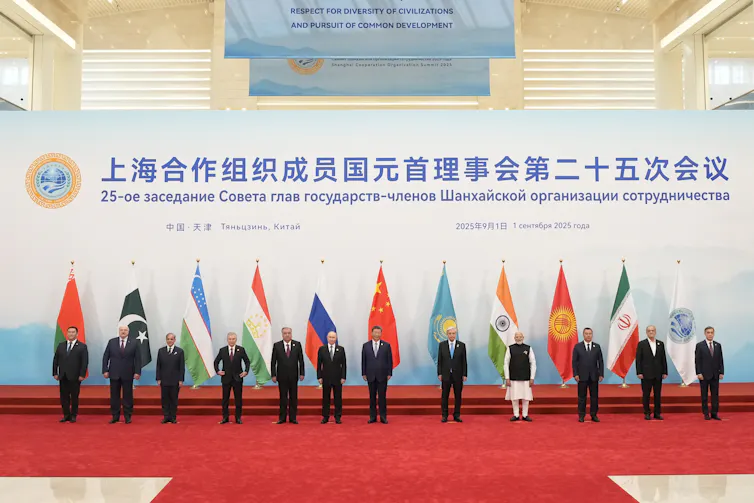
Both are trying to shape the rules, memberships and agendas of the regional and global orders in ways that advance their own influence and constrain the other’s.
On the surface, this can look like just another front in a new cold war. But institutional competition can be one of the safer forms of rivalry.
Competition can force institutions to adapt rather than stagnate. It can encourage new forms of regional cooperation. It can also push rival powers to provide public goods – such as infrastructure, development financing, technological investments and climate initiatives – in order to win support from others.
In infrastructure financing, for instance, China has used the Belt and Road Initiative[4] and the Asian Infrastructure Investment Bank[5] to expand its reach globally. The US and its partners have responded with initiatives of their own[6].
The competition between the two has been beneficial – and it has expanded the options available to developing countries.
This is also why a rush toward broad economic decoupling[7] would be such a mistake. Some restrictions in sensitive sectors may be unavoidable. But a sweeping effort to sever economic ties would remove one of the few remaining guardrails in the relationship.
As long as the United States and China remain economically intertwined, both sides are incentivised to maintain stability and avoid conflict.
3. Lower the temperature
The US and China are not simply clashing over interests. They also have very different political and historical narratives.
US policymakers often cast the rivalry as a defence of the liberal order against authoritarian revisionism[8]. Chinese leaders often see it as a struggle against containment[9], humiliation[10] and foreign interference.
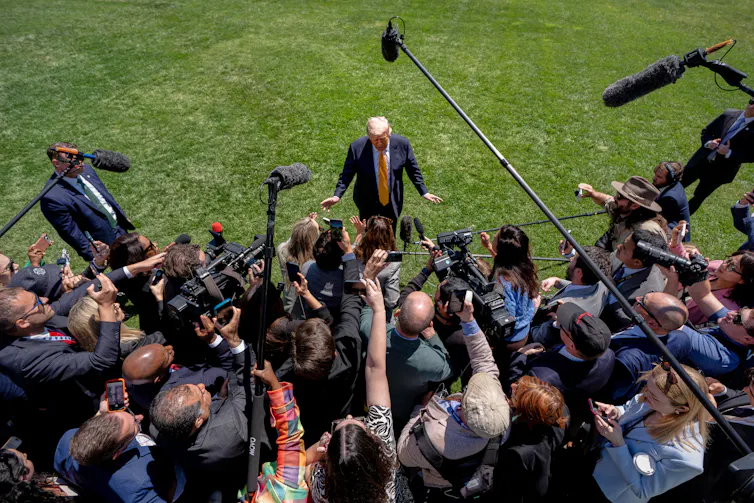
These are not just different rhetorical narratives. They shape what each side sees as threatening, acceptable or beyond compromise. They also help explain why the relationship has become so emotionally and politically charged.
Ideological competition is safest when it remains indirect. Neither Washington nor Beijing is likely to convert the other to its way of thinking. And neither is likely to persuade the wider world through their lectures on ideology.
The sounder strategy is to compete by example.
For the United States, it means showing that democratic governance can still deliver competence, cohesion and long-term economic vitality. For China, it means showing that its model can bring growth, social stability and international cooperation.
Both sides also need to recognise that ideological overreach is dangerous. The more Washington frames competition as a global struggle between democracy and autocracy, the more it encourages Beijing to see compromise as capitulation.
And the more Beijing wraps its foreign policy in narratives of anti-hegemony[11], the more likely Washington is to see its own restraint as weakness.
Engagement still matters for the same reason. If the United States and China stop talking, this ideological competition will harden and become more dangerous.
The greatest danger in the US–China competition is that both sides will come to see restraint as weakness, compromise as surrender and coexistence as impossible. Once that happens, catastrophe becomes far more likely.
The most realistic goal is not friendship, or even reconciliation. It is something harder and more modest: competition without war.
References
- ^ coercive military actions around Taiwan (www.taiwannews.com.tw)
- ^ Trump-Xi summit will be no ‘Nixon in China’ moment – that they are talking is enough for now (theconversation.com)
- ^ Shanghai Cooperation Organisation (www.lowyinstitute.org)
- ^ Belt and Road Initiative (www.cfr.org)
- ^ Asian Infrastructure Investment Bank (www.aiib.org)
- ^ initiatives of their own (www.abc.net.au)
- ^ economic decoupling (hbr.org)
- ^ authoritarian revisionism (trumpwhitehouse.archives.gov)
- ^ containment (www.afr.com)
- ^ humiliation (www.uscc.gov)
- ^ narratives of anti-hegemony (www.chinadailyhk.com)
Authors: Kai He, Professor of International Relations, Griffith University