After the Iran war, Persian Gulf nations face tough decisions on the US – a former diplomat explains
- Written by: Bob Bowker, Honorary Professorial Fellow, Centre for Arab and Islamic Studies, Australian National University
When the US-Israeli war on Iran finally ends, the Middle East will be even less predictable than it was before it started.
The decision by US President Donald Trump and Israeli Prime Minister Benjamin Netanyahu to go to war – and the Iranian response – may be a watershed moment[1] for the region. It is highly unlikely the Persian Gulf states will be prepared to pay a similar price again for the US to pursue its own interests.
When the war began, these countries quickly found that neither their alignment with the US security umbrella, nor their recent diplomatic engagement with Iran, prevented them from being targeted.
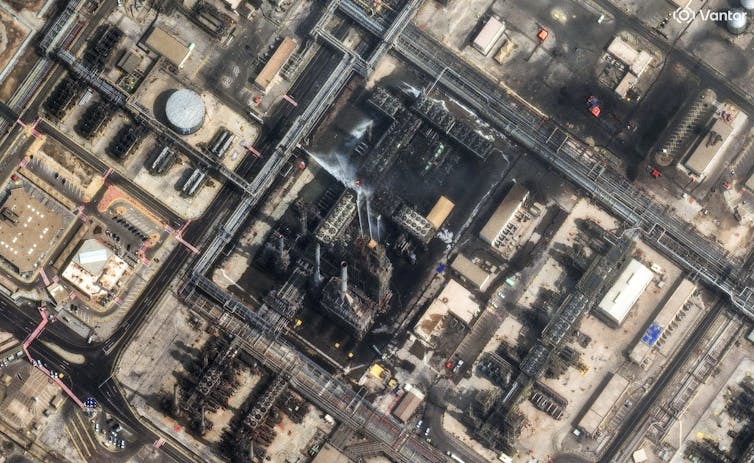
More than 1,700 Iranian missiles and drones[2] have been fired at the United Arab Emirates (UAE) alone. Hundreds more have fallen[3] on Bahrain, Kuwait, Oman, Qatar and Saudi Arabia.
Where does the region go once the bombs stop dropping? Will the Gulf countries recalibrate their relations with the US, and if so, to what extent?
A balancing act with the US
After the war ends, there is no reason to expect tensions between Washington and Tehran will subside to the point where the US can draw down its military assets in the Gulf.
Instead, the Iranian attacks have only underlined the importance to the Gulf states of having ready and reliable access to US defence systems.
Beyond the immediate need to protect their citizens, these countries need to assure energy markets that their reliability as oil and gas suppliers will be maintained. They need to reassure nervous investors that their capital is safe. And they need to ensure that transit through the region by ships and commercial aircraft remains secure and protected.
At the same time, popular opinion in these countries matters, no matter how draconian most rulers are in dealing with dissent.
The Gen Z residents of the region[4], in particular, are more educated, globally connected, and proud of their Arab heritage than previous generations. They are also much more sceptical of US hegemony. And their leaders are aware of this.
Few people are likely to be sympathetic toward Iran, either. Whether Iran wins or loses, many will be even more deeply distrustful of the Shia minorities (or in the case of Bahrain, the Shia majority) in their own countries.
Nevertheless, a large number of people in the Gulf will lay the blame for the war – and the impact on their societies – on the US and Israel.
There’s already a great deal of antagonism toward the United States over its complicity in the catastrophe in Gaza. And despite the Abraham Accords[5] that established formal relations between Israel and some Gulf Arab states, Israel remains anathema to populations across the region.
Simply put, Persian Gulf leaders will face a dilemma after the war: how to deal with an America that simultaneously remains a strategic partner of necessity and a source of enormous popular discontent.
Charting a careful course with Iran
Before the war broke out, Iran and the Gulf states had taken tentative steps toward rapprochement. Attacks on Saudi oil installations and tankers[6] in 2019 nearly led to war with Iran, but Saudi Arabia and the UAE opted for diplomacy instead.
If the Iranian regime survives the war, these Gulf leaders will have to decide how best to deal with it. Under the new supreme leader, Mojtaba Khameini[7], it is certain to be more hardline than it was before.
In doing so, the Gulf countries will need to tread carefully in making choices that privilege – or damage – relations with the United States.
There are likely to be many points of divergence or friction with the US. The UAE, Oman and Qatar can be expected to urge caution in aligning with any US-led attempts to isolate the regime, rather than re-engaging pragmatically with it.
Israel has been largely unrestrained by Washington since the Gaza war began in 2023. As such, it is seen as a regional threat, not an ally.
Any moves by Israel and the US to support non-state actors in Iran to rise up against the regime, including Kurdish separatists[8], would deeply alarm Arab governments facing their own separatist movements. A government collapse and civil war in Iran – both acceptable outcomes from an Israeli perspective – would be a disaster for the region.
The Saudis would also be deeply concerned at the prospect of the US allowing Israel to reoccupy southern Lebanon. And without significant changes in the Trump administration’s approach to Israel, the nightmare in Gaza will drag on.
Major questions moving forward
Leaders in the region have agency. They are much more secure than they were in the past, and their economies are more robust. Three Arab countries alone (the UAE, Saudi Arabia and Kuwait) have invested[9] US$315 billion (A$441 billion) in US Treasury securities. This affords them leverage, should they choose to use it.
Given this, any moves toward a greater assertiveness of national interests would present obvious challenges for US strategy and diplomacy.
In theory, this is a time when the US ought to be shaping or at least influencing how the key players in the region will engage with Iran for years to come. But there is no US “day-after” plan for Iran, or the region, should the Islamic regime collapse.
There is also fear in the Gulf states of further impetuous actions by the Trump administration. Gulf countries remain concerned[10] about being left high and dry by the US once again in their future dealings with Iran, as well.
Importantly, the distrust and political antagonism toward the US across the Arab world cannot be ignored.
In this unprecedented moment for the region, it is doubtful the Trump administration has the diplomatic skills, insight, commitment and credibility to shape a future strategic environment to best serve the interests of the US going forward, as well as the interests of the Arab countries themselves.
References
- ^ watershed moment (www.americanprogress.org)
- ^ More than 1,700 Iranian missiles and drones (www.abc.net.au)
- ^ fallen (www.wsj.com)
- ^ Gen Z residents of the region (carnegieendowment.org)
- ^ Abraham Accords (www.state.gov)
- ^ Attacks on Saudi oil installations and tankers (www.wsj.com)
- ^ Mojtaba Khameini (theconversation.com)
- ^ Kurdish separatists (theconversation.com)
- ^ invested (www.forbesmiddleeast.com)
- ^ concerned (newlinesmag.com)
Authors: Bob Bowker, Honorary Professorial Fellow, Centre for Arab and Islamic Studies, Australian National University