AI is already creeping into election campaigns. NZ’s rules aren’t ready
- Written by: Andrew Lensen, Senior Lecturer in Artificial Intelligence, Te Herenga Waka — Victoria University of Wellington
If you’re often on social media, you’ve probably seen it: the deluge of low-quality, artificial intelligence-made material clogging up our feeds.
So-called “AI slop” – the Macquarie Dictionary’s Word of the Year for 2025[1] – is the result of generative AI being used at scale. It now floods the internet’s most visited platforms[2] with often deliberately misleading text, images and video, siphoning clicks away from real news sources and confusing readers.
In New Zealand, AI-generated fake images of January’s tragic landslide at Mount Maunganui were widely shared[3], misleading people at a time of national disaster.
With a general election later this year, this is likely only the beginning. Already, political parties are toying with this new technology for their campaigns.
Warnings about the risks of AI-driven misinformation have been raised before[4] in New Zealand, but its use is now accelerating – and the rules meant to govern it are struggling to keep up.
Politics in the AI age
On Facebook, bogus news sites[5] have shared deep-fake AI videos purporting to show New Zealand politicians meeting at Waitangi[6] and making policy announcements[7].
More concerningly, some parties have themselves begun using AI to attack opponents. The National Party has already been criticised for posting AI cartoon images[8] of opposition leaders and for creating AI attack ads in the 2023 campaign[9].
Other parties hold mixed views[10] on the use of AI in campaigning, potentially creating an unfair playing field in electioneering. While this might look like just another form of free speech in campaigning, the reality is more troubling.
Political attack ads have been around for centuries, but never has it been so cheap and easy to create them. At virtually no cost, and with minimal technical skill, almost anyone can now use AI to produce a smear campaign that would once have required professional illustration.
Even if political parties keep their distance, third-party lobby groups can do the dirty work instead. And foreign actors could use AI to interfere in New Zealand’s electoral process, potentially swaying an election as closely fought as the 2026 campaign is likely to be.
A much deeper problem lies in how AI can potentially distort voters’ perceptions. Research suggests[11] people are more likely to believe someone is guilty of a crime when shown an AI-generated image – even when they know the content is fake.
At a time when trust in politicians is already low, that risks deepening political disengagement. AI also enables far more personalised campaigning: by profiling voters, a candidate can automatically generate messages tailored to their biggest concerns.
Where NZ’s election rules fall short
New Zealand fortunately has laws to govern election campaigns. But those safeguards were written in a very different technological era.
Current law regulates “election advertisements” in any media. The definition[12] is very broad, covering any message that directly or indirectly promotes or opposes a party or candidate. A range of rules apply to all such material.
All election advertisements must include a “promoter’s statement[13]” identifying who is responsible for them. Spending caps[14] apply to producing and publishing these messages in the three months before election day. And any ad that promotes a party[15] or candidate[16] by name must first get their written permission.
Yet few constraints apply to the actual content of election advertisements. There is no obligation to disclose the use of AI in creating the message and there is no general prohibition on publishing misleading – or even outright false – election advertisements.
Instead, a handful of specific controls may apply to some AI generated election advertisements.
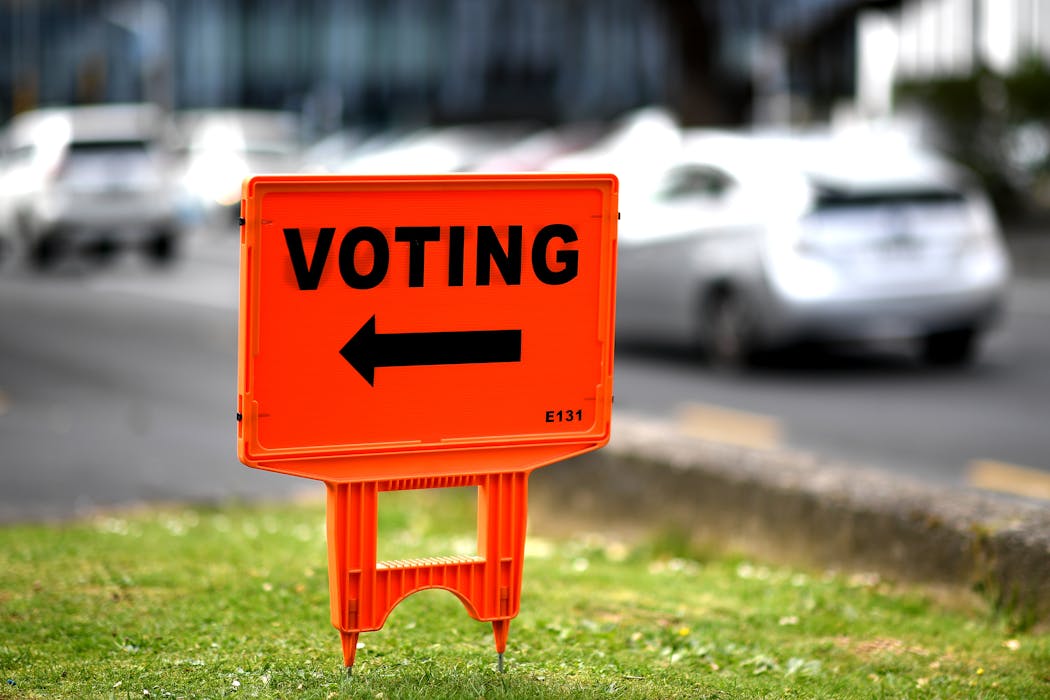
In the final three days of the election period, it is an offence[17] to publish a statement you know is false if the aim is to influence how people vote. But this safeguard is weaker now that voting takes place over 12 days.
The law also bans “undue influence[18]” over voters. This mainly covers force or threats, but it also includes using fraud to stop people voting freely.
In theory, this could apply to fake AI messages designed to suppress turnout or mislead voters about how the system works. But the law dates back to the 19th century and has not been used for many years.
How the law could catch up
What can be done? At a minimum, New Zealand should have rules that require election advertisements to disclose the use of AI, so voters can make an informed decision.
Another simple measure would be to extend the “no deliberate lies to influence voters” rule to cover the entire advance voting period.
Elsewhere, New Zealand can look to other countries now being forced to forge AI-focused laws.
The European Union[19] and many US states[20], for instance, recently passed laws that apply to deepfakes in campaigning.
Closer to home, the Australian Electoral Commission has created a “disinformation register[21]” to combat false claims about how the electoral process works. But this only applies to mechanics of voting processes, not to claims about parties or candidates.
At a time when democracy around the world feels increasingly fragile, protecting the integrity of New Zealand’s elections should be a priority. Free and fair elections depend on transparency, trust and an informed public.
AI is already testing those foundations. Updating the rules will not solve every problem, but doing nothing guarantees the problem will get worse.
References
- ^ Word of the Year for 2025 (theconversation.com)
- ^ floods the internet’s most visited platforms (www.theguardian.com)
- ^ were widely shared (www.1news.co.nz)
- ^ have been raised before (newsroom.co.nz)
- ^ bogus news sites (www.rnz.co.nz)
- ^ meeting at Waitangi (www.facebook.com)
- ^ making policy announcements (www.facebook.com)
- ^ posting AI cartoon images (www.facebook.com)
- ^ AI attack ads in the 2023 campaign (www.stuff.co.nz)
- ^ mixed views (www.1news.co.nz)
- ^ Research suggests (www.nature.com)
- ^ definition (legislation.govt.nz)
- ^ promoter’s statement (legislation.govt.nz)
- ^ Spending caps (elections.nz)
- ^ party (legislation.govt.nz)
- ^ candidate (legislation.govt.nz)
- ^ an offence (legislation.govt.nz)
- ^ undue influence (legislation.govt.nz)
- ^ European Union (digital-strategy.ec.europa.eu)
- ^ many US states (www.ncsl.org)
- ^ disinformation register (www.aec.gov.au)
Authors: Andrew Lensen, Senior Lecturer in Artificial Intelligence, Te Herenga Waka — Victoria University of Wellington