As Syria’s new government consolidates its power, the Kurdish minority fears for its future
- Written by: Ali Mamouri, Research Fellow, Middle East Studies, Deakin University
Renewed fighting[1] in Syria in recent weeks between government-aligned forces and the Kurdish-led Syrian Democratic Forces (SDF) isn’t just a local issue. It has serious implications for the stability of the rest of the Middle East.
Syrian government forces launched an offensive in early January into areas of northeastern Syria controlled by Kurdish forces. The operation enabled the government to gain control[2] of key oil and gas fields and major border crossings with Iraq and Turkey.
Of particular concern to Syria’s neighbours, though, is the thousands of former Islamic State (IS) fighters who have been held in prisons run by the SDF in the region. One camp, al-Hol, reportedly held[3] about 24,000 detainees, primarily women and children. There were also diehard IS supporters from around the world at the camp.
Amid concerns the prisoners would escape with the SDF retreat, the US military began moving detainees[4] from Syria to other facilities in Iraq last week. Some prisoners, however, were able to escape[5].
Though both sides agreed to a ceasefire that would see the SDF forces incorporated into the Syrian armed forces, it remains shaky.
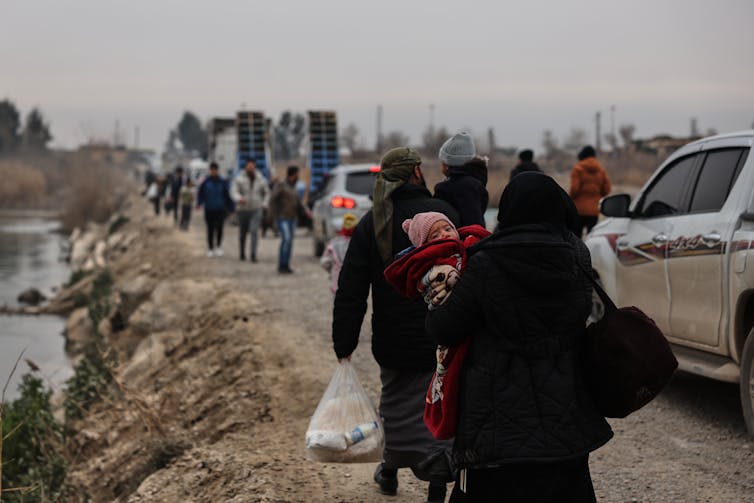
The government’s offensive has also resulted[6] in mass displacement[7], mistreatment of civilians[8] and what the SDF claims are Islamic State-style killings[9] of its forces and civilians.
And there are concerns the Islamic State will take advantage of the chaos[10] to regroup and try to destabilise the region once again.
A pattern of violence
The fighting has followed a pattern disturbingly similar to other violent episodes following the fall of Bashar al-Assad’s government to forces led by now-President Ahmed al-Sharaa in late 2024.
Al-Sharaa has pledged to protect minorities[11] in the new Syria he is building, but religious and ethnic minorities have specifically been targeted[12]. This includes the Druze in southern Syria[13] and Alawite communities in the west[14].
There have been credible reports[15] of summary executions, arbitrary killings[16] and kidnappings.
When the Islamic State controlled large portions of Syria around 2014, its violent actions against civilians – in particular, minorities such as the Yazidis and Kurds – were widely condemned[17] as potential war crimes and crimes against humanity.
In al-Sharaa’s Syria, the violence has allegedly been carried out[18] by government security forces[19], as well as armed factions[20] affiliated with the government, including foreign fighters.
And al-Sharaa’s government has been supported – or at least tolerated – by international actors, most notably the United States. US President Donald Trump praised[21] al-Sharaa earlier this month for his “tremendous progress”, adding, “I think he’s going to put it all together.”
Trump even met[22] al-Sharaa during a visit to Saudi Arabia in May at the behest of Saudi Crown Prince Mohammed bin Salman.
As a result, violent actions that once triggered airstrikes and global outrage are now met largely with silence, caution or political justification.
This shift is most stark in the treatment of Kurdish forces, particularly the Syrian Democratic Forces. These forces have been among the US government’s most effective local partners in the fight against Islamic State for years.
Despite this record, violence against Kurdish civilians[23] has elicited little meaningful reaction. Instead, US policy[24] has focused on supporting the Syrian government structure and urging Kurdish leaders to accept the new political order and fully integrate into state institutions.
For Kurdish communities, this demand carries profound risks. The experiences of the Druze and Alawites offer little assurance that disarmament and territorial concessions will be met with protection or political inclusion.
Many Kurds fear laying down arms without security guarantees could expose them to similar attacks.
A return of Islamic State
Another destabilising consequence of the fighting in eastern Syria has been the collapse of the detention network built to prevent the return of IS.
The US has said up to 7,000 detainees could be transferred[25] from Syria to detention facilities in Iraq in its operations.

While framed as a logistical and security necessity, the announcement immediately triggered alarm[26] across Iraq, where memories of the 2014 Islamic State invasion remain vivid. That was fuelled, in part, by prison breaks from poorly secured detention facilities in Iraq and Syria.
In response to these concerns, Iraqi security forces have deployed[27] in large numbers along the Syrian border to prevent escaped IS detainees from infiltrating the country.

US and Turkish agendas
At the centre of this unfolding crisis is the US, which favours a centralised Syrian state under a single trusted authority. This is easier to manage[28] diplomatically and militarily than a fragmented country with competing armed factions.
This approach also aligns with Trump’s broader regional ambitions, including expanding the Abraham Accords[29] by persuading more regional countries to normalise ties with Israel.
Turkey, a NATO member and key US ally, also has a vested interest[30] in the future of Syria. Ankara, a key backer of al-Sharaa[31], has long viewed any form of Kurdish autonomy in Syria as an existential threat, fearing it would embolden Kurdish demands inside Turkey.
Together, these overlapping agendas reveal why the international response to the fighting in eastern Syria has been so muted. Concerns over civilian protection or the potential regrouping of the Islamic State have been trumped by the strategic realignment taking place with a post-Assad Syria.
Kurdish forces, once indispensable partners, now find themselves caught between shifting alliances and competing regional interests — another casualty of a new international order defined by convenience rather than principle.
References
- ^ Renewed fighting (www.bbc.com)
- ^ gain control (edition.cnn.com)
- ^ reportedly held (apnews.com)
- ^ began moving detainees (www.nytimes.com)
- ^ were able to escape (www.ft.com)
- ^ resulted (abcnews.go.com)
- ^ mass displacement (novact.org)
- ^ mistreatment of civilians (www.hrw.org)
- ^ Islamic State-style killings (www.rudaw.net)
- ^ will take advantage of the chaos (www.forbes.com)
- ^ pledged to protect minorities (www.nytimes.com)
- ^ specifically been targeted (commonslibrary.parliament.uk)
- ^ Druze in southern Syria (theconversation.com)
- ^ Alawite communities in the west (www.reuters.com)
- ^ credible reports (www.ohchr.org)
- ^ arbitrary killings (www.amnesty.org)
- ^ widely condemned (committees.parliament.uk)
- ^ carried out (commonslibrary.parliament.uk)
- ^ government security forces (edition.cnn.com)
- ^ armed factions (www.reuters.com)
- ^ praised (www.wsj.com)
- ^ met (www.nytimes.com)
- ^ violence against Kurdish civilians (www.hrw.org)
- ^ US policy (www.aljazeera.com)
- ^ transferred (www.centcom.mil)
- ^ triggered alarm (middle-east-online.com)
- ^ deployed (shafaq.com)
- ^ easier to manage (jinsa.org)
- ^ expanding the Abraham Accords (orfme.org)
- ^ vested interest (www.reuters.com)
- ^ key backer of al-Sharaa (abcnews.go.com)
Authors: Ali Mamouri, Research Fellow, Middle East Studies, Deakin University