What does halal mean? It’s about more than just food
- Written by: M. Obaidul Hamid, Associate Professor of TESOL Education, The University of Queensland
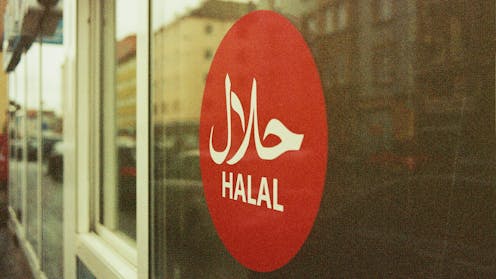
The word “halal” is probably the most common concept associated with Muslims. It is the “social face” of their religious beliefs and practices, which have enriched Australian multiculturalism.
Many non-Muslims, however, don’t have a deep understanding of what halal means. Ignorance and misunderstanding of halal may lead to xenophobic attitudes towards Muslims, as we’ve seen in the past[1].
Knowing its true meaning can enhance mutual respect between Muslims and non-Muslims and cement social harmony. Here’s what the term means and where it comes from.
What’s the definition?
Halal (حلال) is an Arabic word which essentially means all that is permissible or lawful according to Islamic teachings. Its opposite is “haram” (حرام) which refers to everything that is forbidden in Islam.
Scholar Yusuf Qaradawi[2] defines halal as that “which is permitted, with respect to which no restriction exists” and haram as that “which the Law-Giver [God] has absolutely prohibited”.
Haram generally has a limited scope[3] in Islam.
Conversely, the scope of halal is very wide. Anything that is not declared haram and is good for humans is halal. Islamic scholar Mohammad Hashim Kamali quotes[4] a statement from Prophet Muhammad:
Halal is that which God has permitted in His Book, and haram is that which God has prohibited in His Book. As for what He has chosen to remain silent about, it is exonerated.
So, what Islam does not describe as haram, is halal.
Who decides what is halal?
Halal and haram are God’s preserve and cannot be determined by humans.
The Quran advises believers to “partake of the good things” which are provided for their sustenance. What Islam makes permissible is believed to be good for humans, and what it prohibits is harmful for them.
The Quran refers to halal food as “good”. However, halal food can be haram if it’s harmful for health. For example, sugar is halal but consuming it excessively may become haram if it endangers life.
Haram food can also be halal when there is life-threatening hunger.
Meat of certain animals and birds including cows, goats, kangaroos, chicken and duck is halal only if they are slaughtered the Islamic way[5].
Pork and the meat of dogs, carnivorous animals and most reptiles, however, are haram.
Common species of fish and seafood are halal, even though differences of opinion exist over certain items, such as crabs and squid.
Intoxicants (such as smoking and alcohol) and gambling are haram in Islam because they “sow enmity and hatred” between people and turn them away from worship, according to the Quran.
More than just food
An Islamic life cannot be comprehended without the rules of halal and haram.
Such rules encompass all aspects of Muslim life including food and beverage consumption, clothing, verbal and nonverbal behaviour, financial transactions, sexual relations, social interactions and recreations. For example, Muslim women are prohibited from wearing clothing that is typically male and vice versa. Gold, jewellery and silken clothes are prohibited for men but allowed for women[6].
Usury (lending money at unreasonably high rates of interest) is unlawful but making money through fair trade and business practices is lawful.
Manufacturers and marketers increasingly cater to Muslim customer needs by promoting halal brands. But ignorance or only partial understanding of halal remains common among Muslims as well as non-Muslims.
When eating out in mainstream restaurants, Muslims will check if the meat on the menu is halal. Occasionally, we hear employees at food outlets saying: “The beef and the chicken are halal, but I am not sure about the pork”.
Others ask Muslims if they’re allowed to eat fish. Such questions reveal both curiosity and misunderstanding.
A meaningful, ethical life
An unhelpful approach is when halal is taken beyond its true meaning and associated with political and ideological issues. Sometimes halal is weaponised for anti-Muslim propaganda[7].
In most cases, halal and non-halal foods may not have physical, chemical or nutritional differences. It’s only religious or spiritual.

A child of one of this article’s authors once ate a beef sausage at his primary school food festival. When told it was not halal, he said it tasted exactly like halal sausages.
He was right. A non-Muslim kid will have the same experience of halal sausages. As the difference is only in the method of slaughtering an otherwise halal animal, the taste will be identical.
But given the spiritual importance of halal, a Muslim wouldn’t feel good if they ate non-halal food, even by mistake.
Muslims who follow halal rules are likely to respect other people’s diets. Dietary rules or preferences can be the basis[9] for understanding similarities and differences between faith groups.
The knowledge can also help identify common grounds between Muslims and non-Muslims, ensuring inclusion and social connection.
Muslims’ halal practices can bring benefits for society. Halal food acquired through illegal means becomes haram. For example, cheating, corruption and hiding product information can make an income or business transaction un-Islamic.
Making excessive profit by harming customers also goes against the spirit of halal.
So halal is not just avoiding certain foods and drinks. It’s also about living an ethical and meaningful life, both for oneself and others.
References
- ^ we’ve seen in the past (www.abc.net.au)
- ^ Yusuf Qaradawi (www.amazon.com.au)
- ^ limited scope (global.oup.com)
- ^ quotes (www.amazon.com.au)
- ^ the Islamic way (kb.rspca.org.au)
- ^ allowed for women (www.jstor.org)
- ^ anti-Muslim propaganda (www.theguardian.com)
- ^ Gül Işık/Pexels (www.pexels.com)
- ^ can be the basis (www.abc.net.au)
Authors: M. Obaidul Hamid, Associate Professor of TESOL Education, The University of Queensland
Read more https://theconversation.com/what-does-halal-mean-its-about-more-than-just-food-263037