Pragmatic engagement – what Albanese’s visit reveals about China relations in a turbulent world
- Written by: Edward Sing Yue Chan, Postdoctoral Fellow in China Studies, Australian National University
The Albanese government has faced an increasingly uncertain world since its re-election in May.
US President Donald Trump has cast a long shadow[1] over the Australia–US alliance, raising fresh questions about Canberra’s long-term regional strategy.
Against this backdrop, Prime Minister Anthony Albanese’s approach to foreign policy is reflecting a careful recalibration – one that seeks to balance security partnerships with the pursuit of economic opportunities, especially with Australia’s largest trading partner[2], China.
Albanese has wrapped up a six-day visit[3] to China which was characterised by a highly pragmatic approach to dealing with the problems and irritants in the bilateral relationship.
Economic engagement
Albanese’s visit to Beijing, Shanghai and Chengdu – cities emblematic of Australia’s political, economic and cultural connections with China – was more than symbolic.
It was a high-profile diplomatic venture, with Albanese meeting both[4] the Chinese President Xi Jinping[5] and Premier Li Qiang[6].

But it was more than a leaders’ summit. A large team of key business leaders in banking, manufacturing, mining and education were on the trip to meet their Chinese counterparts and seek more cooperation.
Economic engagement dominated the visit. As Albanese highlighted before[8] his trip, “my priority is jobs”.
Broader partnerships spanning multiple sectors[9], including healthcare, education and green energy, were canvassed. The two nations also explored closer cooperation on energy transition and climate change.
Chinese Ambassador to Australia Xiao Qian has even floated a collaboration[10] on artificial intelligence.
However, the suggestion has been met with caution in Canberra due to ongoing concerns around national security and data governance.
Cooperate where we can
Beyond trade and investment, the visit also marked an effort to rebuild people-to-people exchanges.
Since last year, Australian citizens have been able to visit China[11] for up to 30 days without a visa. In turn, Australia will welcome more Chinese visitors under a new Memorandum of Understanding[12] promoting Australia as a premier tourist destination for Chinese travellers.
Albanese’s meetings with Xi Jinping and Li Qiang also yielded concrete results.
The official joint statement[13] emphasised economic cooperation, particularly in climate-related areas such as steel decarbonisation, dryland farming and the green economy.
These outcomes align with the Albanese government’s guiding principle: cooperate where we can.
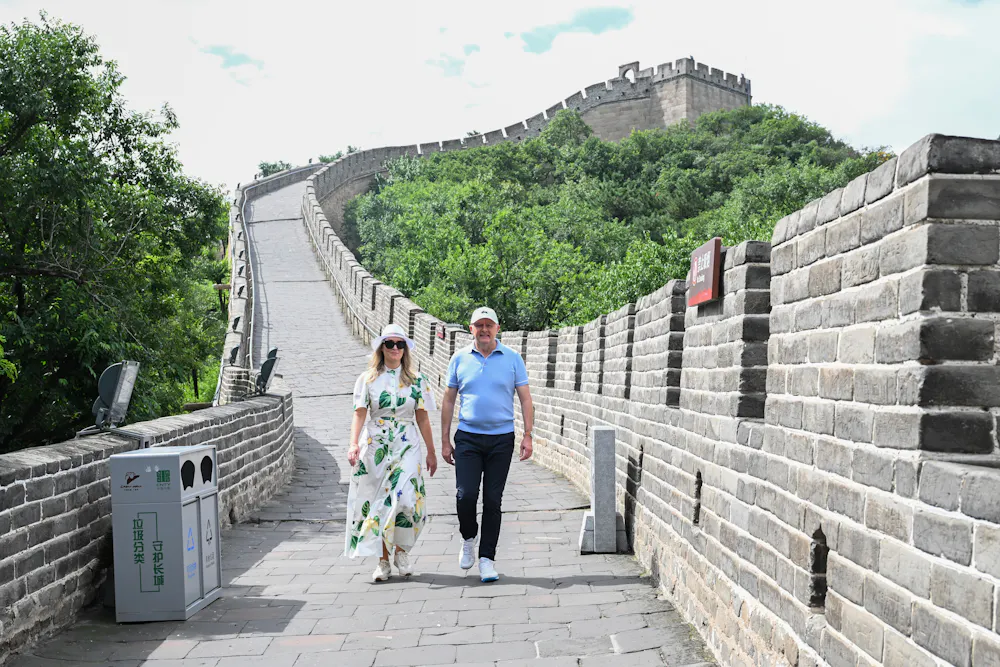
The deeper economic cooperation has been noted in China[15], where there is an expectation collaboration will continue to accelerate on the back of improved relations.
As James Laurenceson[16] of the Australia–China Relations Institute recently noted[17], a stronger economic partnership will help foster more resilient ties across the board.
More independent foreign policy
Other analysts also see increased mutual benefits in the bilateral relationship.
China-watcher James Curran[18] suggests the visit may signal a maturing, more independent[19] Australian foreign policy.
The primary role of Australian statecraft is to do everything we possibly can to avoid a conflict. To avoid ever getting close to a decision about following the Americans into a war of that kind.
This was best illustrated by Albanese’s refusal to provide Washington with a wide-ranging and largely open-ended commitment to support the US in any conflict with China over Taiwan[20].
Indeed, as Curran observes, Albanese has tried to steer the relationship away from disagreement and towards pragmatic engagement.
Following his meeting with Xi, Albanese was repeatedly asked by Australian journalists if he raised sensitive issues such as Taiwan, China’s military build-up[21] and the South China Sea[22].
While he confirmed these topics were addressed, he emphasised a preference[23] for peaceful engagement:
[…] we want peace and security in the region. That is in the interest of both Australia and in the interest of China.
Unsurprisingly, the joint statement made no reference to these issues, reflecting a mutual decision to sidestep confrontation in favour of stabilising the relationship.
Quietly managing differences
This diplomatic posture toward China would appear to be a defining feature of the Albanese government’s second term: strengthening cooperation while quietly managing differences.
Rather than highlighting points of contention, the government is opting to avoid open disagreement where possible.
Overt disputes risk destabilising bilateral ties. If issues are raised publicly, it is unlikely to shift entrenched positions on either side. This explains why the ownership of the Port of Darwin[24], for example, was not mentioned during Albanese’s meeting with Xi.
Critics, however, argue this risks projecting weakness towards China.
Justin Bassi[25], executive director of the Australian Strategic Policy Institute, warns the government is staying silent[26] in the face of ongoing Chinese coercion:
Australia is only complying with China’s desires when the government says nothing and leaves the public to trust that the threats posed by China are all being dealt with in the classified realm. This is not viable policy. Australia’s sovereignty must not be contingent on Beijing’s preferences.
Even within China, analysts are cautious about Albanese’s approach. As one Chinese scholar told us, “a stable relationship does not necessarily mean a friendly one”.
In fact, while the Chinese media has stressed Australia and China’s shared commitment to regional stability, this was barely mentioned in the official joint statement[27].
Mutual interests
Still, there is recognition on both sides that pragmatism rather than ideological grandstanding is the more sustainable path forward.
In sum, Albanese’s visit does not mark a dramatic reset or bold new direction in Australia–China relations. Rather, it signals a shift toward greater realism.
In an increasingly complex and multipolar world, diplomacy grounded in mutual interests, rather than ideology, is not just practical, but may be a growing trend across the globe.
References
- ^ long shadow (www.chathamhouse.org)
- ^ largest trading partner (www.dfat.gov.au)
- ^ six-day visit (www.pm.gov.au)
- ^ meeting both (www.pm.gov.au)
- ^ President Xi Jinping (www.britannica.com)
- ^ Premier Li Qiang (www.chinafile.com)
- ^ Lukas Coch/AAP (photos.aap.com.au)
- ^ highlighted before (www.afr.com)
- ^ multiple sectors (www.bca.com.au)
- ^ a collaboration (www.afr.com)
- ^ visit China (au.china-embassy.gov.cn)
- ^ Memorandum of Understanding (www.pm.gov.au)
- ^ joint statement (www.pm.gov.au)
- ^ Lukas Coch/AAP (photos.aap.com.au)
- ^ noted in China (www.guancha.cn)
- ^ James Laurenceson (profiles.uts.edu.au)
- ^ recently noted (theconversation.com)
- ^ James Curran (www.sydney.edu.au)
- ^ more independent (michaelwest.com.au)
- ^ over Taiwan (theconversation.com)
- ^ military build-up (www.internationalaffairs.org.au)
- ^ South China Sea (www.aspistrategist.org.au)
- ^ a preference (www.pm.gov.au)
- ^ Port of Darwin (www.afr.com)
- ^ Justin Bassi (www.aspi.org.au)
- ^ staying silent (www.aspistrategist.org.au)
- ^ joint statement (www.pm.gov.au)
Authors: Edward Sing Yue Chan, Postdoctoral Fellow in China Studies, Australian National University