Tyranny is an ever-present threat to civilisations. Here’s how Classical Greece and China dealt with it
- Written by: Shannon Brincat, Senior Lecturer in Politics and International Relations, University of the Sunshine Coast
We’re just a few months into US president Donald Trump’s second term but his rule has already been repeatedly[1] compared[2] to tyranny[3].
This may all feel very new to Americans, and to the rest of us watching on from around the world. But the threat of tyranny is an ancient one.
We can learn much from how people in ancient Greece and China dealt with this issue.
Where does tyranny come from?
The peoples of classical Greece were separated into city-states known as the polis.
A few of these, such as Athens and Argos, were democratic.
Others, such as Rhodes or Chios, had had democratic features such as civic participation in public life.
These city-states routinely faced external enemies but also the threat of tyrannical take-over from within.
Things came to a head in 510 BCE under the rule of an oppressive tyrant known as Hippias. He was ultimately expelled, leading eventually to the establishment of democracy through reforms made under an Athenian statesmen called Cleisthenes.
According to Plato, tyranny is the most degenerate political regime[4] and emerges out of democracy’s excesses.
He argued that as democratic citizens become accustomed to living by pleasure rather than reason or duty to the public good, society becomes fragmented.
Demagogues – populist leaders who gain power by appealing to base desires and prejudices of the masses – promise the people more liberties. They turn citizens away from virtue and toward tyranny.
Aristotle, who was Plato’s student, defines[5] tyranny as the corrupted form of monarchy. The tyrant perverts the constitutional order to bring about self-serving rulership – the rule of one. Tyranny, he argued, destroys law and justice, eroding all public trust.
The approach of Plato and Aristotle to combating tyranny was closely tied to their conception of the polis and the importance of citizenship.
For the classical Greeks, citizenship was a binding relationship of reciprocal duties and obligations owed to all other citizens. The law, they believed, was king.
It was these conventions that constrained political power, especially the arbitrary rule of one[6].
Civic education by participation in daily democratic life promoted virtue, they believed. All citizens and the ruler were subservient to the law – a bond that tyranny destroyed.
Aristotle said a strong middle class that could best prevent tyranny because they indicated a less unequal, and therefore more stable, society.
Plato’s view was more inward looking. He saw tyranny as a political manifestation of a disordered “enslaved soul” governed by appetites rather than reason. For him, philosophical guidance back to harmony was required for the tyrant and for the people.
Only through wisdom, he argued, could the people recognise and reject demagogues and populists.
Protecting democracy from tyranny
Some city-states learned from their institutional failings when tyranny had taken them over.
For example, after a coup of aristocrats overtook Athenian democracy in 411 BCE, Athenians began to swear the Oath of Demophantos[7]. This was among the first attempts at a constitutional safeguard of democracy against tyranny.
It legally and morally obliged citizens to resist any attempt to overthrow democracy by force. The undertaking was a reciprocal duty; as other scholars have argued[8], each citizen could count on the support of all others to protect the democracy when a tyrant tried again.
This made it far more likely for people to take action against a would-be-tyrant; they knew every other citizen had sworn an oath to have their back.
The Greek historians of the time support these views. For example, Herodotus[9] in the 5th century documented the rise of several tyrants across Asia Minor (modern-day Turkey). He blamed the political vacuum created by the decline of aristocratic rule. Here, the personal ambition and luxury of elites laid the path to tyrannical behaviour.
Another famous historian named Thucydides, writing at the same time, analysed the power and political corruption behind tyranny. He observed how times of crisis exposed vulnerabilities within Athens, leading to factionalism, instability, and the erosion of democracy.
Tyranny in classical China
In classical China we see a complementary, yet unique view of tyranny.
During the Warring States period (475–221 BCE), when the Zhou Dynasty was divided amongst several competing states, preventing tyranny was a central concern.
These states were mostly hereditary monarchies rather than democracies but they still emphasised accountability to the people.

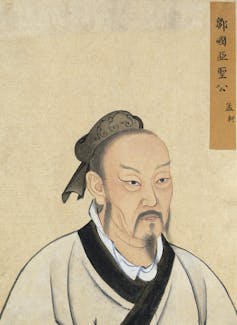
Mencius, a 4th-century BCE Chinese philosopher and Confucian scholar, argued the people’s welfare was the foundation of legitimate rule.
There is, he argued, a responsibility to all under the Mandate of Heaven[11] (天命, tiānmìng). This ancient Chinese doctrine asserted that heaven grants legitimacy to just rulers. If a ruler became despotic or failed to uphold harmony and virtue, the mandate can be withdrawn, justifying rebellion and dynastic change.
Mencius famously said a ruler who oppresses the people is not a ruler but a “mere man” who could be violently overthrown.
Xunzi, another Confucian philosopher writing in the late 4th to 3rd Centuries BCE, believed humans were inherently selfish and chaotic.
To fend off tyranny he emphasised ritual, education, and rule of law. He believed in formal ceremonies and structured practices such as court etiquette, family rites, and daily ethical conduct. These, he believed, helped cultivate virtue, regulate behaviour, and maintain social harmony.
Mozi, writing mostly in the 5th to early 4th centuries BCE, was a Chinese philosopher who opposed Confucianism and founded Mohism, offered a different view.
Opposing all hierarchies, he emphasised jiān ài[12](兼爱) – universal obligation or care to all others – as a core ethical and political principle.
According to Mozi, tyranny arises when rulers act selfishly – favoring their own families, states, or interests over the common good. He advocated for strong moral conduct and competence of leaders, rather than their lineage, wealth or status.
Tyranny today
Viewed together, these traditions suggest preventing tyranny requires more than just moral leadership.
Rather, it requires a notion of reciprocity – of shared obligations between citizens – and systemic safeguards against the personal ambitions of rulers.
Ethical governance, civic education, legal frameworks, and shared responsibilities are essential.
References
- ^ repeatedly (apnews.com)
- ^ compared (www.theatlantic.com)
- ^ tyranny (www.theguardian.com)
- ^ degenerate political regime (www.perseus.tufts.edu)
- ^ defines (www.perseus.tufts.edu)
- ^ arbitrary rule of one (link.springer.com)
- ^ Oath of Demophantos (press.princeton.edu)
- ^ argued (www.jstor.org)
- ^ Herodotus (www.perseus.tufts.edu)
- ^ Pictures from History/Getty Images (www.gettyimages.com.au)
- ^ Mandate of Heaven (www.cambridge.org)
- ^ jiān ài (cup.columbia.edu)
Authors: Shannon Brincat, Senior Lecturer in Politics and International Relations, University of the Sunshine Coast