NZ will soon have no real interisland rail-ferry link – why are we so bad at infrastructure planning?
- Written by: Timothy Welch, Senior Lecturer in Urban Planning, University of Auckland, Waipapa Taumata Rau
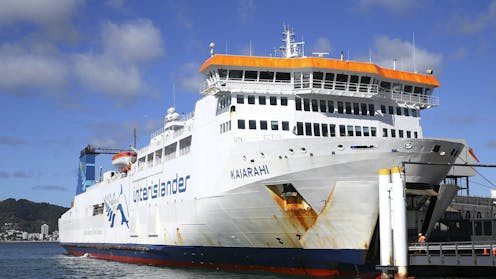
Another week, another Cook Strait ferry breakdown[1]. As the winter maintenance season approaches and the Aratere prepares for its final months of service[2], New Zealand faces a self-imposed crisis.
The government has spent NZ$507.3 million[3] on cancelled iReX ferry plans, the country’s fleet has an average age of 28 years, and the earliest New Zealanders can hope for promised replacements is 2029.
The Marlborough Chamber of Commerce warns[4] unreliable ferries already shake tourist confidence. Several more years of duct-tape solutions won’t help.
The recent pattern of breakdowns and cancellations has become so routine that New Zealand risks normalising what should be viewed as a national crisis: a serious infrastructure failure.
It is also a textbook example of how short-term political cycles, coupled with chronic under-investment, create far more expensive problems than the ones they promise to solve.
Cost blowouts
While ministers claim to have spared taxpayers a $4 billion blowout on new ferries, Treasury papers show almost 80% of the cost escalation[5] lay in seismic upgrades for wharves, not in the vessels themselves. Those land-side works will be required no matter what ferries the country eventually orders.
Justifying the original contract cancellation, Finance Minister Nicola Willis quipped that iReX was a Ferrari when a Toyota Corolla would do[6]. But the cost of finding a suitable Corolla is adding up fast.
Annual maintenance costs are projected to nearly double to $65 million[7], just to keep the existing ageing ferries running. Additionally, $300 million had to be earmarked[8] to cover fees for breaking the original ferry replacement contract.
By retiring the Aratere this year[9] – New Zealand’s only rail-capable ferry – the government is also severing the interisland rail link for almost five years.
KiwiRail will “road-bridge” rail freight, an expensive workaround that involves loading train cars onto trucks, putting those trucks on ferries, then reversing the process at the other end. This will increase truck traffic, produce more emissions and add more wear to already strained infrastructure.
Forcing more than $14 billion worth of annual freight[10] from rail to road could also negatively affect New Zealand’s climate change commitments. Freight moved by rail generates only about 25% of the CO₂ per tonne-kilometre[11] of the same load produced when hauled by truck.
The cancelled hybrid ferries would have also cut emissions by 40%[12]. Instead, New Zealand is locking in higher emissions for another half decade or longer.
Unrealistic timelines
The ferry saga reflects New Zealand’s infrastructure problem in a nutshell. The country tends to underestimate costs, create unfeasible timelines, then shows dismay when projects blow up or limp home at double the price.
Auckland exemplifies the pattern. The city has seen decades of cancelled harbour crossing proposals[13] and a scrapped light rail project, with nothing to show but consultancy fees.
When New Zealand does build –Transmission Gully, for example – the final bill bears little resemblance to initial quotes. The 27 kilometre motorway north of Wellington[14] was nearly 50% over budget and took eight years to build – two years longer than promised.
The systematic underestimation of costs reflects a flawed approach to infrastructure planning. Politicians need quick wins within three-year electoral cycles, while infrastructure projects take decades to deliver.
Projects are approved based on lowball estimates, with the outcome inherited by another administration. This has crossed party lines and created a system that rewards short-term thinking and punishes long-term planning[15].
Just consider the second crossing for Auckland Harbour. For 35 years, the government has commissioned study after study – from the 1988 tunnel plans[16] to the 2010 business cases[17] – each time backing away when the price tag appeared, or the government changed.
The iReX cancellation marks the first time the government has actually signed contracts and then walked away. As with the second Auckland Harbour crossing, each delay has only made the inevitable solution more expensive.
Other countries have, to a degree, addressed this problem. Infrastructure Australia, for example, provides independent cost assessments and long-term planning that transcends political cycles. New Zealand’s Infrastructure Commission, established in 2019, lacks similar teeth and independence.
Ultimately this isn’t really about ferries. It’s about how New Zealand consistently fails to deliver, on time and at cost, the infrastructure that keeps its economy moving.
References
- ^ Cook Strait ferry breakdown (www.rnz.co.nz)
- ^ Aratere prepares for its final months of service (www.rnz.co.nz)
- ^ NZ$507.3 million (www.rnz.co.nz)
- ^ Marlborough Chamber of Commerce warns (www.rnz.co.nz)
- ^ almost 80% of the cost escalation (www.treasury.govt.nz)
- ^ Ferrari when a Toyota Corolla would do (www.rnz.co.nz)
- ^ projected to nearly double to $65 million (www.treasury.govt.nz)
- ^ $300 million had to be earmarked (www.treasury.govt.nz)
- ^ retiring the Aratere this year (www.rnz.co.nz)
- ^ $14 billion worth of annual freight (www.kiwirail.co.nz)
- ^ 25% of the CO₂ per tonne-kilometre (www.kiwirail.co.nz)
- ^ cut emissions by 40% (www.transport.govt.nz)
- ^ decades of cancelled harbour crossing proposals (theconversation.com)
- ^ 27 kilometre motorway north of Wellington (www.rnz.co.nz)
- ^ short-term thinking and punishes long-term planning (theconversation.com)
- ^ 1988 tunnel plans (www.rnz.co.nz)
- ^ 2010 business cases (www.nzta.govt.nz)
Authors: Timothy Welch, Senior Lecturer in Urban Planning, University of Auckland, Waipapa Taumata Rau