Australia has elected its youngest senator. With Gen Z wielding more political power, is it a sign of things to come?
- Written by: Philippa Collin, Professor of Political Sociology, Institute for Culture and Society, Western Sydney University
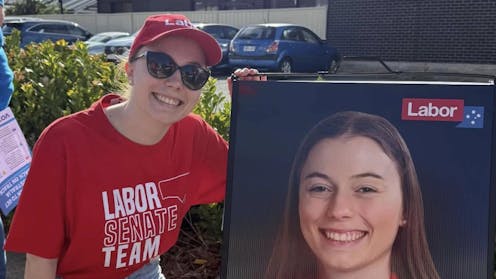
It’s been 30 years since Natasha Stott Despoja[1] became the youngest woman ever elected to the Australian Parliament. A 25-year-old Sarah Hanson-Young beat that record slightly in 2007.
Just over a decade later, the Australian Electoral Commission has confirmed[2] another record-breaking young woman will be entering parliament: 21-year-old Charlotte Walker, in sixth Senate spot for South Australia.
Walker’s election is remarkable because she’s young and she’s female. Both these characteristics run against long-standing trends in Australian politics.
It’s also a reminder of why young people’s representation, both inside and outside parliament, matters for the whole society.
The result of a ‘youth quake’?
In the 2025 election, Gen Z and Millennial voters outnumbered[3] older generations.
While we cannot treat the “youth vote” as a homogeneous bloc, expert analysis[4] of the lower house votes shows young people contributed to the shift away from the Liberals and minor parties in specific seats.
This groundswell helped create a landslide of support for Labor, despite a primary vote[5] of less than 35%.
Amid these changes, Walker joins a select few very young people ever elected to federal parliament.
Wyatt Roy remains the youngest person to take up a federal political post. He was just 20 years old when he entered the lower house in 2010, representing the Queensland seat of Longman for the Liberals.
In 2017, 23-year-old Jordan Steele-John became the youngest senator in Australia’s history, representing the Greens for Western Australia.
According to the Inter-Parliamentary Union[6], this track record puts Australia fifth among the top-ranked democracies for parliamentarians under 30 years old in the upper chamber.
While this suggests Australia does well in having young people represented, only 20.1% of the upper house is under the age of 45. For comparison, the youngest parliament in the world is in Bhutan, with 70.8% of upper house members aged under 45.
So, while they make up more than 30% of the electorate, Millennial and Gen Z Australians are far from proportionately represented.
The growing power of women?
Previous electoral study data[7] indicates young people and women tend to be more progressive and more likely to vote for the Greens and progressive minor parties and candidates.
This, in combination with preference flows[8], almost certainly contributed significantly to the Labor result in both houses.
Another consequence is the 48th parliament will have more female representation[9] than any other, with women making up more than half of the Senate and occupying a record 66 seats in the House of Representatives.
For the first time in Australia’s history, there will be a female majority in the Cabinet.

This is despite women still being less likely[11] to join the major political parties or see themselves running for public office.
But my research[12] over two decades indicates there is a surge of girls and young women leading and participating in non-traditional volunteering, social enterprises and social movements[13].
For example, in the leadership of the student climate movement[14] in Australia, we see mostly young women taking charge of political organising and action. They express strong visions for a better, more equitable and viable world.
To maintain this positive move in young, female representation, political parties and the networks supporting independents would be wise to start engaging seriously with them.
Youth visibility matters
Greater youth representation in formal institutions of government is urgently needed. Young people in Australia face unprecedented levels of economic difficulty and systemic inequality.
The costs of tertiary education is higher than ever. Australia currently collects more[15] in student loan repayments (A$4.9 billion) than it does from the Petroleum Resource Rent Tax ($2.3 billion).
It takes graduates, on average, five to 12 years to pay off current levels of student debt[16].
With the high costs of living, many students are living in poverty[17]. Some universities and their leaders[18] are calling for urgent policy change to address these challenges.
The youth unemployment rate[19] (9%) is twice the national average of 4%.
For those who can afford to buy a house, the average age of first home purchase is now 36 years[20] – more than a decade older than in the early 2000s. People are taking on bigger loans[21] for longer. They also dedicate a greater proportion of their income to repayments[22].
It’s no wonder the mental health of young Australians[23] is worse than ever.
These pressures can be even more significant for First Nations young people, who receive less recognition and representation in Australian politics and policy-making. This is despite the fact they show enormous leadership[24] in researching, documenting and proposing policy recommendations for all levels of government.
Moreover, these trends are related to increasingly acute experiences of climate change[25] over the last ten years: an issue that the majority of Australians[26] are concerned about and want to see greater government action.
Such issues, along with systematic challenges – such as a grossly unequal tax system[27] – mean Walker and her fellow parliamentarians have some big opportunities to drive change in areas that matter to all young people.
Perhaps the election of Charlotte Walker is a sign of things to come: a parliament and Australian democracy more attuned, more representative and more responsive to the needs of this generation of young people and those to come.
References
- ^ Natasha Stott Despoja (www.anu.edu.au)
- ^ has confirmed (www.abc.net.au)
- ^ outnumbered (theconversation.com)
- ^ expert analysis (theconversation.com)
- ^ a primary vote (tallyroom.aec.gov.au)
- ^ Inter-Parliamentary Union (www.ipu.org)
- ^ Previous electoral study data (theconversation.com)
- ^ preference flows (www.afr.com)
- ^ more female representation (theconversation.com)
- ^ Lukas Coch/AAP (photos.aap.com.au)
- ^ less likely (ejpr.onlinelibrary.wiley.com)
- ^ my research (link.springer.com)
- ^ social movements (www.tandfonline.com)
- ^ leadership of the student climate movement (www.emerald.com)
- ^ collects more (www.abc.net.au)
- ^ current levels of student debt (australiainstitute.org.au)
- ^ in poverty (australiainstitute.org.au)
- ^ universities and their leaders (www.westernsydney.edu.au)
- ^ The youth unemployment rate (www.jobsandskills.gov.au)
- ^ 36 years (www.smh.com.au)
- ^ People are taking on bigger loans (www.sbs.com.au)
- ^ income to repayments (povertyandinequality.acoss.org.au)
- ^ the mental health of young Australians (www1.racgp.org.au)
- ^ enormous leadership (www.justreinvest.org.au)
- ^ experiences of climate change (link.springer.com)
- ^ the majority of Australians (www.ipsos.com)
- ^ grossly unequal tax system (drive.google.com)
Authors: Philippa Collin, Professor of Political Sociology, Institute for Culture and Society, Western Sydney University