The ‘responsible gambling’ mantra does nothing to prevent harm. It probably makes things worse
- Written by: Charles Livingstone, Associate Professor, School of Public Health and Preventive Medicine, Monash University
Recent royal commissions[1] and inquiries[2] into Crown and Star casino groups attracted much media attention. Most of this was focused on money laundering and other illegalities.
The Victorian royal commission found widespread evidence[3] that Crown also took advantage of vulnerable people.
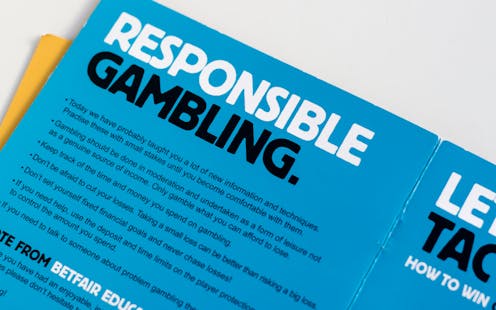
The regulatory framework that in large part allows this to occur is known as “responsible gambling”.
Read more: Whatever happens to Star, the age of unfettered gambling revenue for casinos may have ended[4]
What is ‘responsible gambling’?
Gambling operators usually adhere to a system of purported harm minimisation known as responsible gambling.
In practice, this requires gambling operators to adopt and supposedly implement a “responsible gambling code of practice[5]”.
This is supposed to protect people from experiencing gambling harm. Crown and Star, like other gambling venues, are required to adopt such codes.
Royal Commissioner Ray Finkelstein, overseeing the Victorian Crown inquiry, was scathing in his assessment[6] of Crown’s implementation:
Crown Melbourne had for years held itself out as having a world’s best approach to problem gambling. Nothing can be further from the truth.
Unfortunately, Finkelstein’ comments about Crown could readily be made about most other gambling operators.
How it all began
The responsible gambling framework was developed by gambling operators as a way of deflecting attention from the serious harm of gambling.
The document that arguably consolidated this[7] was prepared in 2004 by a group of gambling researchers gathered, naturally, in Reno, Nevada (close to Las Vegas, the spiritual home of gambling excesses).
This document argued[8] the choice to gamble should be left to people and no external organisation should interfere with this.
Now, responsible gambling is cemented in law, regulation, and practice. It is the overwhelming frame for gambling operators, governments and regulators to conceal gambling’s downside.
Stacking the odds
Responsible gambling depicts gambling harm as an issue for a small minority of people: so-called problem gamblers.
So from this perspective, any issues with gambling are issues with people.
But little if any attention is devoted to the environment in which gambling is available. Often, even less is devoted to examining the nature of gambling products.
When it comes to wagering marketing[9], the Australian gambling ecosystem has argued very effectively to forestall prohibition[10] or further regulation[11] in recent years.
The far-reaching power of this conglomeration of self-interested actors is hard to overestimate.
Read more: Will the government's online gambling advertising legislation ever eventuate? Don't bet on it[12]
At venue level, responsible gambling interventions required include signage, referral to counselling and mottos such as “gamble responsibly”.
With few exceptions, little of this is evidence based[13]. Almost none of it is effective.
Codes of conduct, for example, argue it is possible to intervene at a venue when a gambler shows signs of distress, or has a gambling disorder. While this is theoretically possible[14], the problem is to do so would rob venue operators of their most lucrative customers.
The available evidence[15] indicates such interventions are extremely rare[16], or nonexistent[17].
Another major element is self-exclusion: an opportunity for people (or in some states their relatives) to ban themselves from gambling at particular venues.
This is, again, fine in theory. But it has generally been poorly enforced at “bricks and mortar” venues.
There are two fundamental issues with this approach:
- those who self-exclude are very much in the minority of those with gambling problems
- self-exclusion is generally undertaken only by those who are at rock-bottom. It is not a preventive approach.
The other major intervention in the responsible gambling coda is treatment.
Gambling treatment services are available and free via Gamblers Help[18] but fewer than 10%[19] of those who might benefit from treatment actually seek it.
Unfortunately, attrition rates for counselling are high, so both the lack of help-seeking and the attrition rates when help is sought are at least partially attributable to another side effect of the responsible gambling mantra: shame and stigma[20], which are[21] commonly reported by those struggling with gambling disorders.
The blame game
Responsible gambling effectively blames people for getting into trouble.
It argues problem gamblers are far outnumbered by “responsible gamblers”, and deflects attention away from the highly addictive nature of many gambling products.
It largely absolves operators of responsibility, while maintaining their revenues and stigmatising those who bear the consequences.
As it does all this, it also provides a smokescreen of concern, a suggestion that gambling operators and governments care about gambling harm.
Ideas for the future
The best way to curb gambling harm is to view it as a public health problem.
Public health is generally focused on prevention (think vaccines and clean water). At this stage, the most likely effective preventive intervention is what is known as pre-commitment, which uses technology to allow people to determine the amount of money they want to gamble.
High-intensity gambling products rely on people becoming highly immersed in the product. Gamblers call this “the zone” – which limits or negates a person’s ability to make rational decisions.[22]
But pre-commitment systems allow this choice to be made outside of “the zone”.
Unsurprisingly, few gambling operators[23] support such a solution[24], even though these systems are now commonplace in many European countries[25].
Pre-commitment and cashless systems are now required for casinos in NSW and Victoria, and shortly in Queensland, as recommended by the Crown and Star inquiries.
These are welcome steps but much more is needed.
A long overdue change
Responsible gambling has allowed gambling operators to self-regulate and blame people for harmful gambling practices.
It has made gambling businesses – casinos, wagering companies, pokie pubs and clubs – extraordinary profitable. But this has come at considerable cost to hundreds of thousands of Australians, and their families and friends.
Ditching the responsible gambling mantra is long overdue. Along with effective interventions to prevent harm, doing so will dramatically reduce the damage that gambling does.
References
- ^ royal commissions (rccol.archive.royalcommission.vic.gov.au)
- ^ inquiries (theconversation.com)
- ^ found widespread evidence (rccol.archive.royalcommission.vic.gov.au)
- ^ Whatever happens to Star, the age of unfettered gambling revenue for casinos may have ended (theconversation.com)
- ^ responsible gambling code of practice (www.publications.qld.gov.au)
- ^ scathing in his assessment (www.smh.com.au)
- ^ arguably consolidated this (pubmed.ncbi.nlm.nih.gov)
- ^ This document argued (www.crikey.com.au)
- ^ wagering marketing (theconversation.com)
- ^ forestall prohibition (www.smh.com.au)
- ^ further regulation (www.brisbanetimes.com.au)
- ^ Will the government's online gambling advertising legislation ever eventuate? Don't bet on it (theconversation.com)
- ^ little of this is evidence based (anzsog.edu.au)
- ^ theoretically possible (www.gamblingresearch.org.au)
- ^ available evidence (www.sciencedirect.com)
- ^ extremely rare (harmreductionjournal.biomedcentral.com)
- ^ nonexistent (www.abc.net.au)
- ^ Gamblers Help (www.gamblinghelponline.org.au)
- ^ fewer than 10% (www.addiction.rutgers.edu)
- ^ stigma (pmc.ncbi.nlm.nih.gov)
- ^ which are (www.thelancet.com)
- ^ make rational decisions. (doi.org)
- ^ gambling operators (www.abc.net.au)
- ^ support such a solution (www.smh.com.au)
- ^ European countries (harmreductionjournal.biomedcentral.com)
Authors: Charles Livingstone, Associate Professor, School of Public Health and Preventive Medicine, Monash University