Fresh details emerge on Australia’s new climate migration visa for Tuvalu residents. An expert explains
- Written by: Jane McAdam, Scientia Professor and ARC Laureate Fellow, Kaldor Centre for International Refugee Law, UNSW Sydney
The details[1] of a new visa enabling Tuvaluan citizens to permanently migrate to Australia were released this week.
The visa was created as part of a bilateral treaty[2] Australia and Tuvalu signed in late 2023, which aims to protect the two countries’ shared interests in security, prosperity and stability, especially given the “existential threat posed by climate change”.
The Australia–Tuvalu Falepili Union, as it is known, is the world’s first[3] bilateral agreement to create a special visa like this in the context of climate change.
Here’s what we know so far about why this special visa exists and how it will work.

Why is this migration avenue important?
The impacts of climate change are already contributing[5] to displacement and migration around the world.
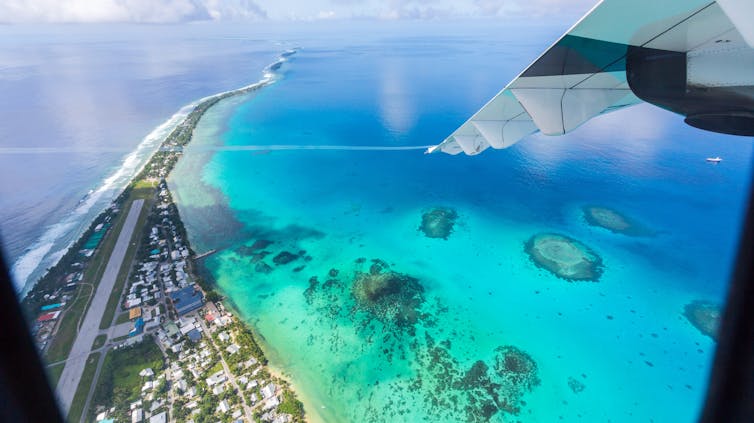
As a low-lying atoll nation, Tuvalu is particularly exposed[6] to rising sea levels, storm surges and coastal erosion.
As Pacific leaders declared[7] in a world-first regional framework on climate mobility in 2023, rights-based migration can “help people to move safely and on their own terms in the context of climate change.”
And enhanced migration opportunities have clearly made a huge difference to development challenges in the Pacific, allowing people to access education and work and send money back home.
As international development expert Professor Stephen Howes[8] put[9] it,
Countries with greater migration opportunities in the Pacific generally do better.
While Australia has a history of labour mobility schemes for Pacific peoples, this won’t provide opportunities for everyone.
Despite perennial calls for migration or relocation opportunities in the face of climate change, this is the first Australian visa to respond.

How does the new visa work?
The visa will enable[11] up to 280 people from Tuvalu to move to Australia each year.
On arrival in Australia, visa holders will receive, among other things, immediate access to:
- education (at the same subsidisation as Australian citizens)
- Medicare
- the National Disability Insurance Scheme (NDIS)
- family tax benefit
- childcare subsidy
- youth allowance.
They will also have “freedom for unlimited travel” to and from Australia.
This is rare. Normally, unlimited travel is capped at five years[12].
According to some experts[13], these arrangements now mean Tuvalu has the “second closest migration relationship with Australia after New Zealand”.
Reading the fine print
The technical name[14] of the visa is Subclass 192 (Pacific Engagement).
The details[15] of the visa, released this week, reveal some curiosities.
First, it has been incorporated into the existing Pacific Engagement Visa[16] category (subclass 192) rather than designed as a standalone visa.
Presumably, this was a pragmatic decision to expedite its creation and overcome the significant costs of establishing a wholly new visa category.
But unlike the Pacific Engagement Visa[17] – a different, earlier visa, which is contingent on applicants having a job offer in Australia – this new visa is not employment-dependent.
Secondly, the new visa does not specifically mention Tuvalu.
This would make it simpler to extend it to other Pacific countries in the future.
Who can apply, and how?
To apply, eligible people must first register their interest for the visa online. Then, they must be selected through a random computer ballot to apply.
The primary applicant must:
- be at least 18 years of age
- hold a Tuvaluan passport, and
- have been born in Tuvalu – or had a parent or a grandparent born there.
People with New Zealand citizenship cannot apply. Nor can anyone whose Tuvaluan citizenship was obtained through investment in the country.
This indicates the underlying humanitarian nature of the visa; people with comparable opportunities in New Zealand or elsewhere are ineligible to apply for it.
Applicants must also satisfy certain health and character requirements.
Strikingly, the visa is open to those “with disabilities, special needs and chronic health conditions”. This is often a bar[18] to acquiring an Australian visa.
And the new visa isn’t contingent on people showing they face risks from the adverse impacts of climate change and disasters, even though climate change formed the backdrop to the scheme’s creation.
 Climate change formed the backdrop to the visa scheme’s creation.
AAP Image/Mick Tsikas[19]
Climate change formed the backdrop to the visa scheme’s creation.
AAP Image/Mick Tsikas[19]
Settlement support is crucial
With the first visa holders expected to arrive later this year, questions remain about how well supported they will be.
The Explanatory Memorandum[20] to the treaty says:
Australia would provide support for applicants to find work and to the growing Tuvaluan diaspora in Australia to maintain connection to culture and improve settlement outcomes.
That’s promising, but it’s not yet clear how this will be done.
A heavy burden[21] often falls on diaspora communities to assist newcomers.
For this scheme to work, there must be government investment over the immediate and longer-term to give people the best prospects of thriving.
Drawing on experiences from refugee settlement, and from comparative experiences in New Zealand with respect to Pacific communities, will be instructive.
Extensive and ongoing community consultation is also needed with Tuvalu and with the Tuvalu diaspora in Australia. This includes involving these communities in reviewing the scheme over time.
References
- ^ details (classic.austlii.edu.au)
- ^ bilateral treaty (www.dfat.gov.au)
- ^ world’s first (theconversation.com)
- ^ AAP Image/Lukas Coch (photos.aap.com.au)
- ^ contributing (www.unsw.edu.au)
- ^ exposed (www.sprep.org)
- ^ declared (forumsec.org)
- ^ Professor Stephen Howes (iceds.anu.edu.au)
- ^ put (devpolicy.org)
- ^ maloff/Shutterstock (www.shutterstock.com)
- ^ enable (www.dfat.gov.au)
- ^ five years (immi.homeaffairs.gov.au)
- ^ some experts (devpolicy.org)
- ^ technical name (classic.austlii.edu.au)
- ^ details (classic.austlii.edu.au)
- ^ Pacific Engagement Visa (immi.homeaffairs.gov.au)
- ^ Pacific Engagement Visa (www.dfat.gov.au)
- ^ bar (neda.org.au)
- ^ AAP Image/Mick Tsikas (photos.aap.com.au)
- ^ Explanatory Memorandum (www.dfat.gov.au)
- ^ burden (www.internationalaffairs.org.au)
Authors: Jane McAdam, Scientia Professor and ARC Laureate Fellow, Kaldor Centre for International Refugee Law, UNSW Sydney