Elon Musk thinks the US should leave the UN – what if Trump does it?
- Written by: Chris Ogden, Associate Professor in Global Studies, University of Auckland, Waipapa Taumata Rau
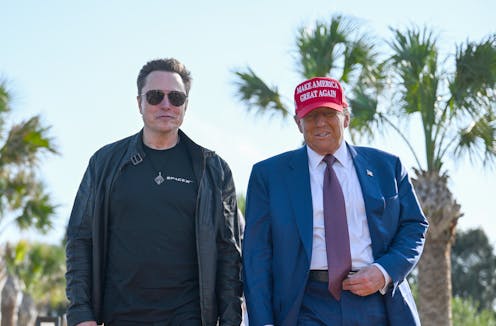
When Donald Trump’s benefactor and cost-cutter-in-chief Elon Musk recently supported[1] a call for the United States to quit NATO and the United Nations, it should perhaps have been more surprising.
But the first months of the second Trump presidency have already seen key parts of the current international order undermined. Musk’s position fits a general pattern.
Aside from the tilt towards a multipolar world order[2], the US now refuses to recognise the International Criminal Court[3], has slashed its foreign aid contributions[4], and has withdrawn from[5] the World Health Organization, the UN Human Rights Council and the Palestinian relief agency UNRWA.
With Trump’s domestic politics displaying a clear autocratic edge[6], the rejection of the founding principles and ideals of the UN comes into sharper relief. The intolerant and impatient negotiating approach he displayed with Ukraine’s President Volodymyr Zelensky[7] also belies a disregard for cooperative and consensus-based diplomacy.
The drive to slash the federal deficit dovetails with this general abandonment of expensive international commitments. If the Trump regime follows through on its apparent strategy of manufacturing crises to advance its agenda[8], then leaving the UN entirely is a logical next step.
Undermined ideals
This is all in stark contrast to the central role the UN has traditionally played within the US-led international order since 1945.
Along with other institutions, the UN allowed the US to shape the international system in its own image and spread its domestic values and interests across the world. Along with NATO, the UN was designed as a global security institution to produce global stability.
In theory at least, the political and economic values of the US and other democracies enabled the construction of the postwar order. According to political scientist John Ikenberry[9], this was based on “multilateralism, alliance partnerships, strategic restraint, cooperative security, and institutional and rule-based relationships”.
But by the 21st century, US actions had undermined many of these principles. The US-led invasion of Iraq in 2003 bypassed the authority of the UN, causing then secretary-general Kofi Annan to declare that “from the charter point of view [the invasion] was illegal[10]”.
This undermined the legitimacy of the UN and America’s place within it. But it also diminished the organisation as a force for maintaining international security and national sovereignty in global affairs.
The subsequent human rights violations[11] by the US through its use of rendition, torture and detention at facilities such as Guantanamo Bay and Abu Ghraib further weakened the UN’s credibility as a protector of liberal international values.
The US has also been a regular non-payer of UN fees, owing US$2.8 billion[12] in early 2025. And it is one of the lowest contribtuors of military and police personnel[13] to UN peacekeeping operations, despite paying nearly 27% of the overall budget[14].
US versus UN
Since the 1990s, several Republican politicians have argued for the US to withdraw entirely from the UN. In 1997, senator Ron Paul introduced the American Sovereignty Restoration Act[15], aimed at ending UN membership, expelling the UN headquarters from New York and ending US funding.
Although it received minimal support and never reached committee hearings, Paul reintroduced the act in every congressional session until his 2011 retirement. It was then taken up by other Republicans, including Paul Broun and Mike Rogers.
In December 2023, senator Mike Lee and representative Chip Roy led the introduction of the “Disengaging Entirely from the United Nations Debacle (DEFUND) Act[16]”.
Roy referenced the perceived negative treatment of Israel, the promotion of China, “the propagation of climate hysteria[17]” and the US$12.5 billion in annual payments. Lee added[18]:
Americans’ hard-earned dollars have been funnelled into initiatives that fly in the face of our values – enabling tyrants, betraying allies, and spreading bigotry.
Public polling in 2024 also showed only 52% of Americans had a favourable view of the UN[19]. This opposition has deeper historical roots, too.
In 1920, US isolationists blocked the ratification of the Treaty of Versailles, and with it US participation in the League of Nations (the predecessor to the United Nations). Although the US would interact with the League of Nations until the UN’s formation in 1945, it never became an official member.
Criticism of the UN also has a bipartisan angle, with the US withdrawing funding of UNRWA in 2024 during Joe Biden’s presidency after Israel accused the agency of links to Hamas[20].
A diminished UN
If Trump harnesses these historical and modern forces to pull the US out of the UN, it would fundamentally – and likely irrevocably – undermine what has been a central pillar of the current international order.
It would also increase US isolationism, reduce Western influence, and legitimise alternative security bodies. These include the Shanghai Cooperation Organisation[21], which the US could potentially join, especially given Russia and India are both members.
More broadly, the reduced influence of the UN will endanger general peace and security in the international sphere, and the wider protection and promotion of human rights.
There would be greater unpredictability in global affairs, and the world would be a more dangerous place. For countries big and small, a UN without the US will force new strategic calculations and create new alliances and blocs, as the world leaps into the unknown.
References
- ^ Elon Musk recently supported (www.huffpost.com)
- ^ tilt towards a multipolar world order (theconversation.com)
- ^ refuses to recognise the International Criminal Court (www.bbc.com)
- ^ slashed its foreign aid contributions (apnews.com)
- ^ withdrawn from (www.whitehouse.gov)
- ^ displaying a clear autocratic edge (theconversation.com)
- ^ displayed with Ukraine’s President Volodymyr Zelensky (www.npr.org)
- ^ manufacturing crises to advance its agenda (theconversation.com)
- ^ According to political scientist John Ikenberry (press.princeton.edu)
- ^ from the charter point of view [the invasion] was illegal (www.theguardian.com)
- ^ subsequent human rights violations (www.aclu.org)
- ^ owing US$2.8 billion (www.globaltimes.cn)
- ^ lowest contribtuors of military and police personnel (peacekeeping.un.org)
- ^ nearly 27% of the overall budget (peacekeeping.un.org)
- ^ American Sovereignty Restoration Act (www.congress.gov)
- ^ Disengaging Entirely from the United Nations Debacle (DEFUND) Act (www.lee.senate.gov)
- ^ the propagation of climate hysteria (roy.house.gov)
- ^ Lee added (roy.house.gov)
- ^ 52% of Americans had a favourable view of the UN (www.deseret.com)
- ^ Israel accused the agency of links to Hamas (www.reuters.com)
- ^ Shanghai Cooperation Organisation (eng.sectsco.org)
Authors: Chris Ogden, Associate Professor in Global Studies, University of Auckland, Waipapa Taumata Rau
Read more https://theconversation.com/elon-musk-thinks-the-us-should-leave-the-un-what-if-trump-does-it-251483