China has invested billions in ports around the world. This is why the West is so concerned
- Written by: Claudio Bozzi, Lecturer in Law, Deakin University
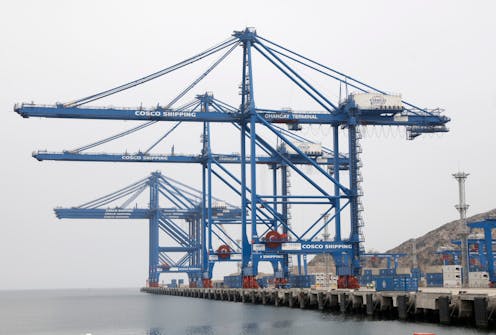
On his way to the G20 summit in Rio de Janeiro in November, Chinese President Xi Jinping met with Peruvian President Dina Boluarte to officially open[1] a new US$3.6 billion (A$5.8 billion) deepwater mega-port in Peru called Chancay.
China’s state-owned Cosco shipping giant had purchased[2] a 60% stake in the port for US$1.6 billion (A$2.6 billion), which gave the company exclusive use of the port for 60 years.
Days later, the first ship departed[3] for Shanghai loaded with blueberries, avocados and minerals.
Chancay is part of China’s vision of a 21st century maritime Silk Road that will better connect China’s manufacturing hubs with its trading partners around the world. This has involved a heavy investment in ports in many countries, which has the West concerned about China’s expanding influence over global shipping routes.
Newly re-elected US President Donald Trump made clear these concerns when he claimed China was “operating[4]” the Panama Canal and the US intended to take it back[5].
China does not operate the canal, though. Rather, a Hong Kong company operates two ports on either side of it.
A booming port expansion
The scale and scope of the maritime Silk Road is impressive. China has invested[6] in 129 ports in dozens of countries through its state-owned enterprises, mostly in the Global South[7]. Seventeen of these ports have majority-Chinese ownership.
According to one estimate, Chinese companies invested[8] US$11 billion (A$17.7 billion) in overseas port development from 2010–19. More than 27% of global container trade now passes through[9] terminals where leading Chinese firms hold direct stakes.
China has entered Latin America aggressively, becoming the region’s top trading partner[10]. Its port strategy has clearly signalled a long-term goal to access the exports essential to its food and energy security: soybeans, corn, beef, iron ore, copper and battery-grade lithium.
Last year, for example, Portos do Paraná, the Brazilian state-owned enterprise that acts as the port authority in the state of Paraná, signed a letter of intent[11] with China Merchants Port Holdings[12] to expand Paranaguá Container Terminal, the second-largest terminal in South America. China may invest in even more Brazilian ports, as 22 terminals are scheduled[13] to be auctioned before the end of 2025.
In Africa, Chinese investment grew from[14] two ports in 2000 to 61 facilities in 30 countries by 2022[15].
And in Europe, Chinese enterprises have complete or majority ownership[16] of two key ports in Belgium and Greece – the so-called “dragon’s head[17]” of the Belt and Road Initiative in Europe.
What’s driving this port strategy?
China’s emergence as a maritime and shipping power[18] is central to Xi’s ambition for global economic dominance.
For one, China requires stable access to key trading routes to continue meeting the demand for Chinese exports globally, as well as the imports Beijing needs to keep its economy humming.
Controlling ports also enables China to create economic zones[19] in other countries that give port owners and operators privileged access to commodities and products. Some fear this could allow China to disrupt supplies of certain goods or even exert influence over other countries’ politics or economies[20].
Another key driver of this strategy is the metals and minerals needed to fuel China’s rise as a tech superpower. Beijing has concentrated its port investment in regions where these critical resources are located.
For example, China is the world’s largest importer[21] of copper ore, mainly from Chile, Peru and Mexico. It is also one of the world’s major lithium carbonate importers[22].), mainly from Chile and Argentina. And its port deals in Africa give it access to rare earths and other minerals.
In addition, tapping into Latin America counteracts the trade tensions China has experienced recently with Europe. It also preempts concerns about possible US tariffs imposed on Chinese goods by Trump.
Military concerns
These moves have prompted concern in Washington that China is challenging US influence in its own backyard[23].
China maintains that its seaport diplomacy is market oriented. However, it has established one naval base in the strategically located African nation of Djibouti. And it is believed to be building another naval base in Equatorial Guinea[24].
According to a recent report by the Asia Society Policy Institute, strategy analysts believe China is seeking to “weaponise[25]” the Belt and Road Initiative.
One way it is doing this is by requiring the commercial ports it invests in to be equally capable of acting as naval bases[26]. So far, 14 of the 17 ports[27] in which it has a majority stake have the potential to be used for naval purposes. These ports can then serve a dual function and support the Chinese military’s logistics network and allow Chinese naval vessels to operate further away from home.
US officials are also concerned China could leverage its influence[28] over private companies to disrupt trade during a time of war.
How is the West responding?
While China’s investments are raising suspicions, the West’s willingness to invest in ports at this scale is limited. The US International Development Finance Corporation[29], for instance, has a much slower, rigorous process for its investments, which generally leads to fairer outcomes for both investors and host nations.
However, some Western companies are acquiring stakes in established and newly built ports in other countries, albeit not to the extent of Chinese enterprises.
The French shipping and logistics company CMA CGM’s global port development strategy, for example, includes investments in 60 terminals worldwide[30]. In 2024, it acquired control[31] over South America’s largest container terminal in the Port of Santos, Brazil.
Trump has threatened tariffs as one way of countering China’s global sea power. An advisor on his transition team has proposed[32] a 60% tariff on any product transiting through the Chancay port in Peru or any other Chinese-owned or controlled port in South America.
Rather than making nations reluctant to sign port deals with Beijing, however, this kind of action just erodes Washington’s regional influence. And China is likely to take retaliatory measures, like banning the export of critical minerals[33] to the US.
Host nations like Peru and Brazil, meanwhile, are using the competition for port investment to their advantage. Attracting interest from both the West and China, they are increasingly asserting their autonomy and adopting a strategy of using ports to “play everywhere” on the global stage.
References
- ^ officially open (www.reuters.com)
- ^ purchased (www.lowyinstitute.org)
- ^ departed (english.www.gov.cn)
- ^ operating (www.nytimes.com)
- ^ take it back (www.bbc.com)
- ^ invested (www.cfr.org)
- ^ Global South (carnegieendowment.org)
- ^ invested (chinapower.csis.org)
- ^ passes through (www.wsj.com)
- ^ becoming the region’s top trading partner (www.cfr.org)
- ^ signed a letter of intent (www.lloydslist.com)
- ^ China Merchants Port Holdings (www.cmport.com.hk)
- ^ scheduled (container-news.com)
- ^ grew from (container-news.com)
- ^ 61 facilities in 30 countries by 2022 (www.nbr.org)
- ^ complete or majority ownership (www.europarl.europa.eu)
- ^ dragon’s head (rosalux.gr)
- ^ maritime and shipping power (www.csis.org)
- ^ economic zones (www.chinadaily.com.cn)
- ^ politics or economies (www.uscc.gov)
- ^ largest importer (wits.worldbank.org)
- ^ lithium carbonate importers (wits.worldbank.org)
- ^ backyard (www.cfr.org)
- ^ Equatorial Guinea (maritime-executive.com)
- ^ weaponise (asiasociety.org)
- ^ naval bases (foreignpolicy.com)
- ^ 14 of the 17 ports (www.cfr.org)
- ^ leverage its influence (www.nytimes.com)
- ^ US International Development Finance Corporation (www.dfc.gov)
- ^ 60 terminals worldwide (gcaptain.com)
- ^ acquired control (www.reuters.com)
- ^ proposed (www.americaeconomia.com)
- ^ export of critical minerals (www.reuters.com)
Authors: Claudio Bozzi, Lecturer in Law, Deakin University