how Australians kept cool in heatwaves before modern technology
- Written by: Mandy Paul, Visiting Research Fellow, School of Humanities, University of Adelaide
The Black Friday bushfires[1] which swept across southeastern Australia in January 1939 have been remembered as a deadly and traumatic event.
Most human deaths, however, occurred during the preceding heatwave – 78 lives were lost to bushfires in mainland southeastern Australia but at least 420 people died as a result[2] of the high temperatures during the preceding week.
Globally, heatwaves still remain one of the deadliest natural hazards[3].
Our research examines how people in the past understood and adapted to extreme weather — without the contemporary comforts of airconditioning and refrigeration.
The fortnight when Adelaide sweltered
Adelaide is the most heatwave affected capital city in Australia[4].
In the first fortnight of 1939, the city endured 13 days of temperatures exceeding 34°C. January 12 was Adelaide’s hottest day since records began: 46.1°C (recorded at the time[5] as 117.7°F) — a record that stood until 2019.
Record highs were also recorded across the southeastern states.
Diaries, press reports and oral history accounts reveal how Adelaidians coped with the heat.
Noel Weller, who lived on a suburban block in Glandore with his wife and two children, kept a daily diary[6]. On January 12, 1939 he wrote:
117.7% A Record Hot Temperature day. I went to work in shirt sleeves. Lil & Peace Tenell who are on holiday came to tea & had shower & so did I morn(ing), night & before bed. We had Ice Blocks & Cool drinks on the front lawn & Chook & Doris came & all left at 11.15. WE ALL SLEPT OUTSIDE on the back lawn.
Like most households, the Wellers relied on an icebox to keep their food and drinks cool. Demand for ice, and prices, soared during the heatwave, and supply ran short, made worse by a mechanical failure at the government ice works.
By January 13, the situation was so dire the police had to manage crowds at some suburban ice depots.
General Motors Holden’s at Woodville was among the industrial workplaces that shortened shifts in response to the heat; others declared holidays to give workers a chance to recover.
Manufacturers of ice cream and cold drinks were extending hours and taking on casual staff to meet unprecedented demand.
How people tried to beat the heat
During this week, a small fashion war was being waged in the press.
Advocates for attire more suited to the climate ridiculed businessmen who determinedly wore suits and ties. Others hailed “courageous” young men[7] for wearing shorts to work.
Women, meanwhile, were advised to wear sandals and go without gloves.
Florence Bond, a well-connected expat visiting from England, wrote[8] of her difficulty sleeping in the heat. She attempted to sleep on a cane lounge in the garden with her dogs – it was an uncomfortable night, disturbed by hot winds and insects.
As the heatwave unfolded, she despaired that a good sleep would be “impossible.”
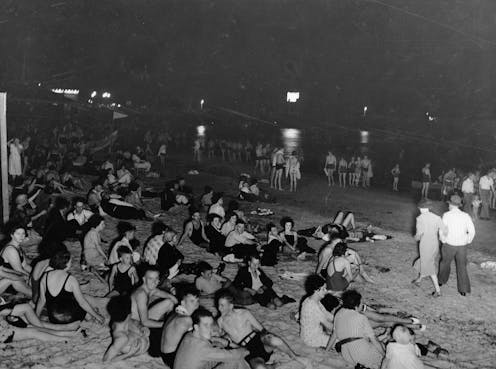
Those without verandas or gardens slept in Adelaide’s public squares and beaches.
Irene Ingram lived in the closely-packed row cottages of Adelaide’s East End in the 1930s with her husband and son. Interviewed in 2000, she vividly recalled[9] sleeping outdoors to escape the heat of the house:
We used to have heat in those days, (one) hundred and ten, hundred and 12, hundred and fourteen (degrees) every day – that’d go on for two weeks. We used to sleep down in Hurtle Square, bring our blanket and a pillow down there, because the little houses we lived in were just so hot. Oh it was great fun; we used to think it was great. Everyone was down there.
The newspapers reported Adelaide’s beaches were crowded as thousands slept on the sand, taking the opportunity to start the next day with a reviving swim.

Some tragic consequences
Hospitals, meanwhile, were facing a rise in heat-related admissions.
Some doctors broke ranks[11] to describe the conditions in some wards of Adelaide Hospital as “a reproach to the main hospital of a capital city”, pointing out the heat in some wards was affecting patients admitted for unrelated conditions.
What wasn’t publicly known until after the event was the death toll. A government statist reported[12] that heat caused 64 deaths in January 1939 across South Australia and was a contributing factor in another 68.
Our detailed study (yet to be published) of death certificates reveals a slightly higher figure for the metropolitan area: 68 deaths for which heat was the only or a primary cause.
Most vulnerable were the very young and the old: two thirds of deaths were people older than 60, with a high proportion in psychiatric, aged or residential care.
Modern solutions
Since 1939, social and technological changes have transformed how Australians live – refrigerators are widespread, as is airconditioning in homes and public buildings.
In 2025, people may not choose to sleep outdoors but other strategies to manage heat remain relevant: using natural ventilation, taking rest, and wearing lightweight, loose-fitting clothing.
Noel Weller and his family visited and entertained friends and family throughout the heatwave, sharing ice cream and soft drinks in the cool of the evening.
Staying socially connected during extreme weather means others can keep an eye out for your welfare – and is as important now as it was in 1939.
References
- ^ Black Friday bushfires (knowledge.aidr.org.au)
- ^ 420 people died as a result (doi.org)
- ^ deadliest natural hazards (www.who.int)
- ^ heatwave affected capital city in Australia (researchportalplus.anu.edu.au)
- ^ recorded at the time (doi.org)
- ^ daily diary (www.catalog.slsa.sa.gov.au)
- ^ “courageous” young men (trove.nla.gov.au)
- ^ wrote (catalogue.nla.gov.au)
- ^ vividly recalled (www.cityofadelaide.com.au)
- ^ Aussie mobs/Flickr (www.flickr.com)
- ^ broke ranks (trove.nla.gov.au)
- ^ reported (trove.nla.gov.au)
Authors: Mandy Paul, Visiting Research Fellow, School of Humanities, University of Adelaide