Is Australian English under threat from the Americans? It’s not as simple as you might think
- Written by: Howard Manns, Senior Lecturer in Linguistics, Monash University
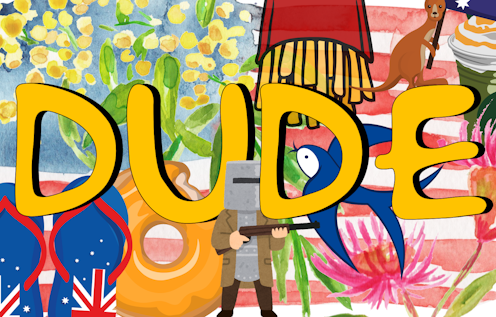
Dudes, dudines and dudettes of Australia, we need to talk about border security. Our long-time frenemies – the Americans (hey bae!) – seem to be taking over our English.
For many Aussies, our linguistic border security is a matter of cultural and national urgency. But are we any good at policing our linguistic ramparts? And how long has this been going on, anyway?
History: from great mate to ‘noxious’ trait
Long before submarines and supersized fast food, our cultural and linguistic relationship with the US was fairly uncontroversial.
In the 19th century, no-one was raising the alarm[1] about Australian identity being steamrolled. True, we were finding our own cultural feet, and some were critical of Australian English, particularly its accent, comparing for example “familiar atrocities amongst young Australians” and “the Yankee twang”. But there was no sense these Australian “atrocities” were American-made.
So, when did commentary around American influence become negative?
Undesirable aspects of a language are typically the fallout of shifts in social dynamics. In Australia, this coincided with nation-building and the forging of a national culture. Aussies grew nervous at the idea of American culture barging in.
This fear grew worse as American cultural products began to weave themselves into the fabric of Australian life. As documented by historian Joy Damousi in Colonial Voices[2], this seems to have taken off with the arrival of “talking pictures”.
In June 1930, a piece in the Sydney Morning Herald noted:
It must be already apparent to many thinking people that since the introduction of the American talking films […] we are in grave danger of the Americanisation of our speech […] I do hope that this matter will be taken up by all those possessing the true Australian spirit, and help to save their country from this wholesale invasion and exploitation by a foreign power.
This Aussie spirit remains strong if the emails we get are anything to go by. Vehement objections are made to “American infiltration into our lingo” and “annoying American habits […] spreading to Australia”.
A little bit of this and a little bit of that …
You’d think the need to “save” our country from “wholesale invasion and exploitation” would make us vigilant.
And yet, our radar has always been a little too finely tuned – and at times, completely miscalibrated. Many named “Americanisms”, it turns out, are not in fact American at all, and it’s always been that way. Here’s explorer and naturalist Isabella Bird describing[3] in 1877 the tendency in Australia to
adopt words which are rather American than English in their use. Thus a coach is a stage; a pair of horses, a span or team; a light trap of any kind, a buggy; light impediment, a swag; a wagon, a dray; a mounted policeman, a trooper.
Only “span” in this list is American English (though the Brits were spanning horses and oxen back in the 1500s).
On July 14 1936, The Sydney Telegraph declared[4]:
much of the slang called Australian is really imported from the United States.
And yet, of the 31 American expressions listed, only “biff”, “bluff”, “boss”, “to chip in”, “to turn down”, “hitched” (married) and “tough” (luck) are American in origin — all the rest are either English or Australian.
Read more: Get yer hand off it, mate, Australian slang is not dying[5]
More recently, Australian journalist Andrew Herrick decried[6] the use of American words like “sandbox”, “mugging” and “rush hour”. “Sandbox” and “mugging” were originally British words (appearing in the 16th and 19th centuries respectively). “Rush hour” (instead of “peak hour”) has been used by some people in Australia since the early 1900s.
Yet, despite our overly sensitive radar, thousands of American expressions have in fact snuck in over the years without detection – arriving on the goldfields, through war, and via American entertainment.
Early arrivals include everyday terms such as “cinch”, “crack down on”, “lay off” (to dismiss a worker), “okay”, “block” (subdivisions of land), “state” (main regional sectors) — even terms we now think of as classic Australianisms, such as “bonzer” (very good) (from US “bonanza”), “digger” (originally a miner), “bushranger”, “squatter”.
Have we got our knickers in a twist over nothing?
This confusion isn’t limited to our beloved Aussie lexicon. Spelling, pronunciation and grammar routinely show up in the crosshairs of complainants today.
But again, American influence isn’t clear-cut. Sure, American lexicographer Noah Webster rejected spellings such as -ise. But British usage accepts both -ize and the more French-looking -ise. In fact, -ize spellings are preferred by some authoritative British sources including The Oxford English Dictionary.
The Age newspaper used -or spellings in words such as “color” from the start of its publication in 1854. As Sidney Baker pointed out[7] in 1945, this was not a convention inherited from America, and yet, it came to be seen as an endorsement of “American” -or spellings in place of English -our. In 2001, public pressure persuaded The Age to instate the -our spelling.
Complaints about pronunciation also highlight the complex and unclear role the US has played in Australian English developments. Take for example, this excerpt from an email we’ve received:
the annoying American habit of dropping the g off words ending in ing (ie walk'n talk'n etc).
So-called “g-dropping” has been a complex tug-of-love over many centuries. In the 19th century, one usage writer observed[8] that the “n” pronunciation was “extremely common in all parts of the empire”. It was once even posh. But “n” has now fallen out of favour – and blame falls squarely, if arbitrarily, on American English.
Though grammar usually flies under our (often miscalibrated) radar, we’d be remiss not to address this common complaint (again, from our email stock): “we even see the American "GOTTEN” metastasising into our media".
And, yet again, we see how complex the question of American influence is. Like “g-dropping”, choose a point in history and either “got” or “gotten” is the baddie.
“Gotten” is the older form (still found in “forgotten” and “ill-gotten”) and certainly the top choice in the earliest grammar books. Bishop Lowth’s influential Short Introduction to English Grammar (1762) describes[9] the modern favourite “got” as an “abuse has been long growing upon us”.
Current popular perception of course brands older “gotten” as American but, given Australia has always had vestiges of dialectal “gotten” users, it is again hard to assess the role of American English contact.
The linguistic border might be more secure than we think
So our linguistic border security is serious business. But US influence can be overstated. Maybe in the words of the Americans, we need to “chill out”.
Further, research[10] shows that if an Americanism does stick around it’s usually filling a niche. Take, for instance, the different terms we use for residential units in a housing block: “apartment”, “condominium” (both American), “flat” (British), “home unit” (Australian) – “flat” and “(home) unit” often imply simpler or smaller living spaces, while “condos” and “apartments” (especially “luxury”) can suggest more upscale accommodation.
When it comes to American influence, it would seem “our plates don’t beat” – to use long obscure bodgie slang, meaning “we don’t quite understand” as much as we think.
References
- ^ no-one was raising the alarm (books.google.com.au)
- ^ Colonial Voices (books.google.de)
- ^ describing (archive.org)
- ^ declared (doi.org)
- ^ Get yer hand off it, mate, Australian slang is not dying (theconversation.com)
- ^ decried (www.smh.com.au)
- ^ pointed out (archive.org)
- ^ observed (press.umich.edu)
- ^ describes (www.gutenberg.org)
- ^ research (researchers.mq.edu.au)
Authors: Howard Manns, Senior Lecturer in Linguistics, Monash University