Jimmy Carter’s idealism and humility left a lasting imprint on American life
- Written by: Jared Mondschein, Director of Research, US Studies Centre, University of Sydney
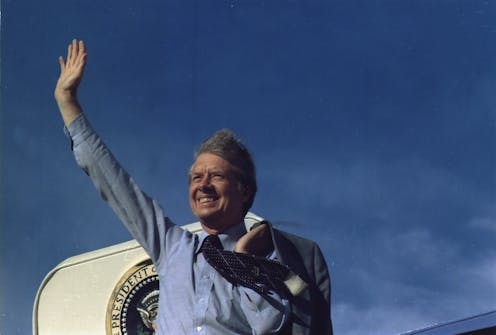
Former US president Jimmy Carter, a man defined by his humility and idealism, has died at 100.
Many US presidents come from modest upbringings. Born in Plains, Georgia, Jimmy Carter’s Depression-era childhood was no exception. His home lacked running water and electricity, while his rural high school lacked a 12th grade.
What made Carter exceptional was the degree to which these humble beginnings would influence his life, most notably his time as America’s 39th president from 1977-1981.
How a peanut farmer became president
A farmer, nuclear submarine officer, state governor and proud Christian, Carter assumed office during a tumultuous time in American history. Three crises in particular are not only widely credited with helping elect the former peanut farmer into the Oval Office, but also still influence how Americans think about American power and politicians half a century later.
The first crisis occurred in March 1973, when newscasts on living room TVs across the country displayed what appeared to be the previously undefined limits of American power: the chaotic – and some would say humiliating – US withdrawal from Vietnam.
The second crisis began in October 1973, when members of the Organisation of Arab Petroleum Exporting Countries (OPEC) imposed an embargo on oil exports to the United States. It caused the price of oil per barrel to quadruple, the US economy to shrink[1] by as much as 2.5%, and dramatic increases in unemployment and inflation.
The third and most prominent crisis, the Watergate scandal[2], forced President Richard Nixon to resign – the first presidential resignation in US history – amid considerable evidence that he committed crimes and abuses of power while in office. Nixon’s successor, and Carter’s Republican opponent in the 1976 presidential election, Gerald Ford, famously pardoned Nixon for any crimes he had committed in office.
The combination of Carter’s humility and idealism amid three major US crises – and his surprise victory in the early Democratic primary state of Iowa – created the unique conditions for a relatively unknown Georgia governor to win the 1976 election. His commitment to restore morality to the White House and US foreign policy, along with his campaign pledge[3] to never lie to the American people, was exactly what many Americans sought from their president after such a turbulent period.
The presidency, 1977-1981
Carter began his White House journey engulfed by existing crises but his time in office undoubtedly featured its own share of crises too. Historians continue to debate how much Carter was responsible for the challenges he faced in office. However, his public approval ratings[4] – 75% when he entered office in 1977 and 34% when he left office in 1981 – give an indication of where the American people placed their blame.
While early in his presidency much of the focus was on addressing the lingering energy crisis, Carter outlined his broader vision and policy agenda in his inaugural address[5] on January 20 1977.
Read more: Jimmy Carter, who died at 100, left a lasting Cold War legacy: His human rights focus helped dismantle the Soviet Union[6]
Carter first thanked outgoing President Ford for all that he had “done to heal our land” — a remarkable statement from a man who sharply criticised Ford’s pardon of Nixon. He went on to speak of “our recent mistakes”, the idea “if we despise our own government, we have no future”, and his hope for Americans to be “proud of their own government once again”.
Two years later, he echoed these sentiments in the most well-known speech[7] of his presidency. Amid yet another oil shock that led to long lines at petrol stations, high inflation and an economic recession, Carter’s televised address to the nation decried a “crisis of confidence” amid “growing doubt about the meaning of our own lives”.
It was this speech, which posited that “all the legislation in the world can’t fix what’s wrong with America”, combined with his firing of five cabinet members a few days later, that many now point to as a turning point for the Carter administration from which it would never fully recover.
Carter’s righteous criticism of the Nixon and Ford administrations had been refreshing to voters when he was an outsider candidate. But such moralising lost its appeal and some perceived it as an abdication of responsibility after Carter had occupied the office for more than two years.
Ted Kennedy, the Democratic senator from Massachusetts, would go on to criticise[8] Carter’s speech as one that dismissed “the golden promise that is America” and instead embraced a pessimistic vision in which Americans were “blamed for every national ill, scolded as greedy, wasteful and mired in malaise”.
Only four months after Carter’s infamous speech, yet another crisis erupted. Supporters of Iranian leader Ayatollah Khomeini took 52 US diplomats hostage in Iran. They would end up being held captive for the rest of Carter’s term in office while the US government’s failed rescue mission in April 1980 only worsened the situation.
Carter undoubtedly racked up foreign policy successes in his normalisation of ties with China and his facilitating of an unprecedented peace agreement between the Israeli and Egyptian governments, known as the Camp David Accords. Ultimately, however, the perception of him having a failed presidency[10] would be such a weight on his administration that Ted Kennedy chose to challenge Carter[11] for the 1980 Democratic presidential ticket.
Carter would end up defeating Kennedy for the Democratic nomination but the damage done to Carter’s presidency allowed a far more optimistic Ronald Reagan to win in a landslide victory over the sitting president in November 1980.
The lasting significance of Jimmy Carter
After the 56-year-old president failed to win a second term, Carter in many ways came to exemplify what a post-presidential life could entail. This included diplomatic and humanitarian efforts that would win him the 2002 Nobel Peace Prize[12] but also public commentary that would sometimes frustrate[13] his successors in the Oval Office.
From his own organisation’s work championing[14] human rights overseas to his commitment to building homes[15] with Habitat for Humanity, Carter’s staunch Christian faith and idealism continued to define his life.
Today, most Americans may take it as unremarkable for a US president to champion human rights, but Carter was the first US president to posit that human rights were central to US foreign policy. While human rights have not always remained central to the policies of his presidential successors, it has undoubtedly influenced them. This includes Ronald Reagan, who criticised Carter’s human rights emphasis during the 1980 presidential campaign but would later take a strong stance against Soviet human rights abuses.
Most living Americans were not yet born on Carter’s last day in office. As a result, the former president is perhaps best known for his rich post-presidential life based out of the small rural town in Georgia he was born in – and where his secret service detail’s armoured vehicles were worth more[17] than the home the former president lived in after departing the White House.
Regardless of whether they realise it or not, the humility, morality and idealism with which Jimmy Carter lived and governed continues to have an impact on Americans and American thinking to this day.
References
- ^ shrink (www.csis.org)
- ^ Watergate scandal (theconversation.com)
- ^ pledge (www.reuters.com)
- ^ public approval ratings (news.gallup.com)
- ^ inaugural address (avalon.law.yale.edu)
- ^ Jimmy Carter, who died at 100, left a lasting Cold War legacy: His human rights focus helped dismantle the Soviet Union (theconversation.com)
- ^ speech (www.c-span.org)
- ^ criticise (www.nytimes.com)
- ^ Wayne Perkins/AP (photos.aap.com.au)
- ^ failed presidency (www.brookings.edu)
- ^ challenge Carter (www.politico.com)
- ^ 2002 Nobel Peace Prize (www.nobelprize.org)
- ^ frustrate (www.reuters.com)
- ^ championing (www.cartercenter.org)
- ^ building homes (www.habitat.org)
- ^ John Amis (photos.aap.com.au)
- ^ worth more (www.washingtonpost.com)
Authors: Jared Mondschein, Director of Research, US Studies Centre, University of Sydney