


In the Bible, angels can be deadly. So why do we place them at the top of our Christmas trees?
- Written by: Robyn J. Whitaker, Associate Professor, New Testament & Director of the Wesley Centre, University of Divinity
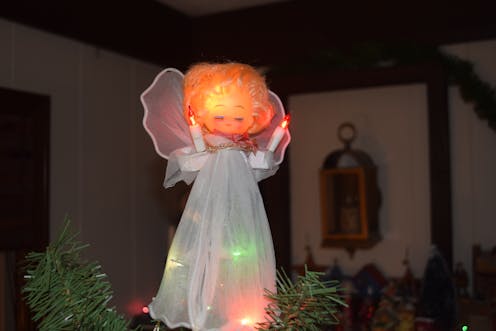
Those beautiful white and gold angels you see on Christmas trees were originally monsters. At least, that is the claim made by scholar Esther Hamori in her book God’s Monsters[1]. Hamori writes that angels “have acquired the soft-edged glow of a Hallmark card, but are some of the deadliest shapeshifters in a universe teeming with bizarre figures”.
Hamori, a scholar of the Jewish and Christian scriptures, demonstrates how angels in the biblical tradition destroy entire towns, unleash plagues, lead armies, and sometimes wield swords.
Biblical angels can be terrifying and monstrous. They appear covered in fire and can also cause fire. Their appearance is sometimes closer to that of a giant fiery, multi-winged serpent than anything human or cherubic. Even when they are more anthropomorphic in form, their faces might be bronzed or shining and their skin like gemstones, clues they transcend the normal created order.
The word angel (Greek: angelos; Hebrew: malach) simply means “messenger”. A messenger can be human, but angelos in the Bible usually refers to a messenger from another realm.
Other types of creatures grouped in the angel category include seraphs and cherubs. Seraphim are essentially burning creatures, probably serpents or dragons, that appear in Isaiah as six-winged heavenly creatures. Even cherubs – usually depicted today as chubby angel babies – did not start out that way.
In the first book of the Bible, Genesis, cherubs (cherubim) are warrior sentinels with fiery swords who guard the gate to the Garden of Eden and, later, the Ark of the Covenant.
There is not much physical description of them in the Bible, but we should not assume they are human-like or small. In one passage their wings span something like four metres (1 Kings 6)[2]; in another they are multi-faced creatures with wheels that move in all directions (Ezekiel[3]).
These biblical angels are so different from contemporary angel Christmas decorations, that numerous amusing memes have been spawned using anatomically “correct” biblical angels[4].
Conversely, angels in the Bible can also be bringers of life. They save life by leading people to food or water and protecting them from wild beasts or enemies. They issue messages from God, including declarations to women who have previously been unable to have children that they will now have a child. Mary, the mother of Jesus, is not the only woman in the Bible to have an encounter with an angel that leaves her pregnant.
As mediators and representatives of God, angelic creatures are capable of giving life or taking it. Perhaps this is why angels in the Bible spend a lot of time saying “do not fear” to terrified humans who are unsure whether angelic presence is going to bring life or death.
As beings who change shape, transverse realms, and exert incredible power, angels in the Bible function in a similar way to monsters in mythical stories and science fiction.
Why would we put such a creature on our Christmas tree? As usual, the answer is not always straightforward. For many, the angel at Christmas is a reminder of Gabriel, who visited Mary to announce she would bear a child called Jesus.
You do not need to be a regular church goer to have seen a nativity play with the angel Gabriel appearing to a young Mary telling her “you will conceive in your womb and bear a son, and you will name him Jesus”. The promise to Mary is that her son will “be great, and will be called the Son of the Most High”. Gabriel in these plays is usually dressed in a long white robe, perhaps with some white feather wings and a gold tinsel halo and accompanied by similarly clad little angel children – a thoroughly domesticated angelic throng compared with the biblical version.
In the Christian tradition, angels usher in the birth of Jesus, the one Christians believe to be saviour of the world. An angel on the tree serves as a reminder that God reaches out to God’s people and promises them good things, much as was promised to Mary.
For others, the angel might represent something a little more mystic, such as the presence of divine creatures who bring messages of hope and peace; things desperately needed in our world.
And while it might be tempting to dismiss the whole thing as pre-scientific nonsense, many religions have similar non-human divine messengers who play important roles in mediating the space between the divine and human world in antiquity.
Even monstrous beings function to help explain the chaos of the world or the presence of death and disease. In Monster Theory, monsters assume a cultural role in embodying our fears and desires, challenging our categories, and helping us make meaning in unimaginable situations.
At one point in her book, Hamori quotes the 5th-century theologian and philosopher Augustine, who called creatures contrary to nature “monsters” (Latin monstra) because they demonstrate something wondrous. For Augustine, the monstrous reflects the diversity of creation and therefore its “whole beauty”.
In her book Phosphorescence[5], Julia Baird explores the wondrous in every day life. For her, attentiveness to the moments of awe and beauty all around us sustain and bring happiness precisely when darkness threatens to overtake. Words like “unearthly” and “startling” feature in her stories, reminding us that awe can be disruptive. Awe and wonder refuse to be contained by our categories and transcend our logic. In this, they are a bit like angels.
Placing angels on our tree might seem an odd tradition given this complex history. Yet perhaps that complexity is itself the point. Angels embody both threat and promise: they remind us that the monstrous and the beautiful might not be so different, and that while real monsters roam our world, the possibility of wonder in everyday life remains.
References
- ^ God’s Monsters (www.booktopia.com.au)
- ^ 1 Kings 6) (www.biblegateway.com)
- ^ Ezekiel (www.biblegateway.com)
- ^ biblical angels (angeltreetopper.com)
- ^ Phosphorescence (www.amazon.com.au)
Authors: Robyn J. Whitaker, Associate Professor, New Testament & Director of the Wesley Centre, University of Divinity