Crisis accommodation is failing women fleeing domestic violence. Here’s how to fix it
- Written by: Anastasia Powell, Professor of Family and Sexual Violence, RMIT University
Every day in Australia, thousands of people call a family violence crisis support line[1]. Often, it’s someone experiencing family violence who fears for their safety and needs support to leave immediately.
These calls are made from shopping centre car parks, from the house of a trusted friend, from doctors’ offices and police stations. At the other end of the line, a family violence worker asks some questions to assess the risk, then a plan is made to support the victim to find a safe place to stay.
If they have supportive friends or family, or access to their own income, it can be easier to find safety. But for many victims of family violence, the control and isolation of the abuse means they have no such resources to draw on.
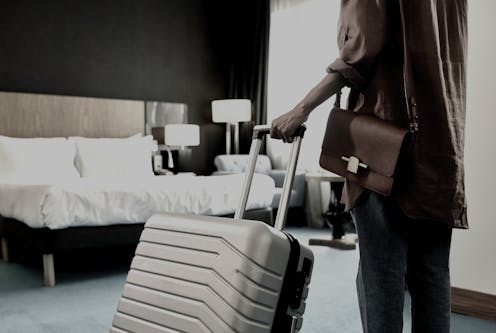
This is where victims might end up in crisis accommodation in a hotel. But while usually safer than their homes, these settings have flaws in meeting the needs of those fleeing violence.
Not enough specialist support
Nationally, women and children who are in physical danger will often spend several nights, if not weeks, in a funded hotel room.
There will be some vouchers for food and to buy the pyjamas, toothbrushes and other items that have usually been left behind. A case manager will phone, once a day, to check they have their basic needs met and to make a plan for their exit.
There are two problems with this system. The first is it’s an isolating and frightening experience – especially for people in a state of shock and trauma.

They can’t tell anyone where they are. They might have been told their phone is not safe and be waiting for a new one. There might be a full kitchen, but often it’s just a kitchenette – and they’re unable to cook the foods that might be familiar and comforting.
Women are often accompanied by children, sometimes babies and toddlers, who have no toys to console or occupy them.
There’s nowhere for kids to play. For adult victims, there’s no one to talk to. They’re fearful of the very real risk of danger, but what is going to happen next –or how long they’ll be waiting to find out – is unknown.
It’s during this time that some victims return to the person using violence[3]. These decisions are complex and there can be many reasons.
But being stuck in a small and unsuitable environment, fearful, isolated and without a clear pathway forward for themselves and their children, is a major factor.
Not enough safe and affordable housing
The second problem, if they do remain in the crisis hotel room, is there are very few places to go next.
Even if they can afford private rental, it can take weeks or months before they can move in.
Sometimes victims of family violence can be supported to return to the family home safely, if there’s an intervention order in place and the person using violence has been excluded from the property.
But it is not always a safe option. And even then, it’s only for those who can afford to take over the rent or mortgage on their own. This too can take time to sort out.
If they cannot afford rent or return home safely, they might be placed on a waiting list for long-term family violence refuge accommodation.
But these waitlists can still be long[4]. The longer it takes, the more difficult the confined and isolated hotel room becomes.
A project underway in Victoria is working to solve this situation, with promising results.
Finding sanctuary from violence
Sanctuary[5] is a supported crisis accommodation that provides safety, rest and wraparound support for victims of family violence.
It’s run by Victoria’s statewide 24/7 family violence service, Safe Steps[6], and has state and federal funding.
It is a purpose-designed building with individual, self-contained units as well as common spaces such as a children’s playroom, outdoor playground, prayer room, consult room and a large open lounge area.
But Sanctuary is more than a place. It is a new model for supporting the safety of victim survivors.
I’ve observed the Sanctuary model in action over the past few months. It is staffed 24/7, so there is always someone on site to talk to.
Family violence case managers and support workers meet in-person with residents every day – sometimes several times a day – to progress plans, and provide practical help and emotional support.
Specialist children’s workers provide tailored family violence responses as well as educational, play and wellbeing activities.
On-site services such as a nurse, visiting lawyer, Services Australia representative and wellbeing programs mean residents aren’t stuck on lengthy waitlists to access these crucial services.
Most often, it takes a few weeks of this intensive support for residents to be ready for their next steps.
The 12-month evaluation shows the Sanctuary model[7] enables safer outcomes for people in a family violence crisis than the current emergency hotels.
It shows that our family violence crisis housing system cannot just be about a physically safe place to stay. If we want to reduce the trauma associated with escaping violence, and create more sustainable pathways to safety, the Sanctuary model offers a much-needed transitional option.
What will remain with me from my time observing Sanctuary is the change I’ve seen in women and children escaping family violence from when they arrive to the time they leave.
It’s hard to measure this difference in a report, but these changes will stay with me. To be surrounded by people who support you, listen to you, work collaboratively with you and your children is life-changing. Victims are shown every day that they matter and that they deserve to be safe and respected.
I’ve seen that difference from the tears, anxiety and fear – to the confidence, strength and smiles – of women and children leaving Sanctuary who now have something that seemed impossible before. Not just a safe place to stay, but support and hope for a safer and happier future.
The National Sexual Assault, Family and Domestic Violence Counselling Line – 1800 RESPECT (1800 737 732) – is available 24 hours a day, seven days a week for any Australian who has experienced, or is at risk of, family and domestic violence and/or sexual assault.
References
- ^ thousands of people call a family violence crisis support line (www.sbs.com.au)
- ^ Shutterstock (www.shutterstock.com)
- ^ return to the person using violence (www.theage.com.au)
- ^ waitlists can still be long (www.abc.net.au)
- ^ Sanctuary (www.abc.net.au)
- ^ Safe Steps (safesteps.org.au)
- ^ 12-month evaluation shows the Sanctuary model (safesteps.org.au)
Authors: Anastasia Powell, Professor of Family and Sexual Violence, RMIT University