The Melbourne synagogue fire is being treated as a terror attack. Here’s why that matters
- Written by: Greg Barton, Chair in Global Islamic Politics, Alfred Deakin Institute for Citizenship and Globalisation, Deakin University
Victoria Police has announced[1] it’s treating the Melbourne synagogue fire as a terrorist attack.
The blaze at the Adass Israel synagogue in Ripponlea soon appeared to many, including Prime Minister Anthony Albanese[2], to be motivated by terror, but it took authorities four days to declare it.
To the casual onlooker, this might seem odd. On December 6, masked men were seen pouring liquid[3] on the floor while people were inside, before the building burst into flames[4]. Opposition Leader Peter Dutton, among others, was adamant[5] it was clearly an act of terror.
But whether or not something is terrorism isn’t always easy to determine, nor is the current political argument about it very useful. If holding those responsible is the goal, careful investigation from the outset is the only way to achieve it, even if it means waiting longer.
Read more: Albanese announces antisemitism taskforce, as synagogue firebombing investigation upgraded[6]
What have police said?
In a press conference[7], Australian Federal Police Deputy Commissioner Krissy Barrett outlined how the investigation has been upgraded from arson to counter-terrorism, based on investigations over the weekend.
The main thing that changes operationally is unlocking more resources[8]: more people with specific expertise, more federal and state cooperation and more agencies involved, including ASIO.
Legally, it means those responsible potentially face harsher penalties. Any charges laid would likely be related to terrorism rather than regular arson or property destruction.
Police have identified three suspects, but have said little about them. This is usual practice in these sorts of investigations as they don’t want to alert the perpetrators that authorities are onto them.
While police haven’t explicitly said so, it’s likely they’ve found evidence of the suspects’ motivations. This could include finding their online footprints, social media posts and communications with each other, presumably discussing what they’d done.
Terrorism, hate crime, or both?
The key to establishing that something is a terrorist attack is to find the motivation of the attacker. This is what distinguishes a terror crime from a hate crime.
A hate crime[9] is an unlawful act perpetrated against someone out of personal malice because of their specific, inherent characteristics, whether that’s race, religion, sexuality or something else.
People who commit hate crimes are typically angry and violent, seeking to take that out on the subject of their hatred.
Terrorists, however, are significantly different. They’re typically angry and violent too, but they are also motivated by a belief their actions will create political change. They act as part of a larger political project with its own goals and values.
In investigating crimes, police look for evidence of this overarching belief system before declaring something a terrorist attack.
In some cases, the evidence is formalised and explicit. In the 2019 Christchurch mosque attack[11], Brenton Tarrant had a clear manifesto.
Read more: Why is the Sydney church stabbing an act of terrorism, but the Bondi tragedy isn't?[12]
But it doesn’t have to be that obvious. Often it’s simply boasting in a text group chat that’s evidence enough of the larger goal.
The need to establish motivation is unusual in Australian law. Why someone did something is usually dealt with when they’re being sentenced for a crime, not before they’re charged with it.
But intent is what makes a terrorist, a terrorist.
Why does it take so long?
It’s easy to forget that police work in the early stages is crucial for prosecuting perpetrators down the line. Anything done now must hold up in court later.
Finding strong evidence can be difficult, especially in this case, where it’s not immediately clear who’s responsible.
In the Wakeley church stabbing[13] earlier this year, authorities had a pretty clear-cut case. The teenage attacker was recorded speaking on camera, was apprehended at the scene, and spoke openly about what he was trying achieve. This all enabled police to declare it a terrorist incident within hours.
The distressing events at the synagogue weren’t nearly as straightforward.
If police declared it was a terrorist attack but turned out to be wrong, it would have two major repercussions.
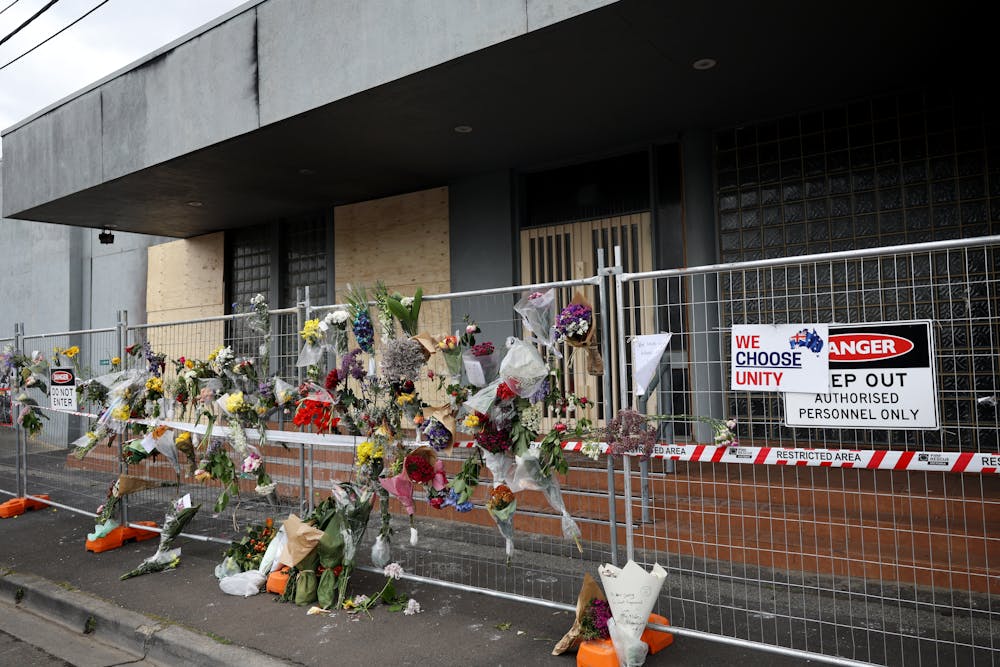
 The investigation has been upgraded to a count-terrorism case.
Con Chronis/AAP[14]
The investigation has been upgraded to a count-terrorism case.
Con Chronis/AAP[14]
First, it would undermine the legal case. Recklessly assuming motivation, without strong evidence to back it up, would seriously jeopardise the likelihood of the perpetrators being successfully prosecuted.
Second, it could diminish the seriousness of terrorism in general. Police don’t want to be the boy who cried wolf, leading to public complacency.
So while it’s understandable a frightened public would want to refer to a clearly abhorrent act using the most serious term we have, there are multiple factors at work behind the scenes to determine whether terrorism is the most accurate descriptor, and what that means for the investigation.
The politics of terrorism
It can be frustrating when legal definitions and common sense don’t seem to match up.
But definitions exist for a reason. The ultimate goals are to prevent this sort of despicable act from happening again and to break the cycle of radicalisation. Muddying the waters doesn’t help achieve those.
Nor does politicking about who has best responded to a tragedy. Putting pressure on police to make a terrorism announcement prematurely can be counterproductive, especially remembering the long-term legal case at play.
An attack on a synagogue is a horrible crime. Such crimes need to be prevented, regardless of whether they’re deemed terrorist attacks or something else.
Dealing with events like this should be beyond party politics. While Australia has had a good track record on this, the discussion of this attack hasn’t been a shining moment in our political discourse.
References
- ^ has announced (theconversation.com)
- ^ Anthony Albanese (www.theguardian.com)
- ^ pouring liquid (www.police.vic.gov.au)
- ^ burst into flames (www.abc.net.au)
- ^ was adamant (www.theguardian.com)
- ^ Albanese announces antisemitism taskforce, as synagogue firebombing investigation upgraded (theconversation.com)
- ^ press conference (www.abc.net.au)
- ^ more resources (www.theguardian.com)
- ^ hate crime (www.police.nsw.gov.au)
- ^ Con Chronis/AAP (photos.aap.com.au)
- ^ Christchurch mosque attack (theconversation.com)
- ^ Why is the Sydney church stabbing an act of terrorism, but the Bondi tragedy isn't? (theconversation.com)
- ^ Wakeley church stabbing (theconversation.com)
- ^ Con Chronis/AAP (photos.aap.com.au)
Authors: Greg Barton, Chair in Global Islamic Politics, Alfred Deakin Institute for Citizenship and Globalisation, Deakin University