Fit kids have better mental and physical health. What’s the best way to get them active?
- Written by: Ben Singh, Research fellow, Allied Health & Human Performance, University of South Australia
The mental health benefits of exercise for adults are well known, easing depression and reducing anxiety[1].
Now, emerging research[2] highlights its rising importance for children’s wellbeing. Staying active could be key to safeguarding and enhancing young people’s mental health.
Mood-boosting benefits
One in seven[3] adolescents worldwide has a mental illness. As a result, parents and health-care providers are increasingly seeking effective prevention strategies.
Evidence is accumulating to suggest one surprisingly simple approach: physical fitness.
One recent study[4] reveals even small improvements in fitness were linked to improved teen mental health. When adolescents improved their fitness by just 30 seconds on a running test, their risk of developing anxiety, depression, and attention-deficit hyperactivity disorder (ADHD) dropped by 7-8%.
This suggests something as straightforward as regular exercise could play a crucial role in protecting young people’s mental wellbeing.
For parents and health professionals looking to support adolescent mental health, encouraging participation in team sports could also be an especially effective strategy.
A study of more than 17,000 teenagers[5] revealed a powerful link between sports and mental health: teens who participated in sports clubs were 60% less likely to experience depression[6] compared to inactive kids.
This suggests team sports offer a unique environment for teens’ mental wellbeing, combining physical activity, social connection and structured routines.
Active kids do better in the classroom
Physical activity can also sharpen kids’ thinking and improve school performance: being active is associated with improvements in concentration[7], decision-making abilities, attention and academic performance[8].
Studies have also found positive links between physical activity and performance in maths[9] and reading skills[10].
Even short ten-minute bouts of activity[11] can have immediate positive effects on classroom performance.
Adding more physical activity to the school day — rather than cutting it for academic subjects — can not only boost students’ academic performance but also enhance their overall health and wellbeing.
Getting kids started with fitness and physical activity delivers myriad benefits.Starting early: when and how
Age considerations
While there’s no one-size-fits-all approach, experts generally agree it’s never too early to encourage physical activity.
The World Health Organisation recommends[12] children aged 3-4 should engage in at least 180 minutes of physical activity daily, with at least 60 minutes being moderate to vigorous intensity: activities that cause kids to huff and puff, such as running or playing sports.
For school-age children (five to 17 years), the recommendation[13] is at least 60 minutes of moderate to vigorous physical activity daily, with activities that strengthen muscles and bones at least three times a week.
Getting started
The key to introducing fitness to children is to make it fun and age-appropriate. Here are some strategies:
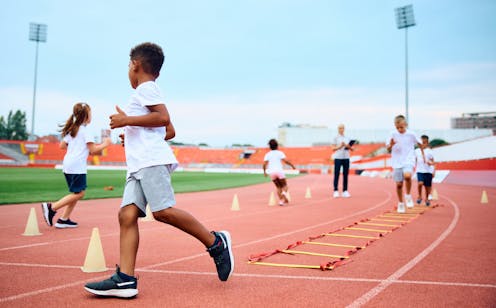
Incorporate play: for younger children, focus on active play[14] rather than structured exercise. Activities such as tag, hide-and-seek, or obstacle courses can be both fun and physically demanding.
Explore various activities[15]: expose children to different sports and activities to help them find what they enjoy. This could include team sports, dance, martial arts, or swimming. Consider activities that are culturally relevant or significant to your family, as this can enhance their sense of belonging and interest.
Lead by example[16]: children often mimic their parents’ behaviours, observing their actions. By being active yourself, you not only set a positive example but also encourage your children to do the same.
Make it a family affair[17]: encourage physical activity by planning active family outings like hikes, bike rides, or trips to the park to foster a love of exercise in a fun and engaging way.
Limit screen time: Encourage outdoor play[18] and physical activities as alternatives to sedentary screen time, fostering a healthier lifestyle and promoting wellbeing.
Potential risks and how to mitigate them
While the benefits of fitness for children are clear, it’s important to approach it safely. Some potential risks include:
Injuries from overexertion: children eager to push their limits can suffer from overuse injuries[19], such as sprains or strains. Encourage a variety of physical activities to prevent overuse injuries. Ensure adequate rest during training and competition, and promote proper a warm-up and cool-down.
Heat-related illness: children exercising in hot weather are at risk of heat exhaustion[20], with symptoms including dizziness and nausea. Emphasise hydration[21] before, during and after exercise. Schedule activities during cooler times and provide shaded areas for breaks, teaching kids to recognise signs of overheating.
Improper technique and equipment: using incorrect form or inappropriate equipment can result in injuries and impede development[22]. It’s essential to provide proper instruction, ensure equipment is size-appropriate, and supervise children during exercise. Programs should be designed to be safe and inclusive, accommodating children with disabilities, ensuring everyone can participate meaningfully without barriers.
Burnout: excessive exercise or pressure to perform can cause physical and mental burnout[23]. This can lead to a loss of interest. To prevent burnout, it is important stick to national[24] and international[25] activity recommendations, ensure adequate rest, and encourage a balance between structured exercise and free play.
A love for movement and activity
The evidence is clear: fit kids are happier, healthier, and better equipped to handle life’s challenges.
By introducing fitness early and in an engaging, age-appropriate manner, we can set children on a path to lifelong physical and mental wellbeing.
Remember, the goal is to foster a love for movement and activity that will serve children well into adulthood.
References
- ^ depression and reducing anxiety (bjsm.bmj.com)
- ^ emerging research (www.sciencedirect.com)
- ^ One in seven (www.who.int)
- ^ study (jamanetwork.com)
- ^ study of more than 17,000 teenagers (bmcpublichealth.biomedcentral.com)
- ^ 60% less likely to experience depression (bmcpublichealth.biomedcentral.com)
- ^ concentration (onlinelibrary.wiley.com)
- ^ decision-making abilities, attention and academic performance (www.jsams.org)
- ^ maths (ijbnpa.biomedcentral.com)
- ^ reading skills (bmcpublichealth.biomedcentral.com)
- ^ ten-minute bouts of activity (www.frontiersin.org)
- ^ The World Health Organisation recommends (www.who.int)
- ^ the recommendation (www.who.int)
- ^ focus on active play (www.health.gov.au)
- ^ Explore various activities (bmcpublichealth.biomedcentral.com)
- ^ Lead by example (pmc.ncbi.nlm.nih.gov)
- ^ Make it a family affair (bmcpublichealth.biomedcentral.com)
- ^ Encourage outdoor play (pubmed.ncbi.nlm.nih.gov)
- ^ overuse injuries (pmc.ncbi.nlm.nih.gov)
- ^ heat exhaustion (www.tandfonline.com)
- ^ hydration (www.healthdirect.gov.au)
- ^ impede development (link.springer.com)
- ^ burnout (publications.aap.org)
- ^ national (www.health.gov.au)
- ^ international (www.who.int)
Authors: Ben Singh, Research fellow, Allied Health & Human Performance, University of South Australia