We tried a different preschool curriculum to prevent youth crime. Checking in 20 years later, it worked
- Written by: Jacqueline Allen, Senior Lecturer, Griffith University
There’s been an increased political and media focus recently on so-called youth crime waves, particularly in Queensland[1] and the Northern Territory.
This has unfortunately led to crackdowns from governments and police. Young people in Alice Springs have been subject to curfews[2].
Queensland Opposition Leader David Crisafulli (who’s ahead[3] in the polls ahead of this weekend’s election) has suggested[4] young people found guilty of some crimes should be sentenced as adults.
But punitive youth crime policies violate children’s human rights[5] and are an expensive[6] way of making the community less safe. It’s much better to stop youth crime before it starts by supporting children’s positive development in early childhood.
In a new evaluation[7], we found a preschool program reduced the amount of young people before the courts by more than 50%. When the right family support was provided too, the chances of the children committing crimes were even lower.
Our original study
Early community-based crime prevention strategies have been greatly neglected[8] in Australia. This is despite international evidence[9] and the recommendations of a widely circulated 1999 Commonwealth government report[10].
Scientific evidence has been accumulating for more than 50 years that shows the root causes of serious youth crime can be addressed in early childhood through prevention initiatives. The most famous example is the Perry Preschool Project[11], implemented in a disadvantaged area of Michigan in the early 1960s.
In Australia, the Pathways to Prevention Project[12] operated in a disadvantaged, multicultural region of Brisbane from 2002 to 2011.
It was a collaboration between Griffith University, the Queensland Department of Education, and national community agency Mission Australia.

The project aimed to improve child and youth outcomes by partnering with local preschools, schools, families and community organisations.
In 2002 and 2003, 214 four-year-old children attending two local preschools received an enhanced program focused on communication skills. This is called an “enriched preschool program”.
It was integrated into the standard curriculum and delivered by specialist teachers working with the children’s classroom teachers and their parents.
Evidence at the time showed communication skills were directly linked to success at school. They were also linked to to success in life through improved behaviour[14] and enhanced social skills.
The communication program brought children together in small groups with similar levels of language competence. The groups were balanced in terms of gender and cultural background. They completed carefully curated activities including games, bookmaking and reading.
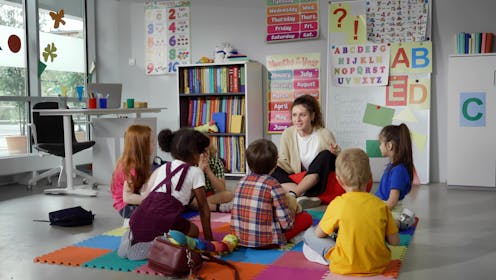
 Reading was a large part of the enriched preschool curriculum.
Shutterstock[15]
Reading was a large part of the enriched preschool curriculum.
Shutterstock[15]
These provided children with the opportunity to extend and practice oral language skills in ways that were personally meaningful. These activities were led by the specialist teachers who had postgraduate qualifications in communication and oral language development.
The specialist teachers engaged parents and children in joint activities, and actively supported reading and language activities at home. By year one, children who received the communication curriculum had better language proficiency, social skills, classroom behaviour and academic achievement than children in the other preschools.
The children’s families could also access practical support from community workers from their own cultural background. This included parenting education, advocacy with government agencies and counselling. This continued until 2011.
What’s new?
Earlier evaluations[16] showed the enhanced curriculum helped improve children’s readiness for school, among a range of other benefits. Now we’ve evaluated the success of the program over the long term.
Using anonymised data-linkage procedures, we followed up the students who received the enhanced curriculum back in 2002 to see what’s happened since.
Children who received the enhanced curriculum had improved classroom behaviour throughout primary school. They were also 56% less likely to be involved in serious youth crime by age 17.
Read more: Is Australia in the grips of a youth crime crisis? This is what the data says[17]
Remarkably, our evaluation found none of the children whose families also received support in the preschool years went on to offend.
The full Pathways Program was implemented widely in the community over a ten-year period, so we thought it might have had an impact more broadly.
We looked at the rate of youth offending in the region in the years 2008–16, when members of the 2002–03 preschool cohort were between 10 and 17 years old. It was 20% lower in this region than in other Queensland regions at the same low socioeconomic level.
How does this lead to less youth crime?
Programs like this work by levelling the playing field and improving the lives of children early in their developmental pathways. Developmental pathways are events and experiences that follow on from each other, or cascade, across the course of life.
For instance, a difficult transition to school increases the likelihood of poor engagement and academic problems. These are well-known risk factors[18] for antisocial behaviour.
The long-term impact of Pathways to Prevention on youth offending means it could be a model for similar programs across Australia.
This is especially the case given our nation’s chronic under-investment in community-based developmental crime prevention. We need more programs in disadvantaged communities that are open to everyone and don’t stigmatise people.
Overwhelmingly, efforts across the country are devoted to early intervention with children identified as “at risk” in some way (such as showing disruptive behaviour), or to the treatment of young people who become enmeshed in the youth justice system.
In Queensland, there is an over-reliance on youth detention[19], which is often very harmful for children and of no preventative value.
Using Pathways as a model for other communities doesn’t necessarily mean exactly replicating what we did (though this is also important). Any early prevention initiative will have the best chance of success if it includes evidence-based strategies that improve children’s life chances.
These can be implemented cost-effectively through existing systems including preschools, schools and primary care. Ideally, they should operate through local partnerships[20] involved at all stages of planning, data collection, implementation and evaluation.
References
- ^ Queensland (www.couriermail.com.au)
- ^ curfews (theconversation.com)
- ^ ahead (theconversation.com)
- ^ suggested (www.sbs.com.au)
- ^ human rights (www.ohchr.org)
- ^ expensive (www.journals.uchicago.edu)
- ^ new evaluation (www.researchgate.net)
- ^ greatly neglected (humanrights.gov.au)
- ^ international evidence (doi.org)
- ^ 1999 Commonwealth government report (doi.org)
- ^ Perry Preschool Project (cehd.uchicago.edu)
- ^ Pathways to Prevention Project (www.researchgate.net)
- ^ Shutterstock (www.shutterstock.com)
- ^ improved behaviour (www.sciencedirect.com)
- ^ Shutterstock (www.shutterstock.com)
- ^ Earlier evaluations (www.researchgate.net)
- ^ Is Australia in the grips of a youth crime crisis? This is what the data says (theconversation.com)
- ^ risk factors (doi.org)
- ^ youth detention (assets.nationbuilder.com)
- ^ local partnerships (www.parliament.nsw.gov.au)
Authors: Jacqueline Allen, Senior Lecturer, Griffith University