Jokowi was once seen as Indonesia’s ‘new hope’. Instead, he leaves a legacy of democratic backsliding
- Written by: Edward Aspinall, Professor in Southeast Asian Politics, Australian National University
As Indonesia’s president Joko Widodo (Jokowi) prepares to leave office, Indonesia is still routinely lauded as one of Asia’s most important democracies. Jokowi was first elected, in 2014, on the promise of breaking with the old Jakarta elite and making government more responsive to ordinary people.
He was backed by many ardent supporters of Indonesia’s Reformasi movement. This movement had brought down the authoritarian leader, Suharto, in 1998 and pushed a transition to democracy in the years that followed.
But Jokowi has overseen a serious period of democratic backsliding[1].
Democratic decline
Under his watch, the Indonesian government has hobbled democratic control institutions[2]. This includes Indonesia’s once-lauded Corruption Eradication Commission[3], abbreviated as KPK.
Security agencies such the army and the police have begun to resume a political role[4].
The government has banned major Islamic organisations[5].
Civil society groups speak of a dramatically narrowed civic space[6]. They complain, for example, about the government’s increasing reliance on the Electronic Information and Transactions Law to prosecute critics of the government for defamation[7] and its growing willingness to use violent means to respond to protests[8].
Jokowi’s opponents in the political elite are routinely[9] investigated[10] for corruption and other alleged wrongdoing.
In last February’s presidential election, there were widespread[11] reports[12] the police and other agencies were pressuring community leaders[13] to mobilise the vote for Jokowi’s preferred candidate, Prabowo Subianto.
How and why does Jokowi leave this legacy?
How did a man who was once seen as a “new hope[14]” for Indonesian democracy end up here?
The answer is part of a global story that has become broadly familiar in recent years.
These days, it is generally not unelected coup leaders who destroy democracy. Experiences like those of Thailand and Myanmar in recent years are, happily, no longer typical.
Instead, elected populist leaders hollow democracy out from within. They do so by hobbling institutions[15], such as anti-corruption commissions[16], which are meant to check executive power.
Jokowi has, in my view, followed this pattern.
Unlike many populists, Jokowi never peppered his early speeches with angry denunciations of his opponents as traitors. He never tried to whip up vitriol against vulnerable minorities.
Instead, he positioned himself as a leader who was uniquely able to understand and to embody the aspirations of ordinary people.
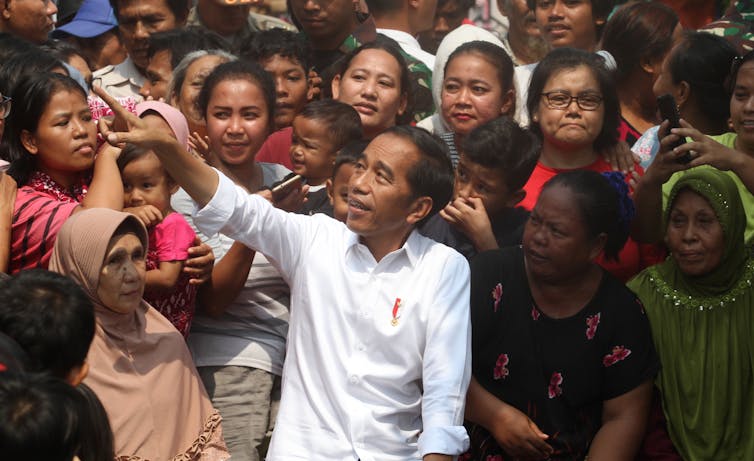
His trademark campaign method was known as blusukan[17]. He would drop by unexpectedly at a marketplace, for example, to chat with ordinary people about prices and other everyday matters.

A former mayor, he was interested in the nitty gritty of governance, such as how to improve transport services or upgrade parks. He was less interested in “abstract” notions like human rights.
The implications of this philosophy only became apparent after Jokowi was elected president.
He retained his belief in his own unique ability to understand the aspirations of ordinary citizens, which had been long neglected by elite politicians.
He maintained a single-minded focus on what ordinary Indonesians wanted – improved living standards and better social welfare. And he used polls[19] to regularly monitor public opinion.
For Jokowi, maintaining popular support and satisfying public demands was the essence of democracy. He was not interested in institutions[20] that place limits on governmental power, which are arguably just as important to a functioning democratic system.
For example, his government enacted legal amendments that significantly weakened[21] the Corruption Eradication Commission (KPK).
Late last year, the Constitutional Court[22] – headed by his brother-in-law – changed the the rules on candidate age limits[23] to allow Jokowi’s son, Gibran Rakabuming Raka, to stand for the vice presidency. Many Indonesians viewed[24] this as a transparent – and successful – attempt to manipulate a key control institution for the purpose of maintaining Jokowi’s dynastic grip on power.
Even so, as Jokowi leaves office, he does so a very popular politician.
Prabowo as president
Jokowi hands power to a man with an even more chequered democratic history.
Prabowo Subianto is a former general with a record[25] of alleged human rights abuses dating back to the late Suharto period. (Although, like other senior military officers accused of responsibility for the Suharto regime’s well-documented record of human rights abuses, he was never convicted[26] of any crimes). Prabowo was close to the heart of that regime: indeed, he used to be Suharto’s son-in-law.
 Prabowo has promised he would provide the strong hand the country needed.
Algi Febri Sugita/Shutterstock[27]
Prabowo has promised he would provide the strong hand the country needed.
Algi Febri Sugita/Shutterstock[27]
Prabowo has since reinvented himself as a fun-loving grandfather figure[28] and Jokowi’s greatest fan, capitalising on the president’s own popularity.
In fact, Prabowo used to be among Jokowi’s greatest rivals before becoming his defence minister in 2019.
In previous elections, Prabowo presented himself as a firebrand populist who angrily denounced his opponents for allegedly selling Indonesia out to foreigners. He promised he would provide the strong hand the country needed to become truly great.
We don’t know yet what kind of president Prabowo will be. His early political socialisation, as a leading elite figure close to the heart of the Suharto regime, suggests his instincts[29] are likely to be deeply authoritarian[30].
He inherits from Jokowi a country in which democratic institutions have already been seriously undermined, and a series of lessons in how to weaken them further.
References
- ^ democratic backsliding (researchportalplus.anu.edu.au)
- ^ hobbled democratic control institutions (muse.jhu.edu)
- ^ Corruption Eradication Commission (indonesiaatmelbourne.unimelb.edu.au)
- ^ resume a political role (indonesiaatmelbourne.unimelb.edu.au)
- ^ major Islamic organisations (www.lowyinstitute.org)
- ^ dramatically narrowed civic space (indonesiaatmelbourne.unimelb.edu.au)
- ^ defamation (www.giga-hamburg.de)
- ^ protests (www.amnesty.id)
- ^ routinely (tirto.id)
- ^ investigated (indonesiaatmelbourne.unimelb.edu.au)
- ^ widespread (bookshop.iseas.edu.sg)
- ^ reports (reporter.anu.edu.au)
- ^ pressuring community leaders (majalah.tempo.co)
- ^ new hope (time.com)
- ^ hobbling institutions (www.journalofdemocracy.com)
- ^ anti-corruption commissions (indonesiaatmelbourne.unimelb.edu.au)
- ^ blusukan (setkab.go.id)
- ^ BahbahAconk/Shutterstock (www.shutterstock.com)
- ^ polls (researchportalplus.anu.edu.au)
- ^ interested in institutions (www.journalofdemocracy.com)
- ^ significantly weakened (indonesiaatmelbourne.unimelb.edu.au)
- ^ Constitutional Court (thediplomat.com)
- ^ candidate age limits (www.aljazeera.com)
- ^ viewed (en.tempo.co)
- ^ record (www.bbc.com)
- ^ never convicted (www.smh.com.au)
- ^ Algi Febri Sugita/Shutterstock (www.shutterstock.com)
- ^ fun-loving grandfather figure (www.theguardian.com)
- ^ instincts (eastasiaforum.org)
- ^ authoritarian (www.bbc.com)
Authors: Edward Aspinall, Professor in Southeast Asian Politics, Australian National University