Why a portrait of a former NRL great could spark greater concussion awareness in Australia
- Written by: Stephen Townsend, Research Fellow, UQ School of Human Movement and Nutrition Sciences, The University of Queensland
A new portrait of NRL legend Wally Lewis conveys a striking message about the consequences of brain trauma in sport.
The portrait, created by visual artist Jamie van Leeuwen[1] in cooperation with Lewis, is currently entered in the 2024 Brisbane Portrait Prize[2].
It uses artificial intelligence (AI) and traditional photography to depict Lewis contemplating his own brain, prompting viewers to consider the consequences of athletes subjecting their bodies (and brains) to a lifetime of physical trauma in contact sports.
It further suggests that art has an important role to play in science communication.
Heavy lies the crown
Lewis is one of Queensland’s most beloved figures and one of Australia’s greatest rugby league players[3].
His intelligence was matched by a rugged playing style. He thrilled crowds by appearing to relish hard tackles and seeking confrontation.
Lewis’ State of Origin performances for Queensland, the Australian representative team, and multiple clubs earned him the nickname “The King” and the “Emperor of Lang Park,” where he is celebrated with a life-size statue[4].
In short, it is difficult to overstate the affection many Queenslanders have for Lewis and the magnitude of his reputation in the Australian rugby league community.
The King speaks
Although rugby league gave a lot to Lewis, it also took a heavy toll.
After retiring he moved into broadcasting, becoming the long-term sports anchor for Channel Nine in Queensland.
In late 2006, he had two successive epileptic episodes on live television.
Following the second episode, Lewis announced publicly[5] that he had been diagnosed with epilepsy during his playing career but hid the condition for decades. He further revealed his epilepsy was caused by repeated concussions.
Wally Lewis has spoken out about his epilepsy struggles.More recently, Lewis has become one of the most prominent figures[6] in the broader conversation around brain trauma in sport, particularly following his 2023 diagnosis of traumatic encephalopathy syndrome (TES)[7], the symptomatic precursor of the brain disease chronic traumatic encephalopathy[8] (CTE).
This diagnosis is likely linked to his lifetime accumulation of brain trauma in rugby league.
Who is listening?
Many Australian sports and athletes are being impacted by concussion[9], with a cacophony of experts and advocates attempting to make themselves heard.
Scientists, researchers, doctors, athletes, parents, families, and politicians are all straining to communicate[10] the potentially serious consequences of brain trauma to the sporting public.
This portrait of Lewis cuts through the noise and conveys a complex and sometimes controversial narrative: the neurological consequences of contact sport can outweigh its benefits.
This is a particularly fraught conversation in light of a recent study[11] that argued the opposite.
The King’s Battle
The portrait conveys the duality of contact sport in an instant.
As the artist states, the meaning of the piece is “about legacy […] both sides of legacy.”
Lewis’ successes are evidenced by the 1987 Maroons jersey he wears and the crown atop his head.
The costs are equally visible.
His wearied expression, the blood and grime on his collar and the disembodied brain resting in his palms prompt the viewer to imagine Lewis’s thoughts.
Is he re-imagining past victories? Planning an uncertain future? Harbouring fears for his fellow athletes?
After viewing the image for the first time, Lewis said:
It pretty much tells the story straight away […] there is great hope in the future that I’m going to be able to deal with some of the difficulties.
The image is emotionally freighted in a way that researchers and medical practitioners usually try to avoid, particularly in discussions about sports concussion where advocates for player safety have been accused of being overly emotional or scare-mongering[12].
The King’s Battle reminds us brain trauma is an emotional issue as much as a scientific one.
As ANU science media researcher Matt Ventresca[13] says, some of the most effective advocates for player welfare are former and current athletes who “in the absence of scientific certainty, express fear[14] about the health of their brains.”
Art and the future of science
Arts and science are often viewed as contradictory, but creative expressions like The King’s Battle should play a role in science communication.
Think Susan Sontag’s brilliant essay Illness as Metaphor[15] or the haunting lyrical description of cancer in Blood[16] by Australian band The Middle East.
“Blood”, by Australian indie band The Middle East, became the band’s signature song.The concussion crisis is a potent space for artistic representation – the 2015 film Concussion[17] starring Will Smith is a landmark in public perceptions of brain trauma in sport.
The upcoming ABC television program Plum[18] also tells the story of a brain damaged former sports star.
A 2024 portrait of former Australian NFL player Colin Scotts shows the consequences of a life in contact sport[19].
Artistic representations such as The King’s Battle are important because they bring home the consequences of brain trauma in ways that traditional science communication struggles to achieve.
It reminds us that understanding the emotion of health is just as important as understanding its scientific and medical aspects.
For CTE researchers, van Leeuwen’s portrait also carries abstract echoes of another hope for the future.
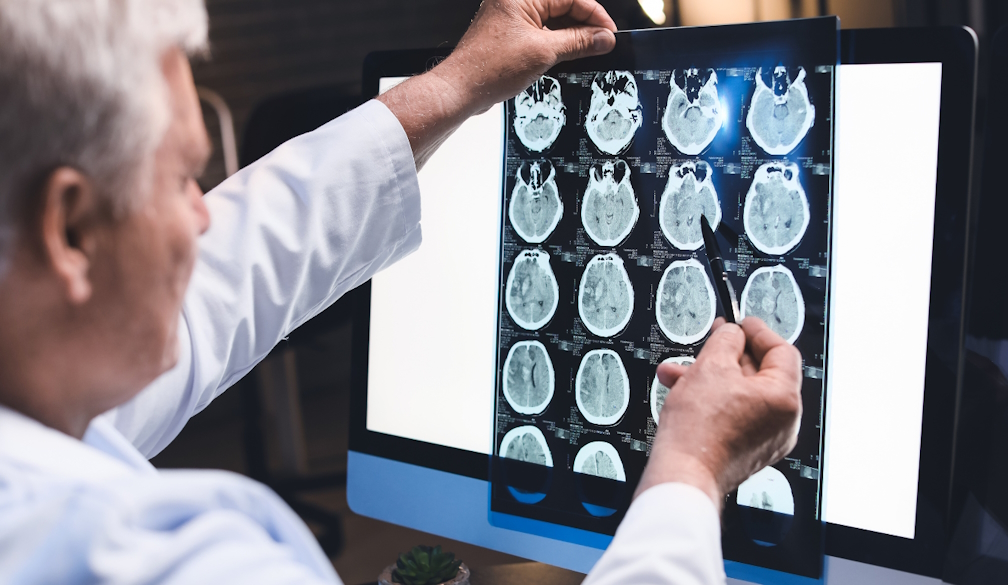
His use of AI technology to disembody Lewis’ brain in the artwork is reminiscent of current methods of CTE diagnosis: post-mortem removal and dissection of the brain.
The difference in The King’s Battle is that Lewis can look on the damage done to his brain while still very much alive.
In much the same way, we hope in the near future that technological advances will allow us to see CTE in the brains of living athletes and help them to live better lives with the disease.
References
- ^ Jamie van Leeuwen (www.absolutelyai.com.au)
- ^ Brisbane Portrait Prize (brisbaneportraitprize.org)
- ^ Australia’s greatest rugby league players (www.nrl.com)
- ^ life-size statue (suncorpstadium.com.au)
- ^ announced publicly (www.youtube.com)
- ^ prominent figures (www.abc.net.au)
- ^ 2023 diagnosis of traumatic encephalopathy syndrome (TES) (www.abc.net.au)
- ^ chronic traumatic encephalopathy (concussionfoundation.org)
- ^ being impacted by concussion (www.theguardian.com)
- ^ straining to communicate (www.theguardian.com)
- ^ recent study (theconversation.com)
- ^ overly emotional or scare-mongering (www.2gb.com)
- ^ Matt Ventresca (journals.sagepub.com)
- ^ express fear (www.sciencedaily.com)
- ^ Illness as Metaphor (en.wikipedia.org)
- ^ Blood (www.youtube.com)
- ^ Concussion (www.youtube.com)
- ^ Plum (iview.abc.net.au)
- ^ consequences of a life in contact sport (www.sbs.com.au)
Authors: Stephen Townsend, Research Fellow, UQ School of Human Movement and Nutrition Sciences, The University of Queensland