Can Australia prosecute foreigners for genocide overseas? Here’s how our atrocity laws work
- Written by: Alister McKeich, Lecturer and Researcher in Law, Criminology and Indigenous Studies, Victoria University, Victoria University
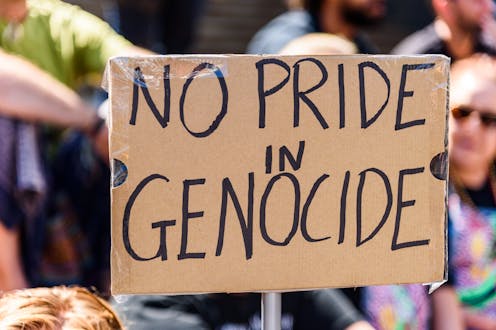
The onslaught in the Middle East has brought to the world’s attention once again the “crime of crimes[1]”, genocide.
Both the the International Court of Justice and International Criminal Court (ICC) have brought allegations of genocide against Israel as a state[2] and Israeli and Hamas leaders as individuals[3].
The Australian government’s response to the Gaza crisis has included temporarily freezing[4] of A$6 million of funding to the United Nations Relief and Works Agency for Palestine. Though funding has been flowing again since March, Prime Minister Anthony Albanese has been referred[5] to the ICC by a law firm for being “an accessory to genocide”.
Against this backdrop, Australia’s own genocide legislation is under parliamentary scrutiny. A bill[6] tabled by independent Senator Lidia Thorpe (for whom I work as a casual legal researcher) seeks to change the way Australia deals with genocide.
So what do our current laws say and what’s the case for changing them?
What do our laws say?
Australia ratified the Genocide Convention[7] in 1949.
Yet it was not until 2002, once the ICC was established, that the Commonwealth Criminal Code was amended[8] to create a new division of atrocity crimes.
Through this legislation, Australia may prosecute any person accused of a Rome Statute crime (such as genocide) under Australian law.
At the moment, written consent from the attorney-general is required before legal proceedings about genocide and other atrocity crimes can commence. This is called the “attorney-general’s fiat”.
Further, the attorney-general’s decision is final[9]. It “must not be challenged, appealed against, reviewed, quashed or called into question”.
Thorpe’s bill seeks to overturn these two measures.
The explanatory memorandum[10] in the 2002 amendment did not say why the attorney-general’s consent was necessary.
Consent from an attorney-general (or similar position) is not an international requirement.
Australia is only one of a handful of other countries (including the United Kingdom[11], New Zealand[12] and Canada[13]) where the fiat also exists.
Why is it a problem?
The Australian government has justified the rule[14] on the basis that prosecutions for atrocity crimes against individuals could affect Australia’s international relations and national security.
However, submissions[15] from legal experts and community groups to a senate inquiry looking at the issue point out flaws.
They say this rule prevents access to justice for victims and survivors of atrocity crimes. It can also create the potential for government bias.
Submissions also say the lack of explanation or appeal process ignores fundamental principles of jurisprudence.
Has the rule been used?
The attorney-general’s fiat has been used in a limited number of cases.
In 2009, Palestinian rights groups Australians for Palestine issued a request for consent for the prosecution of former Israeli prime minister Ehud Olmert, who was visiting at the time.
The Australian Centre for International Justice states in its submission how then-attorney-general Robert McClellend denied the request[16]. He cited matters of international state sovereignty and the difficulties of pursuing such a case in an overseas jurisdiction.
Then, in 2011, Arunchalam Jegastheeswaran, an Australian citizen of Tamil background, sought the attorney-general’s consent[17] for the prosecution of then Sri Lankan President, Mahinda Rajapaksa, who was due to visit Australia.

McClellend again denied the request, saying Rajapaska was protected under “head of state immunity”. This concept is controversial in international law, given it’s often heads of state who commit atrocity crimes.
Head of state protection was also offered to former Myanmar (Burma) leader Aung San Suu Kyi, who was in government when the 2017 genocide against the Rohingya was committed.
With Suu Kyi due to be in Australia for an ASEAN conference in 2018, the Australian Rohingya community sought a prosecution[19]. It was denied by then attorney-general Christian Porter.
And in 2019, retired Sri Lankan General Jagath Jayasuriya visited Australia. Despite concerted efforts to raise evidence to prosecute Jayasuriya of war crimes[20], delays with the Australian Federal Police meant the case never reached the point of attorney-general consent.
First Nations plaintiffs such as Paul Coe[21] and Robert Thorpe[22] have also sought to bring cases of genocide before the domestic courts, with no success.
What would changing the laws mean?
As it’s unlikely an attorney-general would consent to prosecutions against its own government, submissions to the inquiry argue the rule creates a direct conflict of interest.
For First Nations people seeking justice for crimes of “ongoing genocide[23]” perpetuated by the Commonwealth, any government is hardly going to rule in their favour.
Some Indigenous community groups argue[24] the high rates of First Nations children in protection, deaths in custody, hyper-incarceration and cultural, land and environmental damage amount to genocide crimes.
Submissions to the inquiry recommend instead of requiring the consent of the attorney-general, claims of genocide should be directed to the Commonwealth Director of Public Prosecutions. This would ensure greater independence from government.
The director has a mandate for this sort of work. It already investigates similar crimes[25] such as people smuggling, human trafficking, slavery and child exploitation.
Internationally, the implications of this bill, if passed, will be consequential. The Australian Centre for International Justice estimates[26] up to 1,000 Australian citizens have returned to Israel to fight as part of the Israel Defense Forces. Israel has been accused[27] of serious atrocity crimes in Gaza.
Should any of those citizens return, there could be attempts to mount a case. The government would then have to consider Australia’s political and economic ties with Israel.
Whether the bill is passed will depend on parliament. But the situation highlights a paradox: the state itself will be deciding whether to remove its own inbuilt protections against charges of genocide.
References
- ^ crime of crimes (journals.sagepub.com)
- ^ as a state (www.hrw.org)
- ^ as individuals (www.icc-cpi.int)
- ^ freezing (www.aljazeera.com)
- ^ referred (birchgrovelegal.com.au)
- ^ A bill (www.aph.gov.au)
- ^ Genocide Convention (www.un.org)
- ^ was amended (www.aph.gov.au)
- ^ final (parlinfo.aph.gov.au)
- ^ explanatory memorandum (parlinfo.aph.gov.au)
- ^ United Kingdom (www.legislation.gov.uk)
- ^ New Zealand (www.legislation.govt.nz)
- ^ Canada (laws-lois.justice.gc.ca)
- ^ justified the rule (www.alrc.gov.au)
- ^ submissions (www.aph.gov.au)
- ^ denied the request (www.aph.gov.au)
- ^ sought the attorney-general’s consent (law.unimelb.edu.au)
- ^ Chamila Karunarathne/EPA (photos.aap.com.au)
- ^ sought a prosecution (www.theguardian.com)
- ^ to prosecute Jayasuriya of war crimes (acij.org.au)
- ^ Paul Coe (database.atns.net.au)
- ^ Robert Thorpe (jade.io)
- ^ ongoing genocide (www.aph.gov.au)
- ^ argue (www.aph.gov.au)
- ^ similar crimes (www.cdpp.gov.au)
- ^ estimates (acij.org.au)
- ^ accused (news.un.org)
Authors: Alister McKeich, Lecturer and Researcher in Law, Criminology and Indigenous Studies, Victoria University, Victoria University