What a ‘forgotten’ Torres Strait Island Paralympian teaches us about representation, achievement and history
- Written by: Alistair Harvey, UQ Amplify Research Fellow, The University of Queensland
The full significance of Harry Mosby[1]’s silver-medal win in the men’s discus at the 1976 Paralympic Games in Canada[2] was unrecognised for 45 years: Paralympics Australia thought he was a Western Australian.
In truth, Mosby was a Torres Strait Islander from Masig (Yorke Island), one of around 600 Islander men who worked to support his family on the Australian mainland during “railway time[3]” from the late 1950s to the early 1970s.
Until 1965, the Queensland Torres Strait Islander Act[4] controlled resident Islanders’ lives, including their wages and movements.
Mosby, who left the Strait in 1963 and lost both legs in a railway accident in the Pilbara in 1968, was among the first to leave.
Paralympics Australia now recognises Mosby[5] not only as a Torres Strait Islander but also as the first, and only, Paralympian from the Strait.
This recognition came in 2021 following our (Phillips and Osmond) research on the history of the Australian Paralympic movement[6], in collaboration with Paralympics Australia.
The longstanding misunderstanding about Mosby’s origins existed because he was based in Perth, rehabilitating from his accident, when he was selected to represent Australia in 1976.
A comment made in an oral history interview[7] by his teammate Frank Ponta referring to Mosby as a Torres Strait Islander, led us to investigate his origins and connected us to his family on Masig.
Our experience with the Paralympics’ history project and encounter with Mosby led us to ask questions about other pioneering Indigenous Paralympians and Olympians.
Aboriginal trailblazers
The first Aboriginal Paralympian was wheelchair basketballer Kevin Coombs[8], who competed in the inaugural Paralympics in Rome in 1960, the first of his five Paralympics.
A Wotjobaluk man from Balranald, NSW, Coombs began competing before the 1967 referendum[9], when Indigenous people went uncounted in the census. He was devastated to need an honorary British, rather than Australian, passport[10] to compete in Rome.
Those games were the ninth iteration of the Stoke Mandeville Games[11], the predecessor to the Paralympics, held since 1948, yet no identified Indigenous athletes participated in those earlier events.
Aboriginal and Torres Strait Islander Olympians and Paralympians unveiled an athlete-drafted plan for Brisbane 2032.Historic questions
Mosby’s and Coombs’ Paralympic experiences raise questions about Indigenous participation in the Olympic Games.
Ask yourself: who were the first Aboriginal and Torres Strait Islander Olympians? Which games and sports did they compete in? How did government legislation shape their opportunities? How did they avail themselves of these opportunities? Were these athletes recognised as Indigenous at the time?
The first Aboriginal athletes to participate in the Olympics, in Tokyo 1964, were boxers Adrian Blair[12] and Frank Roberts[13], and basketballer Michael Ah Matt[14].
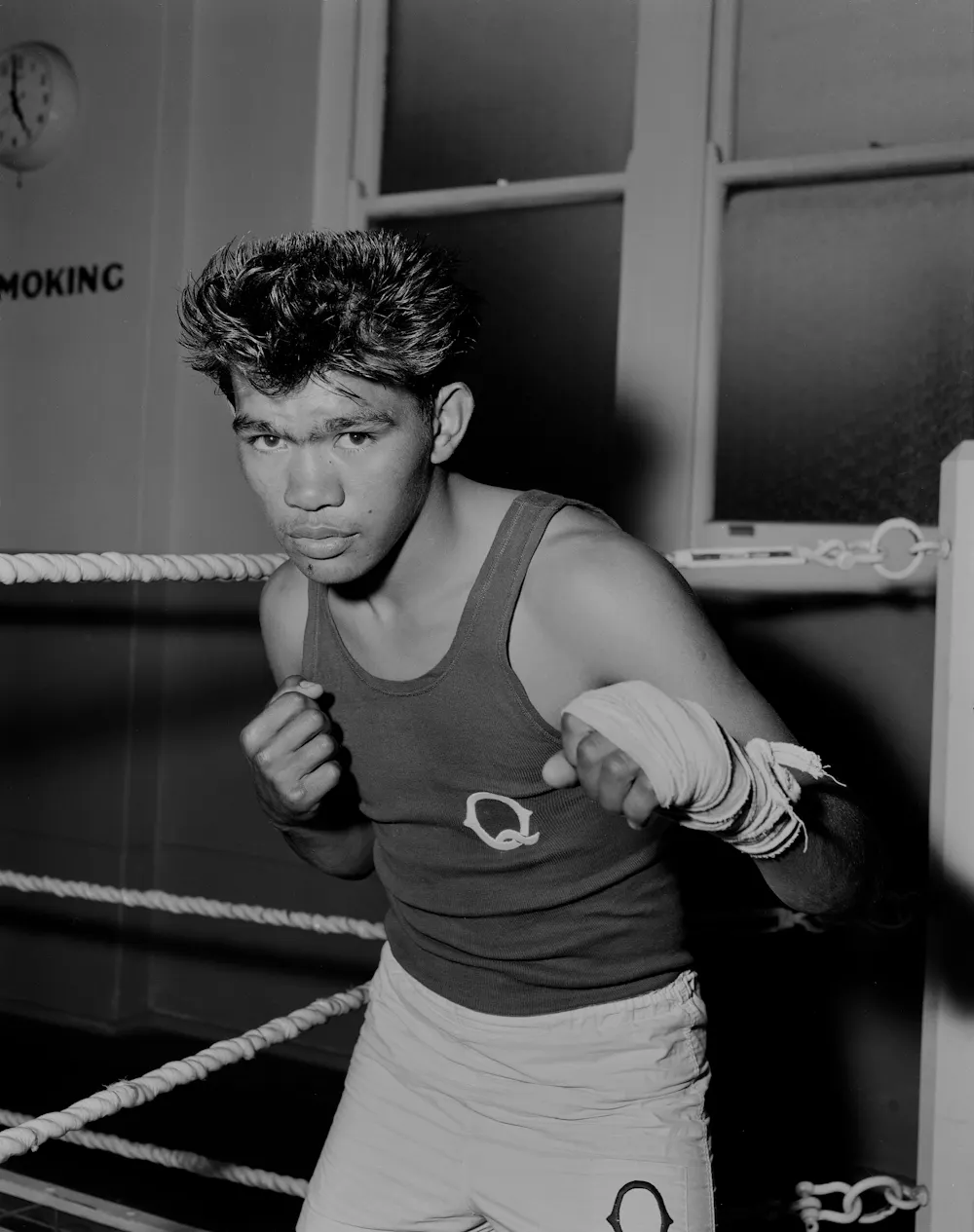
All three learned their sports under the restrictions imposed by state-based legislation governing the lives of Aboriginal people: Blair was from Cherbourg, an Aboriginal settlement in Queensland; Ah Matt grew up in Darwin, while Roberts was from Cubawee Aboriginal Reserve in NSW.
Even though these men experienced broad systemic racism like other Aboriginal people at the time, they were selected in the team for Tokyo.
Nevertheless, the Australian Olympic Federation did not acknowledge their Aboriginal identity[15].
This was consistent with government policies of assimilation requiring Aboriginal people to deny their cultures, languages and identities in order to “blend in” to White Australia.
Assimilation helps to explain that while we celebrate Cathy Freeman[16] and Patty Mills[17], we know little about their Aboriginal and Torres Strait Islander predecessors.
Sixty Indigenous Australians known to the Australian Olympic Committee have represented the nation at the Olympics.A platform to shine
The modern Olympics began in 1896 but it took until 1964 before any athletes who were identified as Aboriginal were selected. There were outstanding athletes, however.
Yorta Yorta man Lynch Cooper[18] was the world’s professional sprint champion in 1929[19], for example, and Yiman boxer Jerry Jerome[20] claimed the Australian middleweight crown in 1912.
But they were professionals at a time when the Olympics enforced an amateur/professional divide.
While regimes of control over Aboriginal people restricted access to amateur sports, many athletes were attracted to professional sports to escape poverty.
Aboriginal professional athletes on the world stage in this period like Lionel Rose[21] were ineligible for Olympic competition.
Others, like Evonne Goolagong[22], were professional but played in sports that weren’t on the Olympic program[23].
Torres Strait Islanders had an even longer wait than Aboriginal athletes to enter the Olympic arena – Danny Morseu[24], who played basketball in Moscow 1980, was the first.
Like their Aboriginal cousins seeking to escape poverty through professional sports, many Islanders sought to escape government control over work and wages[25].
While Mosby was one of the earliest Islander men to leave, Morseu’s generation had greater freedoms and he was able to move to Melbourne to pursue his basketball career.
Australian women first competed in the summer Olympics in 1912[26].
It was not until 1992, however, that an Indigenous woman competed – breaststroker Samantha Riley[27].
Hockeyroo Nova Peris[28] became the first Indigenous Australian woman to win a gold medal, in 1996, and in 2000 Freeman became the first Aboriginal athlete to claim an individual Olympic gold[29].
The delayed debut of Indigenous women reflects the double fold of discrimination – gender and racism – they faced in sport.
Indigenous Australians experienced nearly two centuries of containment and control by the time Aboriginal and Torres Strait Islanders represented Australia at the Paralympic and Olympic Games.
Paris will see more First Nations athletes in competition, adding to the 60 recognised Indigenous Olympians[30] and 16 Paralympians[31] who competed between 1960 and 2021.
As we watch them perform, let’s not forget their trailblazing forebears and ensure future Indigenous Olympians and Paralympians don’t face similar challenges.
References
- ^ Harry Mosby (ia.anu.edu.au)
- ^ 1976 Paralympic Games in Canada (www.paralympic.org)
- ^ railway time (www.tandfonline.com)
- ^ Queensland Torres Strait Islander Act (aiatsis.gov.au)
- ^ now recognises Mosby (www.paralympic.org.au)
- ^ history of the Australian Paralympic movement (paralympichistory.org.au)
- ^ an oral history interview (catalogue.nla.gov.au)
- ^ wheelchair basketballer Kevin Coombs (www.paralympic.org.au)
- ^ the 1967 referendum (aiatsis.gov.au)
- ^ an honorary British, rather than Australian, passport (www.abc.net.au)
- ^ Stoke Mandeville Games (paralympichistory.org.au)
- ^ Adrian Blair (espace.library.uq.edu.au)
- ^ Frank Roberts (aiatsis.gov.au)
- ^ Michael Ah Matt (www.olympics.com.au)
- ^ did not acknowledge their Aboriginal identity (scholarlypublishingcollective.org)
- ^ Cathy Freeman (olympics.com)
- ^ Patty Mills (sahof.org.au)
- ^ Lynch Cooper (ia.anu.edu.au)
- ^ the world’s professional sprint champion in 1929 (trove.nla.gov.au)
- ^ Jerry Jerome (adb.anu.edu.au)
- ^ Lionel Rose (ia.anu.edu.au)
- ^ Evonne Goolagong (theconversation.com)
- ^ sports that weren’t on the Olympic program (olympics.com)
- ^ Danny Morseu (www.olympics.com.au)
- ^ work and wages (theconversation.com)
- ^ in the summer Olympics in 1912 (www.theguardian.com)
- ^ Samantha Riley (www.olympics.com.au)
- ^ Nova Peris (ia.anu.edu.au)
- ^ an individual Olympic gold (www.britannica.com)
- ^ 60 recognised Indigenous Olympians (www.olympics.com.au)
- ^ 16 Paralympians (www.ais.gov.au)
Authors: Alistair Harvey, UQ Amplify Research Fellow, The University of Queensland