US voters speak many languages, but non-English campaigning remains risky for Harris and Trump
- Written by: Geoffrey Miller, PhD Candidate in Politics, University of Otago
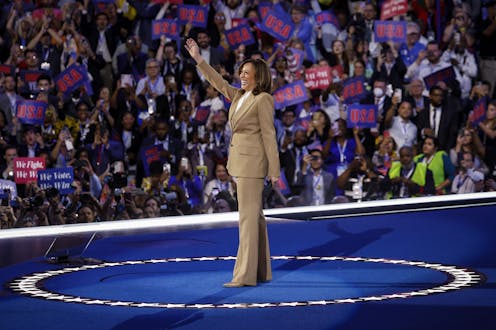
Tim Walz speaks[1] Mandarin. But don’t expect to hear Kamala Harris’ running mate deploying his Chinese language skills on the US election campaign trail.
While languages are inextricably interlinked with identity, they are also becoming a political hot potato. In February, Donald Trump warned supporters[2] that migrants “have languages that nobody in this country has ever heard of. It’s a very horrible thing”.
And J.D. Vance, now Trump’s own vice-presidential pick, last year proposed[3] an “English Language Unity Act” to make English the official language of the United States.
Despite the potential electoral advantages of campaigning in multiple languages, the risks of alienating sections of the voting public mean candidates are wary of going too far.
Monolingual politics
English-speaking countries are now home to enormous linguistic diversity, driven by decades of immigration. Around one in five Americans speak a language other than English at home. This proportion has more than doubled since 1980, according to US census data[4].
The percentages are similar in Australia[5] and New Zealand[6], while in Canada[7], 23% of people have a mother tongue other than the official languages of English and French. In the United Kingdom[8], the share of non-English native speakers is smaller – roughly 10% – but the upward trend is the same.
Despite these demographic shifts, however, election campaigns remain largely monolingual affairs. For example, there is little obvious sign of non-English messages in campaign leaflets[9] uploaded to the Open Elections crowdsourcing website for the recent British election.
Exceptions largely prove the rule. For instance, in July, Republican Senator Ted Cruz launched[10] a US$4.4 million Spanish-language campaign targeted at Hispanic voters – but only in Texas.
In New Zealand, the Labour Party translated[11] its 2023 campaign slogan “In it for you” into the Māori language: “Māu, Mā Tātou”. But in practice the Māori version was used only sparingly, such as in the annual Māori language week[12] that fell during the campaign period.
Majority rules
The reluctance to engage in multilingual campaigning might seem surprising. After all, modern political parties frequently resemble businesses, competing for votes in the election marketplace.
In theory, they would have much to gain by speaking to voters – their customers – in their preferred tongues. As former German Chancellor Willy Brandt reportedly said[13]: “If I am selling to you, I speak your language. If I am buying, dann müssen Sie Deutsch sprechen.”
The reluctance of parties to mount multilingual campaigns is probably driven by one major factor: they believe it would cost them votes overall. Indeed, research suggests multilingual campaigning runs the risk of turning off majority language voters.
For instance, a 2022 Canadian study[14] found over 90% of French speakers in Quebec were annoyed by English-only campaign signs. A 2018 US study[15] came to similar conclusions, with monolingual English speakers becoming more hostile to candidates who ran campaign ads in Spanish.
Still, such attitudes are not necessarily set in stone. After all, legislatures themselves have undergone rapid shifts as parties reflect more diverse societies in their candidate selection.
Some 14% of MPs[16] in the British House of Commons now come from ethnic minorities, up from just 2% in 2005. And in Washington, 25% of members of Congress[17] now identify as non-white, double the share of 20 years ago.
The picture is similar in Australia[18], while ethnic minorities – including Māori – now make up over 40%[19] of New Zealand’s parliament.
AI translation
Of course, change is not always easy. As things stand, few major parties in the Anglosphere even make their main websites available in a language other than English. And Pew Research Centre data[20] released in June showed just 68% of all US voters were comfortable with people speaking a language other than English in public.
But the risks must be set against the potential rewards. Many of the key swing states[21] in the 2024 US campaign are becoming more and more diverse. Around 30% of people in Arizona and Nevada[22], and 10% in Georgia, are Hispanic. Battleground state Michigan is home to 13% of all Arabic[23] speakers in the US, with 190,000 living in the Detroit metro area alone.
It is true that multilingualism can be complex and costly. AI solutions and algorithm-driven micro-targeting could be partial solutions – if used wisely.
Lessons might be drawn[24] from India’s recent election campaign, where the Bharatiya Janata Party (BJP) used AI to rapidly translate Prime Minister Narendra Modi’s campaign messages from Hindi into the country’s many other languages.
Ultimately, the chief potential benefit of genuine, two-way multilingual communication lies in its ability to help political parties understand and address the needs of more diverse populations.
Today, multilingual campaigning in English-speaking countries remains rare. But in a tight campaign, it could provide a crucial edge.
References
- ^ speaks (www.theguardian.com)
- ^ warned supporters (www.nbcnews.com)
- ^ proposed (www.vance.senate.gov)
- ^ US census data (www.census.gov)
- ^ Australia (profile.id.com.au)
- ^ New Zealand (www.ethniccommunities.govt.nz)
- ^ Canada (www.canada.ca)
- ^ United Kingdom (www.ons.gov.uk)
- ^ campaign leaflets (www.openelections.co.uk)
- ^ launched (www.axios.com)
- ^ translated (www.labour.org.nz)
- ^ Māori language week (www.tiktok.com)
- ^ reportedly said (www.theguardian.com)
- ^ Canadian study (theconversation.com)
- ^ US study (www.tandfonline.com)
- ^ 14% of MPs (news.sky.com)
- ^ 25% of members of Congress (www.pewresearch.org)
- ^ Australia (www.aph.gov.au)
- ^ over 40% (teara.govt.nz)
- ^ Pew Research Centre data (www.pewresearch.org)
- ^ swing states (www.statista.com)
- ^ 30% of people in Arizona and Nevada (worldpopulationreview.com)
- ^ 13% of all Arabic (www.axios.com)
- ^ might be drawn (theconversation.com)
Authors: Geoffrey Miller, PhD Candidate in Politics, University of Otago