


what really happened at the ancient Olympics
- Written by: Konstantine Panegyres, McKenzie Postdoctoral Fellow, The University of Melbourne
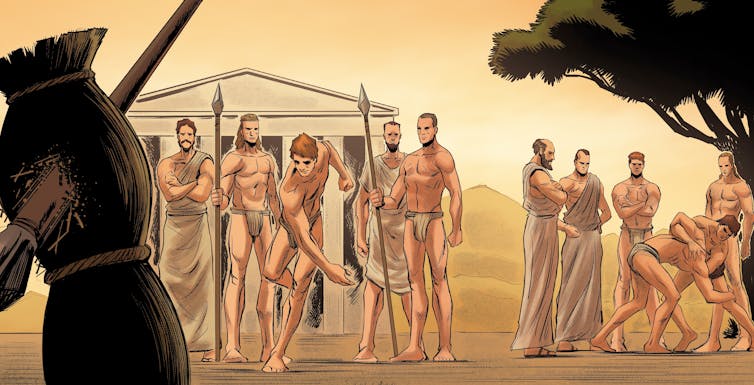
The first recorded victor at the Olympics was Coroebus of Elis[1]. A cook by profession, Coroebus won the event called the “stadion” – a footrace of just under 200 metres, run in a straight line.
Coroebus was victorious in the year 776 BC, but this was probably not the year of the first Olympic games.
A few ancient writers, such as the historian Aristodemus of Elis[2] (who lived in the 2nd century AD or earlier), believed[3] there had been as many as 27 Olympic contests prior to 776 BC, but the results had never been recorded because people before that time did not care about recording the names of the winners.
The games were held every four years at Olympia[4], a site in Western Greece that had a famous temple to the god Zeus[5].
The games started in mid-August and were part of a religious festival dedicated to Zeus.
The Olympics began as part of a religious festival honouring the Greek god Zeus.Competing for glory
In the early days of the Olympics, there was only one event (the “stadion[6]”) and one victor.
Over the centuries, other events were added, like chariot races, wrestling, long-distance running and boxing. The Roman emperor Nero[7] (37-68 AD) even “introduced a musical competition at Olympia”, as the biographer Suetonius[8] (1st/2nd century AD) informs[9] us.
Victors at Olympia won a wreath of wild olive. Unlike today, there were no prizes for second or third.
The athlete Iccus of Tarentum[10], who lived in the 5th century BC and won victory in the pentathlon at the Olympics of 476 BC, apparently said[11] that for him “the prizes meant glory, admiration in his lifetime, and after death an honoured name”.
Mostly men competed for the prizes but some women took part.
Cynisca[12], daughter of King Archidamus II of Sparta[13], was the first woman to achieve an Olympic victory. She got the prize because the horses she trained won the chariot racing event in the year 396 BC, as the traveller Pausanias[14] (2nd century AD) writes[15]:
Cynisca was exceedingly ambitious to succeed at the Olympic games and was the first woman to breed horses and the first to win an Olympic victory. After Cynisca, other women have won Olympic victories but none of them was more distinguished for their victories than her.
But competing in the games could be dangerous.
Lucius Annaeus Seneca[16] (c. 50 BC-c. 40 AD) describes[17] how a father lost both sons in the “pancration[18]”, a type of combat sport that was a violent mixture of boxing and wrestling:
A man trained his two sons as pancratists, and presented them to compete at the Olympic games. They were paired off to fight each other. The youths were both killed together and had divine honours decreed to them.
Going to the games
People travelled far to see the athletes competing in the famous games.
The rhetorician Menander[19] (3rd/4th century AD) said[20] of the Olympic games: “the journey there is very difficult but nevertheless people take the risk”.
In 44 BC, the Roman statesman Cicero[21] (106-43 BC) wrote[22] a letter to his friend Atticus about planning a trip to Greece to see the games:
I should like to know the date of the Olympic games […] of course, as you say, the plan of my trip will depend on chance.
Cicero never made it to the Olympics – he was interrupted by other business. If he had gone, the trip would have involved a voyage by sea from Italy to Greece, then a carriage ride to Olympia.
Once at Olympia, travellers stayed at lodging houses with other travellers. There they mixed with strangers and made new friends.
There is a famous story about what happened when the philosopher Plato[23] (428/427-348/347 BC) stayed at Olympia for the games.
Plato lived there with others who did not realise he was the celebrated philosopher and he made a good impression on them, as the Roman writer Claudius Aelian[24] (2nd/3rd century AD) recalled[25]:
The strangers were delighted by their chance encounter […] he had behaved towards them with modesty and simplicity and had proved himself able to win the confidence of anyone in his company.
Later on, Plato invited his new friends to Athens and they were amazed to find out he was in fact the famous philosopher who was the student of Socrates[26].
It’s unclear how many people actually visited the ancient games each time they were held, although some modern scholars think[27] the number could have been as high as 50,000 in some years.
Watching the games
The Greek writer Chariton[28] (1st century AD) in his novel Callirhoe wrote[29] how athletes – who had often also made a long journey to get to the games – arrived at Olympia “with an escort of their supporters”.
Athletes competed naked, and women were usually not permitted to watch.
But there were some exceptions. For example a woman called Pherenice, who lived in the 4th century BC, was permitted to attend the Olympics as a spectator. As Claudius Aelian explains[30]:
Pherenice brought her son to the Olympic festival to compete. The presiding officials refused to admit her as a spectator but she spoke in public and justified her request by pointing out that her father and three brothers were Olympic victors, and she was bringing a son who was a competitor. She won over the assembly and she attended the Olympic festival.
As the contest was held in the middle of summer, it was usually extremely hot. According to Claudius Aelian, some people thought[31] watching the Olympics under “the baking heat of the sun” was a “much more severe penalty” than having to do manual labour such as grinding grain.
The site at Olympia also had problems with freshwater supply. According to the writer Lucian of Samosata[32] (2nd century AD), visitors to the games sometimes died of thirst[33]. This problem was fixed when Herodes Atticus[34] built an aqueduct[35] to the site in the middle of the 2nd century AD.
The atmosphere of the crowd was electric.
The Athenian general and politician Themistocles[37] (6th/5th century BC) apparently said[38] the most enjoyable moment of his life was “to see the public at Olympia turning to look at me as I entered the stadium”.
They praised him when he visited the games at Olympia because of his recent victory against the Persians at the battle of Salamis[39] (480 BC).
When the games were over, winning athletes returned home to a hero’s welcome.
According to Claudius Aelian, when the athlete Dioxippus[40] (4th century BC) returned to Athens[41] after being victorious in the pancration at Olympia, “a crowd collected from all directions” in the city to celebrate him.
The end of the ancient games
The Roman historian Velleius Paterculus[42] (born 20/19 BC) called[43] the Olympic games “the most celebrated of all contests in sports”.
Current research suggests[44] the ancient games probably ended in the reign of the Roman emperor Theodosius II (reigned 408-450 AD).
There may have been a number of reasons for the demise but some ancient sources specifically say[45] it was caused by a fire that destroyed the temple of Zeus at Olympia during Theodosius II’s reign:
After the temple of Olympian Zeus had been burnt down, the festival of the Eleans and the Olympic contest were abandoned.
The Olympics were not revived again until 1896, the year of the first modern Olympics[46].
References
- ^ Coroebus of Elis (anastrophe.uchicago.edu)
- ^ Aristodemus of Elis (quod.lib.umich.edu)
- ^ believed (www.attalus.org)
- ^ Olympia (www.britannica.com)
- ^ Zeus (www.britannica.com)
- ^ stadion (www.britannica.com)
- ^ Nero (www.britannica.com)
- ^ Suetonius (www.oxfordreference.com)
- ^ informs (www.loebclassics.com)
- ^ Iccus of Tarentum (www.perseus.tufts.edu)
- ^ said (www.loebclassics.com)
- ^ Cynisca (www.jstor.org)
- ^ Archidamus II of Sparta (www.britannica.com)
- ^ Pausanias (www.britannica.com)
- ^ writes (www.loebclassics.com)
- ^ Lucius Annaeus Seneca (www.oxfordreference.com)
- ^ describes (www.loebclassics.com)
- ^ pancration (www.britannica.com)
- ^ Menander (www.oxfordreference.com)
- ^ said (www.loebclassics.com)
- ^ Cicero (www.britannica.com)
- ^ wrote (books.google.com.au)
- ^ Plato (www.britannica.com)
- ^ Claudius Aelian (www.britannica.com)
- ^ recalled (www.loebclassics.com)
- ^ Socrates (www.britannica.com)
- ^ think (olympics.com)
- ^ Chariton (www.britannica.com)
- ^ wrote (www.loebclassics.com)
- ^ explains (www.loebclassics.com)
- ^ thought (www.loebclassics.com)
- ^ Lucian of Samosata (www.britannica.com)
- ^ died of thirst (www.tertullian.org)
- ^ Herodes Atticus (www.britannica.com)
- ^ aqueduct (www.perseus.tufts.edu)
- ^ See U in History/Shutterstock (www.shutterstock.com)
- ^ Themistocles (penelope.uchicago.edu)
- ^ said (www.loebclassics.com)
- ^ battle of Salamis (www.britannica.com)
- ^ Dioxippus (ia801308.us.archive.org)
- ^ returned to Athens (www.loebclassics.com)
- ^ Velleius Paterculus (www.oxfordreference.com)
- ^ called (www.loebclassics.com)
- ^ suggests (www.cambridge.org)
- ^ say (ancientolympics.arts.kuleuven.be)
- ^ modern Olympics (olympics.com)
Authors: Konstantine Panegyres, McKenzie Postdoctoral Fellow, The University of Melbourne