why NZ’s new housing rules risk cheap builds and shoebox apartments
- Written by: Christine McCarthy, Senior Lecturer in Interior Architecture, Te Herenga Waka — Victoria University of Wellington
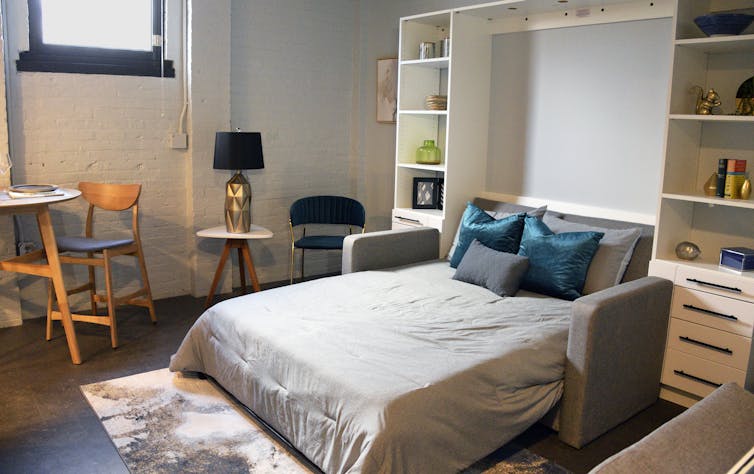
There is a lot of good in Housing Minister Chris Bishop’s new housing policy[1] – especially in relation to mixed-use developments[2] and intensification along transit corridors[3]. But he has also proposed the abolition of minimum floor area and balcony requirements.
Will removing minimum dwelling sizes result in poor quality housing? The short answer is yes.
The minister has justified the minimum requirements by arguing any apartment, regardless of the size, will be bigger than a car or an emergency motel room[4].
Of course, he’s right about this. For those vulnerable to homelessness[5] and poor housing[6] – the poor, immigrants, pensioners, students and ex-prisoners, for example – a warm, dry shelter is vital. Anything is better than nothing for those without.
But there are risks to removing size regulations, even when it is meant to help solve New Zealand’s long-running housing crisis[7].
Small can work
Small does not necessarily mean bad. As the United Nations has noted[8], smaller units are often more sustainable. Other factors also determine the quality of living spaces. Overcrowded conditions, for example, can make a perfectly liveable space unviable.
There are numerous examples of high-quality small and micro-apartments – usually defined as being 14–32 square metres (sqm).
Take, for example, PKMN Architecture’s La Casa de Yolanda[9] (Madrid, 50 sqm), Graham Hill’s Life Edited Apartment[10] (SoHo, New York City, 39 sqm), Tsai Design’s Type Street Apartment[11] (Richmond, Australia, 33 sqm), Proctor and Shaw’s Shoji Apartment[12] (North London, 29 sqm), Brad Swartz’s Darlinghurst Apartment[13] (Sydney, 27 sqm), Takeshi Hosaka’s Love2 House[14] (Tokyo, 18 sqm), and A Little Design’s Taiwanese studio[15] (Taipei, 17.6 sqm).
But these are all architect-designed and expensive. They often use generous room heights to create a sense of spaciousness. On top of that, many require owners to have sufficient strength to move walls or unfold furniture to transform a room from, say, a bedroom into a living room.
That could be ideal for the proverbial young professional, living much of their lives outside their flat, or for the short-term rental market. But it doesn’t work as well for families or older people.
The fear of shoebox apartments
A lack of minimum regulations can also cause unintended consequences.
In Melbourne, loose regulations[17] resulted in “saddleback bedrooms” – where long thin light corridors (or “snorkels”) were built to access the required external windows. Bedrooms became reliant on borrowed light from other rooms.
Using borrowed light is now banned[18] there, and snorkels have restrictions.
Auckland’s late 20th century shoebox apartments[19] were built as small as 12 sqm[20] – smaller than many of the motel rooms Bishop uses to justify abandoning minimum dwelling sizes.
These apartments led to the introduction of New Zealand’s minimum size requirements in the early 2000s.
Existing protections
New Zealand’s building code[21] requires “adequate” openings for natural light, with illuminance of no less than 30 lux at floor level (for 75% of the time) – 30 lux being the equivalent of the light from 30 candles.
Openings must be transparent, suitably located and provide awareness of the outside.
Councils have different, but often similar, requirements for interior spaces. For example, Wellington’s District Plan’s Residential Design Guide[22] requires dwellings get at least four hours sun in the main living room during the winter.
All habitable rooms must have natural light, rooms must be large enough for furniture, and circulation and windows must be placed for privacy.
The guide also requires that sleeping areas are shielded from external noises. These safeguards will mean there is a minimum quality for new apartments even if they are small. But it will also require political will from local government to ensure these safeguards are mantained.
Building for future risks
The real question, though, is whether the new policy will protect New Zealand long term – when the full wrath of climate change hits, or during any lockdown when the inevitable next pandemic[23] emerges.
New Zealand needs homes offering longevity and resilience, as well as compassion for when we are most vulnerable. Cramped spaces are not great for mental well-being[24].
Housing rules need to be cognisant of infrastructure needs for a changing climate and decades of network neglect. This will be a challenge. Under the proposed policy, councils will not be able to refuse a development on the grounds that infrastructure costs are too high[25].
So yes, these changes will undoubtedly increase housing supply – but we need to ask if these builds are fit for purpose. There needs to be a balance between the very real need for more houses on one hand, and the need to preserve adequate dwelling standards on the other.
References
- ^ new housing policy (wellington.scoop.co.nz)
- ^ mixed-use developments (www.voanews.com)
- ^ intensification along transit corridors (www.rnz.co.nz)
- ^ car or an emergency motel room (www.beehive.govt.nz)
- ^ homelessness (www.thepeoplesproject.org.nz)
- ^ poor housing (www.parliament.nz)
- ^ long-running housing crisis (www.rnz.co.nz)
- ^ United Nations has noted (sustainableconsumption.usdn.org)
- ^ La Casa de Yolanda (www.archdaily.com)
- ^ Life Edited Apartment (www.idesignarch.com)
- ^ Type Street Apartment (assemblepapers.com.au)
- ^ Shoji Apartment (www.nevertoosmall.com)
- ^ Darlinghurst Apartment (www.archdaily.com)
- ^ Love2 House (www.archdaily.com)
- ^ Taiwanese studio (arqa.com)
- ^ John Carl D'Annibale /Getty Images (www.gettyimages.com.au)
- ^ loose regulations (www.smh.com.au)
- ^ now banned (www.planning.vic.gov.au)
- ^ shoebox apartments (www.1news.co.nz)
- ^ 12 sqm (mangeredevelopment.co.nz)
- ^ building code (www.legislation.govt.nz)
- ^ Residential Design Guide (wellington.govt.nz)
- ^ inevitable next pandemic (theconversation.com)
- ^ mental well-being (www.verywellmind.com)
- ^ infrastructure costs are too high (www.beehive.govt.nz)
Authors: Christine McCarthy, Senior Lecturer in Interior Architecture, Te Herenga Waka — Victoria University of Wellington