Norway, Spain and Ireland have recognised a Palestinian state – what’s stopping NZ?
- Written by: James Mehigan, Associate Professor in Law, University of Canterbury
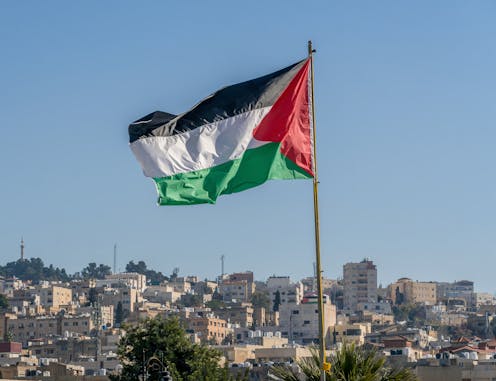
Norway, Spain and Ireland will formally recognise the state of Palestine[1] today (May 28). While 143 of the 193 United Nations member states already recognise Palestine, this is a significant moment – and leaves New Zealand in an even smaller group of countries yet to follow suit.
The latest move is important because it makes a clear statement that members of the international community can no longer wait for the Middle East peace process to conclude before recognising Palestinian statehood.
New Zealand – along with a number of former colonial powers such as the United States, United Kingdom, France, Germany, Japan and Italy – continues to withhold recognition. Foreign minister Winston Peters has said[2] it is a matter of “when, not if”, but also that recognition will depend on certain conditions.
These include holding elections (although this was never a requirement for recognising China), and the vague standard[3] of “serious negotiations between both Israel and Palestinians, including over the political authority of a future Palestinian state”.
This position represents the longstanding view that statehood was to be an incentive to completing peace negotiations. But the latest developments signal a shift away from that. As the Norwegian foreign minister told media[4]:
We used to think that recognition would come at the end of a process […] Now we have realised that recognition should come as an impetus, as a strengthening of a process.
The tattered ‘road map’ for peace
That process is often referred to as the “two-state solution[5]” and has for decades had the support of many countries, including New Zealand. In essence, it would mean Israeli and Palenstininan states would be established on the land where Israel and the Occupied Palestinian Territories now stand.
The exact borders and relationships between the two states would be ironed out in the peace process. This would involve each state’s leaders making appropriate concessions, developing trust and goodwill, and bringing their people with them to a sustainable peace.
(The Northern Irish Peace Process, culminating in the 1998 Good Friday Agreement[6], is often given as an example of how this might succeed.)
The high point of progress in developing a two-state solution came with the signing of the Oslo Accords[7] in 1993. This was not an agreement, but a “roadmap” to developing one.
Within a few years however, violence on both sides – including Hamas attacks against civilians and the 1995 assassination of Israeli Prime Minister Yitzhak Rabin by a Jewish opponent of the peace process – made it impossible to sustain that progress.
Recognition of Palestine, not Hamas
When Israeli prime minister Benjamin Netanyahu first came to power in 1996, the two-state solution was left to wither on the vine.
It has been moribund ever since, with Israeli leaders prevaricating over progressing the idea, while increasing the levels of military and civil oppression faced by Palestinians. Netanyahu remains implacably opposed[8] to Palestinian statehood.
New Zealand has supported the two-state solution for decades, and has not been afraid to challenge Israel. During its time on the UN Security Council[9] (2015-16), New Zealand voted for Resolution 2334[10], which condemned Israeli settlement building in the Occupied Territories.
Because the US abstained, the resolution passed. It stands as one of the high-water marks of international opposition to Israel’s illegal occupation policies (which are in direct contravention of the Geneva Conventions[11]).
Officially recognising a Palestinian state, then, would be in line with New Zealand’s past positions and actions. It would be one part of a bigger push to achieve a peaceful two-state solution, and it would not mean recognition of Hamas (or any other party).
‘Soft power’ can be effective
Recognition is not, as the Israeli government has portrayed it[12], a “reward” for the horrendous Hamas attacks of October 7. But it would be an acknowledgement that the peace process has stagnated and a different approach must be tried.
In the short term, the practical effect of recognising a Palestinian state would be minimal. Palestine’s representative in Canberra would present their credentials in Wellington, and relations with Palestine would continue as normal.
The long-term effects may be more significant, however. If Palestine is a state, then the two-state solution has its vital components. It will then be time to focus on how those two states will coexist in peace.
Small states can often feel powerless at times of international upheaval, and in some respects (particularly when hard military power is being used) they are. But there are still levers of “soft power” available. These become more effective when used collectively in conjunction with other small states.
The actions of Norway, Spain and Ireland present a unique opportunity for New Zealand to be in the vanguard of the development of a lasting peace in Israel and Palestine.
References
- ^ recognise the state of Palestine (www.bbc.com)
- ^ Winston Peters has said (www.rnz.co.nz)
- ^ vague standard (www.beehive.govt.nz)
- ^ told media (apnews.com)
- ^ two-state solution (theconversation.com)
- ^ Good Friday Agreement (www.theguardian.com)
- ^ Oslo Accords (www.britannica.com)
- ^ implacably opposed (www.timesofisrael.com)
- ^ time on the UN Security Council (www.mfat.govt.nz)
- ^ Resolution 2334 (www.un.org)
- ^ contravention of the Geneva Conventions (ihl-databases.icrc.org)
- ^ Israeli government has portrayed it (www.irishtimes.com)
Authors: James Mehigan, Associate Professor in Law, University of Canterbury