the work of Indigenous women needs to be valued
- Written by: Elise Klein, Associate professor, Australian National University
It’s commonly accepted that women do the vast majority of caregiving in Australian society. But less appreciated is that Indigenous women do larger amounts of unpaid care than any other group.
Working with the Aboriginal and Torres Strait Islander Social Justice Commissioner’s office, we worked with more than 100 Indigenous women across[1] Australia to talk about their interpretations and experiences of care.
“Mainstream” definitions and measures of care do not include the vast and complex ways care is defined by First Nations women. This includes care not only for people, but for communities, Country and culture.
It means important work goes unrecognised, uncompensated or misunderstood, leading to the marginalisation of this crucial work and the women who do it.
Read more: 'Definitions are often very western. This excludes us.' Our research shows how to boost Indigenous participation in STEM[2]
Redefining the concept
The Australian Human Rights Commission’s Wiyi Yani U Thangani[3] report illuminates the crucial importance of the care provided by First Nations women. Our work follows and builds on this report.
An Indigenous woman from the East Kimberley told us:
Well, care for me, as an Indigenous person, is not just caring for your family, it’s caring for your Country.
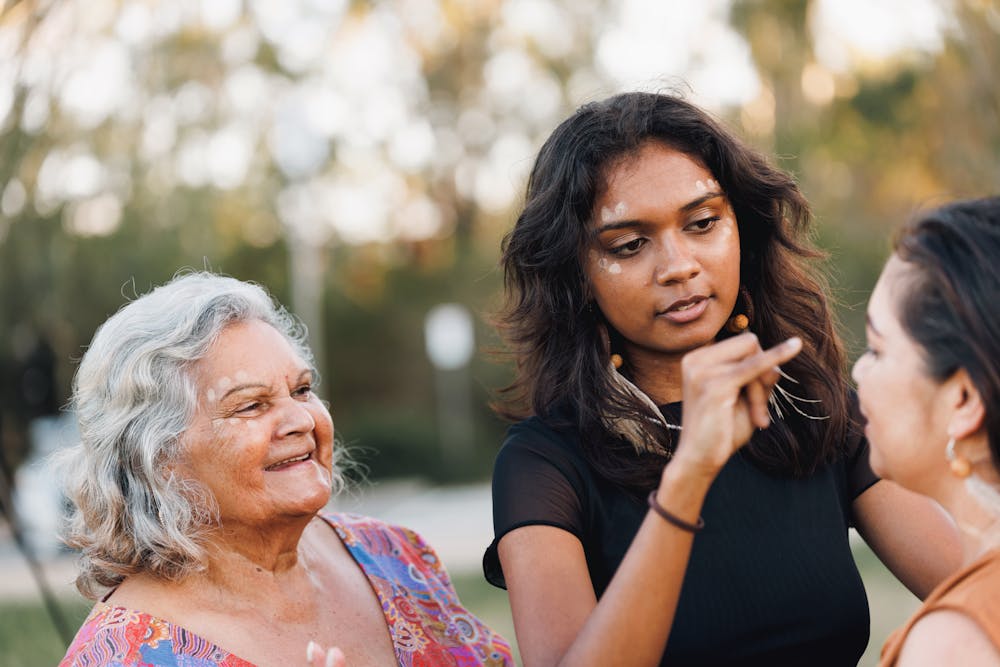
Another woman from the ACT told us care is a disposition, and a means of respecting culture and heritage:
[Care is] enveloped in everything we do and everything we are and everything about where we are going and paying homage again to our ancestors and who’s come before us. That’s what care is.
This notion of care as a strength is an important insight from the women in this study. However, unpaid care is often unrecognised and undervalued in Australian policy, which while prioritising getting women into employment, has neglected funding and supporting the existing unpaid care work that women do.
What is evident from our study is that Indigenous women want more support for the care work they do, as well as better care services largely within Aboriginal community-controlled organisations to assist them in doing it.
Care has consequences
Women frequently linked their demanding care loads to ongoing colonisation, which continues to create damage to the lives of Aboriginal and Torres Strait Islander people. A woman from greater Sydney said:
It’s colonial […] It’s just not being able to do things in the way we should be doing them […] because of the colonial structure and things like that.
This includes the impacts of colonisation on gender roles, child removals, incarceration rates, poor health, poverty, racism and more.
It also includes the impacts of state institutions set up to “care”, but which are often uncaring[5] and may be violent and harmful[6].
Ultimately, this requires Indigenous people’s care to heal, adding extra demands on existing care loads.
Read more: First Nations women don't always access health care after head injuries from family violence. Here's why[7]
Many of the women interviewed in this study were also tired, and often carers needed care too. Some were in, or had been through, periods of utter exhaustion and illness due to trying to carry their stressful care load. A Central Australian woman told us:
It’s hard. It’s draining. Every day just exhausted. Sometimes there’s days when I just can’t keep up with it. And I don’t want to listen, just go away. But those are days when they really need help. So yeah, it’s very exhausting.
Time is money, but no one gets paid
Our research also included a time-use survey, which showed that all unpaid care activities accounted for, on average, 62% of our participant women’s time on a usual weekday (about 14.8 hours per day on average), with 48% of their time (around 11.5 hours) spent caring for others and/or caring for Country and culture specifically.
Because (lost) remuneration for this work was raised as a crucial point by Indigenous women during our interviews, we also calculated the approximate market value of this unpaid care work through using hourly award rates for corresponding care activities (sometimes called the replacement method, which understands the cost of this work in the paid market).
The estimated economic value of this work ranged between $223.01 and $457.39 per day (representing an estimated annual salary of between $81,175.64 and $118,921.40). This estimation is conservative as it does not include the multitasking of more than one care activity at the one time.
The estimation raises important questions as to what is owed to Indigenous women, not just because the economy free-rides on unpaid care, but also because much of this care work mops up the mess of colonisation.
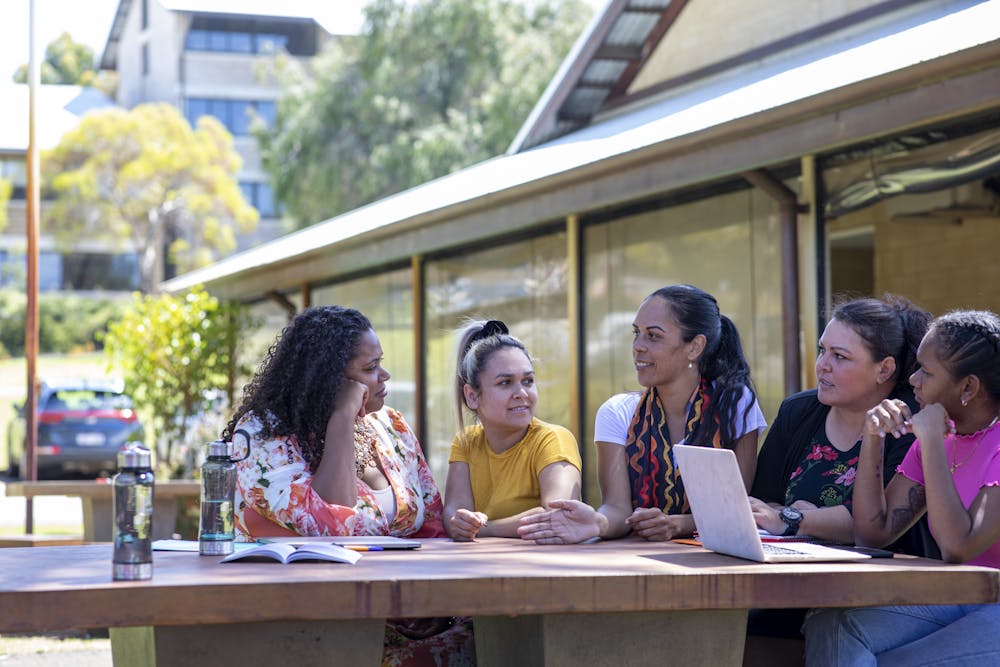 Traditional measures don’t adequately account for the time Indigenous women spend giving care, both inside and outside the home.
SolStock/Getty[8]
Traditional measures don’t adequately account for the time Indigenous women spend giving care, both inside and outside the home.
SolStock/Getty[8]
Many of the women we spoke to also talked about how unpaid care and paid employment interact.
In addition to their unpaid care roles, most women in paid employment in this study had roles in the community sector which put them at the frontline of caring for community. They saw this work as part of their broader commitment to supporting their families, communities and advancing Indigenous peoples. It is therefore hard to draw a line for these women between paid and unpaid work, meaning it is rare to be able to “switch off”.
Often, employers didn’t realise the amount of unpaid care of this type women do in their paid work roles[9], even though this actually makes their paid employment successful. Women are also not paid adequately for these valuable skills.
A new approach is needed
Our research follows generations of Indigenous women who have long shown the strength of care, but also looks at how settler society makes this work harder.
This research underlines the importance of a new approach to supporting Indigenous women, in which their voices, ideas and needs are central, and where care is placed at the heart. This is different to just “fitting” Indigenous care into various settler models, policies and measures already in circulation.
References
- ^ more than 100 Indigenous women across (caepr.cass.anu.edu.au)
- ^ 'Definitions are often very western. This excludes us.' Our research shows how to boost Indigenous participation in STEM (theconversation.com)
- ^ Wiyi Yani U Thangani (humanrights.gov.au)
- ^ Thurtell/Getty (www.gettyimages.com.au)
- ^ often uncaring (www.theguardian.com)
- ^ may be violent and harmful (theconversation.com)
- ^ First Nations women don't always access health care after head injuries from family violence. Here's why (theconversation.com)
- ^ SolStock/Getty (www.gettyimages.com.au)
- ^ their paid work roles (theconversation.com)
Authors: Elise Klein, Associate professor, Australian National University