Why we should celebrate Australia Day on March 3 – the day we became a fully independent country
- Written by: Benjamin T. Jones, Senior Lecturer in History, CQUniversity Australia
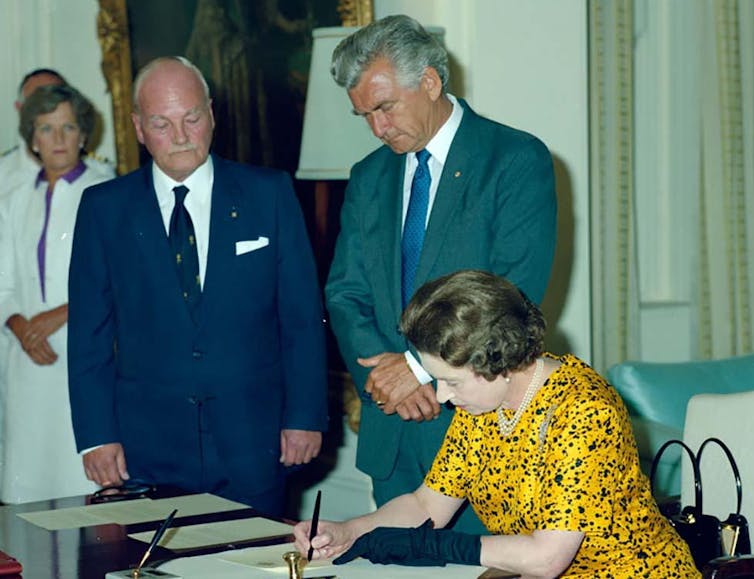
Every year, there are debates over the appropriateness of January 26 for a national holiday.
Australia Day has been celebrated on different dates[1] since its inception as a fundraiser for the war effort in 1915. The choice of January 26, the day in 1788 when the British flag was raised in New South Wales, attracted significant protest from First Nations, especially at the sesquicentenary in 1938 and bicentenary in 1988.
In recent years, January 26 has become a date that divides Australians. More than 80 local councils[2] have chosen not to have it as a day of celebration, and Triple J stopped[3] using the date to hold its Hottest 100 competition in 2018. This year, Woolworths’ commercial decision not to stock Australia Day merchandise was met with calls to protest[4] the supermarket giant.
If the purpose of Australia Day is to unite Australians and celebrate our achievements as a nation, then would our Independence Day – March 3 1986 – be a better choice?
Read more: Australia Day wasn't always January 26, but it was always an issue[5]
Wasn’t Australia independent before the 1980s?
You might be thinking, hang on, surely Australia was already independent in the 1980s?
To give a typical historian’s answer, yes, but it’s more complex than that.
In 1901, Australia federated and became a nation, but not an independent one. Its initial status was a Dominion of the British empire, self-governing but with its foreign affairs dictated from Westminster.
The Imperial Conference of 1923 gave majority-white Dominions such as Australia control over foreign affairs, while the 1926 Balfour Declaration[6] asserted that Dominions were “autonomous Communities within the British Empire, equal in status”.
The passage of the 1931 Statute of Westminster[7] confirmed that the Dominions were not subordinate to Britain. While this might seem like the independence moment, Australia saw no need for the change and did not ratify it until 1942[8].
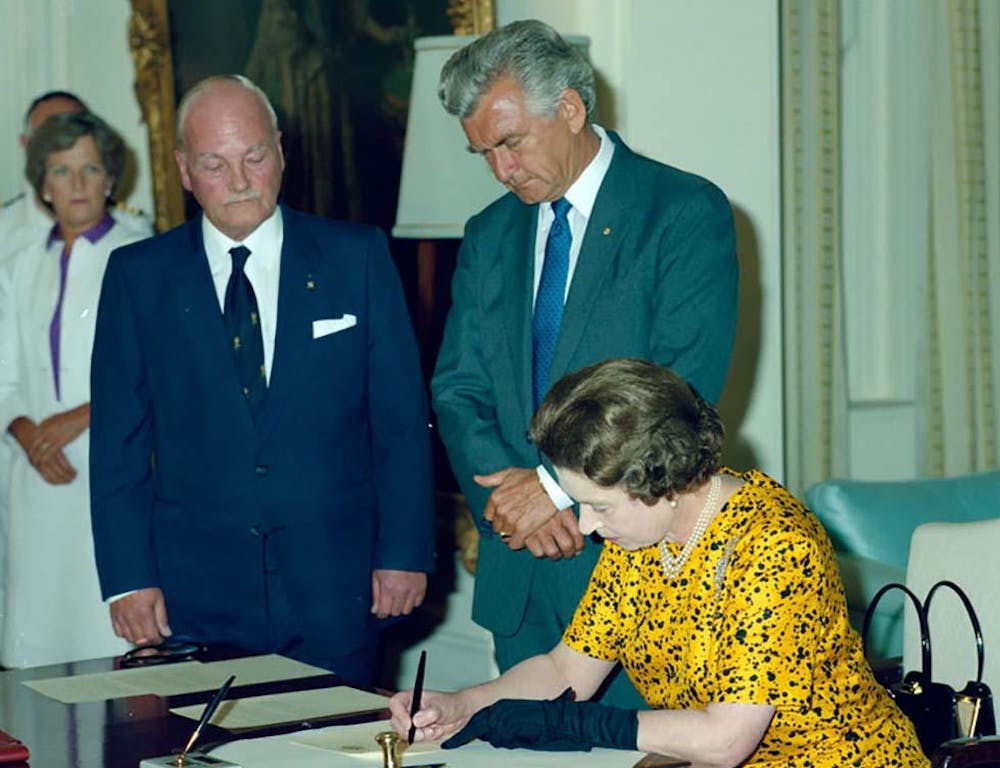
The second world war convinced the Australian government it needed its own diplomats and embassies in foreign nations. Then, in the 1960s, Britain’s attempts to join the European common market and its decision to remove its military from South-East Asia (known as East of Suez[11]) prompted Australia to show greater independence in its trade and security policies.
Even if the Commonwealth government was independent from 1931 (or 1942, technically), colonial anomalies remained and would not be addressed until 1986.
Read more: Welcome to May 9 – the true Australia Day[12]
Wait, so Australia wasn’t fully independent?
When the Hawke government took office in 1983, the state governments retained their colonial constitutions and were still answerable to the British government.
Further, those unhappy with a ruling in their state supreme court could challenge it in Britain’s Privy Council. These colonial hangovers were not harmless relics, but had real consequences.
While protocol dictates that the monarch must accept the prime minister’s advice when appointing the governor general, at state level, British ministers felt free to reject the advice of premiers.
This was seen in 1975 when Queensland premier Joh Bjelke-Petersen had his attempts to extend the term of governor Sir Colin Hannah blocked[13].
Similarly, the Privy Council continued to hear cases from Australia. In 1984, 14 appeals[14] from Australia were received, with a further ten in 1985. One of these was instigated by West Indies cricket captain Clive Lloyd, who was awarded damages after an article in The Age[15] implied his team deliberately lost a match. The NSW Court of Appeal overturned the verdict but Lloyd successfully challenged the decision in the Privy Council, undermining the power of the state legal system.
The Australia Acts[16] are twin legislation passed in the UK and Australian parliaments (hence Acts not Act), matched by consenting legislation from each state parliament.
 A special edition of the Commonwealth Gazette was published when the Australia Acts had been finalised.
Office of Parliamentary Counsel (OPC)/National Library of Australia, CC BY[17][18]
A special edition of the Commonwealth Gazette was published when the Australia Acts had been finalised.
Office of Parliamentary Counsel (OPC)/National Library of Australia, CC BY[17][18]
They were the result of years of complex negotiations but were aided by political goodwill from both major parties and the UK government. The Australia Acts ended all remaining powers of the UK parliament over Australian states and confirmed that the High Court of Australia is the final court of appeal.
Australian independence did not come as a result of a dramatic struggle or revolutionary war. Instead, it was a gradual evolution. Queen Elizabeth II commented that “surely no two independent countries could bring to an end their constitutional relationship in a more civilised way” (though, we would continue to share the same head of state).
Despite the significance of the occasion, the passage of the Australia Acts had only limited public interest. The various developments were noted in newspapers in Australia and Britain but usually in the back pages.
For example, when the British legislation passed the House of Lords in December 1985, The Age informed its readers that “the sun sets today on the shreds of colonial bondage” on page 24, next to the daily crossword and a cartoon.
When the Acts came into effect on March 3 1986, the Australian media presented it as a mundane piece of constitutional upkeep, which perhaps explains why the date is not well known today.
A better choice for Australia Day?
Australia does not have a single independence moment. It has no equivalent to the War of Independence in the United States or the storming of the Bastille in France.
Nevertheless, as legal expert Anne Twomey has concluded[19], it is indisputable that full legal independence was achieved through the Australia Acts.
While historians have been more opaque, Deborah Gare argues convincingly[20] that despite the increased freedoms after 1931, a nation can hardly be called independent without sovereignty over its own judiciary.
January 26 is engulfed in a culture war. It does not satisfy those who want it to be a day of contemplation or those who want it to be a day of united celebration.
Read more: 'Change the date' debates about January 26 distract from the truth telling Australia needs to do[21]
For all the commentary, however, few Australians really care[22] what day it is held. Most simply want an opportunity to take a day off work and celebrate the achievements of the country, individually and collectively.
January 26 will always be a significant historical date, but its meaning is contested. By contrast, few would dispute that Australia achieving its full legal independence was a positive development, worthy of celebration.
There is no requirement that Australia Day be celebrated on a historically significant date. The last Friday in January is sometimes suggested to ensure a long weekend.
But for those who do want history to guide the national celebrations, the Australia Acts provide an uncontroversial alternative.
References
- ^ different dates (theconversation.com)
- ^ 80 local councils (www.news.com.au)
- ^ stopped (www.abc.net.au)
- ^ calls to protest (www.theguardian.com)
- ^ Australia Day wasn't always January 26, but it was always an issue (theconversation.com)
- ^ Balfour Declaration (www.foundingdocs.gov.au)
- ^ Statute of Westminster (www.foundingdocs.gov.au)
- ^ ratify it until 1942 (classic.austlii.edu.au)
- ^ National Archives of Australia (www.naa.gov.au)
- ^ CC BY (creativecommons.org)
- ^ East of Suez (www.tandfonline.com)
- ^ Welcome to May 9 – the true Australia Day (theconversation.com)
- ^ blocked (www.aph.gov.au)
- ^ 14 appeals (www.jstor.org)
- ^ article in The Age (justinian.com.au)
- ^ Australia Acts (www.foundingdocs.gov.au)
- ^ Office of Parliamentary Counsel (OPC)/National Library of Australia (trove.nla.gov.au)
- ^ CC BY (creativecommons.org)
- ^ has concluded (www.theaustralian.com.au)
- ^ argues convincingly (www.tandfonline.com)
- ^ 'Change the date' debates about January 26 distract from the truth telling Australia needs to do (theconversation.com)
- ^ really care (www.smh.com.au)
Authors: Benjamin T. Jones, Senior Lecturer in History, CQUniversity Australia