At a time when journalism needs to be at its strongest, an open letter on the Israel/Hamas war has left the profession diminished
- Written by: Denis Muller, Senior Research Fellow, Centre for Advancing Journalism, The University of Melbourne
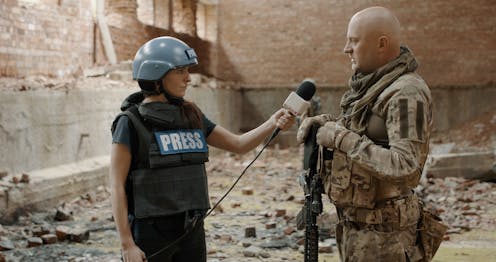
The journalists who signed an open letter[1] to Australian media organisations last week calling for ethical reporting on the war in Gaza have succeeded in intensifying the dispute over whether the coverage has been fair. At the same time, they’ve called their own impartiality into question.
At last count, the letter had attracted 270 signatories from journalists at a range of institutions including the ABC, Guardian Australia, The Sydney Morning Herald, The Age, The Conversation and Schwartz Media.
At the Herald and The Age, both owned by the Nine company, senior editorial executives, including the papers’ editors, have banned those staff[2] who signed the letter from having any role in covering the war.
The ABC’s director of news, Justin Stevens, did not go that far, but warned his staff[3] that if they signed the letter, their ability to cover the story impartially may be brought into question.
Read more: ABC chief is right: impartiality is paramount when reporting the Israel-Gaza war[4]
Addressing journalist deaths
The signatories to the letter, in addition to the individuals, were the journalists’ section of the Media Entertainment and Arts Alliance (MEAA) and its house (branch) committees at the ABC and Guardian Australia. It is not clear exactly under whose auspices the letter was written, but it is clear it has the endorsement of the union.
The letter raises two main issues.
One is that the Israeli Defence Force (IDF) has killed at least 53[5] journalists in the course of the present conflict and has a history of targeting journalists.
The letter provides links to reputable organisations – Reporters Without Borders, the International Federation of Journalists, the Committee to Protect Journalists – each of which provides substantial detailed evidence making a strong case against the Israeli Defence Force.
The letter states:
As reporters, editors, photographers, producers, and other workers in newsrooms around Australia, we are appalled at the slaughter of our colleagues and their families and apparent targeting of journalists by the Israeli government, which constitutes a violation of the Geneva Conventions.
That much of it can be defended as an attempt to stand up for press freedom and hold the Israeli forces to account.
Read more: More than one journalist per day is dying in the Israel-Gaza conflict. This has to stop[6]
Clear implications of pro-Israel bias
However, the letter then goes on to argue in a veiled but unmistakable way that the Australian media’s coverage of the war has been pro-Israel.
This is achieved by a series of what, on the surface, look like journalistic motherhood statements:
We call for […] Australian newsroom leaders to be as clear-eyed in their coverage of the atrocities committed by Israel as they are of those committed by Hamas.
The immense and disproportionate human suffering of the Palestinian population should not be minimised.
Apply as much professional scepticism when prioritising or relying on uncorroborated Israeli government and military sources to shape coverage as is applied to Hamas […] The Israeli government’s version of events should never be reported verbatim without context or fact-checking.
The clear implication is that this is not being done, and that taken together they add up to a pro-Israel bias that needs to be corrected.
That is a highly contestable proposition and it needs evidence, but none is provided.
The letter goes on to urge that “adequate coverage be given to credible allegations of war crimes, genocide, ethnic cleansing and apartheid”.
The position taken by the ABC on the use of these terms was set out[7] ten days ago by its managing director and editor-in-chief, David Anderson. He said the ABC would report other people’s use of them but would not adopt them for itself.
This is the conventional way for impartiality to be applied when such politically charged language is used. When they are reporting atrocities of the kind perpetrated by both sides in this war, on what authority do journalists take it upon themselves to apply these definitions?
Messy fall-out amid messy messaging
A further question concerning impartiality then arises: does signing this letter disqualify a journalist from being involved in covering the war? Does it justify the action taken by the Herald and The Age?
Those two newspapers have traditionally taken a strict line on these issues, and their decision this time is consistent with that tradition. Many years ago, a Herald reporter was taken off the reporting of state politics when he declared his membership of the Labor Party.
The reason given by the editorial executive who made this decision was not that his coverage had been biased but that there would be an apprehension among those who knew of his affiliation that his coverage might be biased.
A strict line on impartiality is fine, if it is applied impartially, but Crikey has drawn attention[8] to an uncomfortable fact: that three of the four editorial executives at Nine who imposed the ban have participated in trips to Israel sponsored by pro-Israeli groups.
You might think the handling of these problems by the media industry and the journalism profession couldn’t get much messier, but it could.
On November 11, a group of journalists calling themselves MEAA Members for Palestine published a separate letter[9] in Overland magazine, and in this there was nothing veiled about the position they took.
Read more: 'I just find it very hard to talk about it without getting emotional': top journalists reveal their trade secrets to Leigh Sales[10]
They condemned the Australian government’s support for what they called Israel’s genocidal assault on Gaza, called on the government to demand that Israel withdraw its forces and stop the bombing in Gaza, and condemned “the silencing and intimidation that our members experience when expressing support for, or reporting on, Palestine”.
They called on the Media Entertainment and Arts Alliance to support the Palestinian solidarity movement and join with trade union action across the world to “end all complicity and stop arming Israel”.
As a trade union, the alliance undoubtedly has the right to take sides, even in a war. But doing so is irreconcilable with the professional ethical obligations of its members to report impartially.
The Overland letter and the more restrained open letter to the media organisations might be two separate documents but it would be naïve in the extreme not to think that the first was parent to the second.
The whole episode, including the obvious hypocrisy of the Nine editorial management, has left the profession and the industry diminished at a time when Australian society needs them to be at their strongest.
References
- ^ open letter (form.jotform.com)
- ^ banned those staff (www.news.com.au)
- ^ warned his staff (www.theaustralian.com.au)
- ^ ABC chief is right: impartiality is paramount when reporting the Israel-Gaza war (theconversation.com)
- ^ at least 53 (cpj.org)
- ^ More than one journalist per day is dying in the Israel-Gaza conflict. This has to stop (theconversation.com)
- ^ set out (theconversation.com)
- ^ drawn attention (www.crikey.com.au)
- ^ published a separate letter (overland.org.au)
- ^ 'I just find it very hard to talk about it without getting emotional': top journalists reveal their trade secrets to Leigh Sales (theconversation.com)
Authors: Denis Muller, Senior Research Fellow, Centre for Advancing Journalism, The University of Melbourne