Weekend Times


Google Workspace

Business News

How to never get a speeding fine again — and maybe save a child's life

  • Written by Matthew Mclaughlin, Adjunct Research Fellow, The University of Western Australia
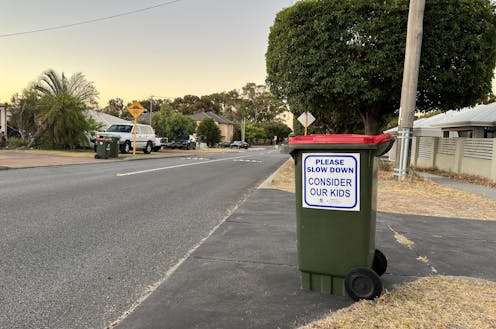
How to never get a speeding fine again — and maybe save a child's life

What if our cars didn’t allow us to speed? Or, at least, strongly encouraged us not to speed?

We could help motorists avoid speeding — and therefore reduce emissions and fuel use[1], improve traffic flow[2], reduce crashes[3], lower insurance costs[4], make streets feel safer[5] to walk and cycle – and totally avoid speeding fines.

Reducing speeding is crucial[6] if we are to reduce the rising road toll. More than 1,200 people were killed[7] on Australian roads in the past year.

It’s no wonder Australians want this technology – 81%[8] believe “intelligent speed assist” technology is important for making roads safer.

Technology to stop speeding

“Intelligent speed assist” is the name of the low-cost[9] technology that could save lives every year by reducing speeding.
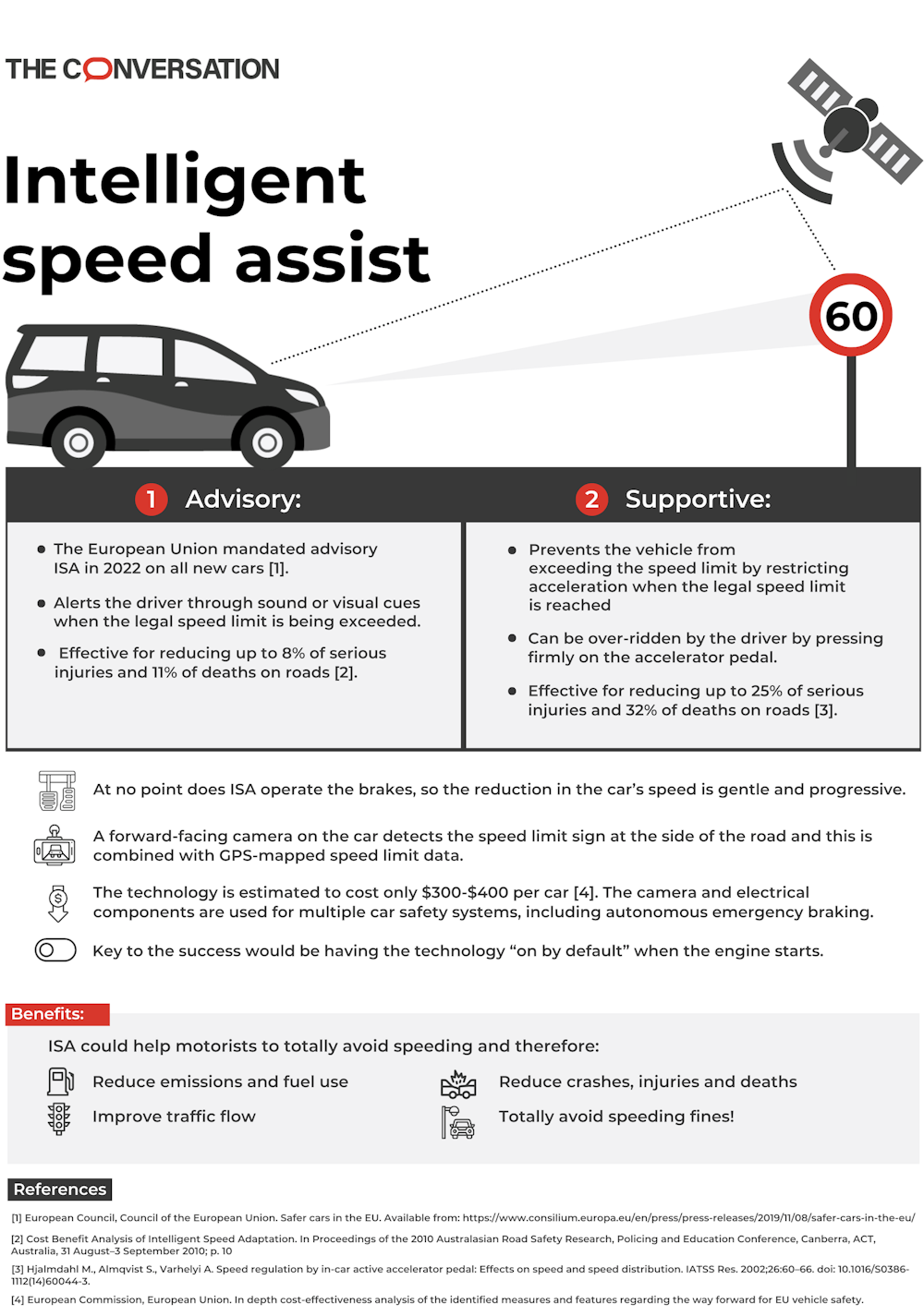
Graphic explaining what intelligent speed assist does, how it works and the benefits
CC BY[10] The idea of helping drivers to avoid speeding is more than 100 years old[11]. But early speed-limiting technologies proposed a top speed limit (similar to the way e-scooters are regulated[12] in Australia), rather than allowing motorists the option to break the speed limit. If we don’t do intelligent speed assist, what’s the alternative? Currently, we must constantly monitor speed limits and adjust our speed accordingly to avoid speeding. That means looking often at our speedometers. There is some research[13] to suggest continually taking our eyes off the road to review our speedometer could be dangerous. Given how often speed limits can change on a route, and that we all make mistakes, it’s no wonder speeding is so common. Will it work? Installing intelligent speed assist in all cars could prevent at least 8%[14] and up to 19%[15] of all crashes Australia-wide. This represents up to 200[16] lives saved per year. A NSW Centre for Road Safety trial[17] found advisory intelligent speed systems reduced speeding in 89% of vehicles, across more than 1.9 million kilometres of testing. Intelligent speed assist is not yet a perfect system. Hurdles to overcome include: different speed sign coverage[18] and designs from state to state maintaining an accurate map of speed limits across Australia for GPS potential over-reliance on the feature in varying driving conditions, such as wet weather, corners and so on. But shouldn’t we be doing everything we can to overcome these hurdles, to make such a life-saving, child-saving technology work as well as it can? What’s already been done? Legislation[19] in 2022 has made intelligent speed assist technology mandatory for all new cars sold in the European Union. In Australia, if you drive a relatively new car, you may already have the option of intelligent speed assist. For example, if you drive a new Ford[20], you can activate its Intelligent Speed Limiter. Intelligent speed assist adds to a growing list of in-vehicle safety technologies, such auto emergency braking[21], lane keep assist[22] and blind spot monitoring[23]. We know older vehicles[24] that lack such technologies are involved in more crashes. What about older vehicles? Cars have an average age of 10.4[25] years. So retrofitting older cars[26] with intelligent speed assist technology has been trialled[27]. Despite the European legislation[28], there’s no expectation of a wide-scale retro-fitting program. It is common, though, to retrofit fleet cars such as government and company vehicles with intelligent speed assist. This improves fleet safety[29] and distributes new technologies when these vehicles are sold on the second-hand market. ‘But I only speed a little bit’ Research[30] shows most people think they’re better-than-average drivers. More than one in four[31] Australians think it’s ok to speed if driving “safely”. But you can’t speed and drive safely. For every 1km/h increase in speed, there is a 4%[32] increase in fatal crashes. If everyone was to increase their speed by just 1km/h, we could expect an extra 48 deaths[33] a year. Road deaths remain the number one[34] killer of children in Australia and speed is the most common[35] factor in a crash. Current measures to reduce speeding haven’t gone far enough. Despite two in three[36] Australian drivers admitting to speeding every week, only one in ten[37] got a speeding fine last year. If you are worried about the government losing out on revenue, don’t. Road traffic crashes cost the Australian economy A$27 billion[38] a year. Speed camera fines generate just $1.5 billion[39] a year. Read more: Despite lockdowns, 1,142 Australians, including 66 kids, died on our roads in the past year. Here's what we need to do[40] 3 actions to get started Intelligent speed assist is not a silver bullet. But it is one of five crucial actions[41] that can make zero road deaths possible. More than 200 cities[42] around the world have already achieved this goal at least five times for a calendar year since 2009. Here are three actions to get started: install intelligent speed assist in all all public buses and government fleet cars – the NSW government fleet, for example, has 25,000 cars[43] require intelligent speed assist for a 5-star ANCAP[44] safety rating adopt the EU legislation[45] in Australia to require intelligent speed assist in all new cars. We have an urgent problem, we have the technology, we have the evidence it works, so what’s stopping us using it to save lives on our roads? The authors have provided footage online[46] of intelligent speed assist in action, for free reuse. References^ emissions and fuel use (www.sciencedirect.com)^ traffic flow (www.rsa.ie)^ crashes (casr.adelaide.edu.au)^ insurance costs (www.cis.org.au)^ feel safer (www.healthystreets.com)^ crucial (www.transport.nsw.gov.au)^ 1,200 people were killed (app.powerbi.com)^ 81% (towardszero.nsw.gov.au)^ low-cost (op.europa.eu)^ CC BY (creativecommons.org)^ 100 years old (dx.doi.org)^ the way e-scooters are regulated (scooterhut.com.au)^ some research (psycnet.apa.org)^ 8% (acrs.org.au)^ 19% (www.transport.nsw.gov.au)^ 200 (theconversation.com)^ trial (archive.acrs.org.au)^ coverage (austroads.com.au)^ Legislation (www.consilium.europa.eu)^ Ford (www.ford.com.au)^ auto emergency braking (www.carsguide.com.au)^ lane keep assist (howsafeisyourcar.com.au)^ blind spot monitoring (www.carsguide.com.au)^ older vehicles (www.monash.edu)^ 10.4 (www.abs.gov.au)^ retrofitting older cars (www.eiturbanmobility.eu)^ trialled (www.eiturbanmobility.eu)^ legislation (www.consilium.europa.eu)^ improves fleet safety (digital.library.adelaide.edu.au)^ Research (osf.io)^ one in four (www.infrastructure.gov.au)^ 4% (cdn.who.int)^ extra 48 deaths (www.bitre.gov.au)^ number one (www.aihw.gov.au)^ most common (www.transport.nsw.gov.au)^ two in three (arsf.com.au)^ one in ten (www.budgetdirect.com.au)^ A$27 billion (www.bitre.gov.au)^ $1.5 billion (www.whichcar.com.au)^ Despite lockdowns, 1,142 Australians, including 66 kids, died on our roads in the past year. Here's what we need to do (theconversation.com)^ five crucial actions (theconversation.com)^ 200 cities (www.dekra-vision-zero.com)^ 25,000 cars (www.governmentnews.com.au)^ ANCAP (www.ancap.com.au)^ legislation (www.consilium.europa.eu)^ footage online (drive.google.com)Authors: Matthew Mclaughlin, Adjunct Research Fellow, The University of Western Australia

Read more https://theconversation.com/how-to-never-get-a-speeding-fine-again-and-maybe-save-a-childs-life-216347

The Weekend Times Magazine

The best Nike shoes you can buy right now

You certainly have a few pairs of Nike sneakers around the house, but you may not be aware that the brand famous for its Swoosh was not always known as...

The Best Luxury Cars in 2021

The best luxury cars that you can look out for this year. You are probably looking for the most comfortable car this year. You go for these types of cars...

Finding the Perfect Wedding Suit in Adelaide: Your Ultimate Guide

Your wedding day is one of the most important days of your life, and every detail matters. From the venue to the vows, everything should be perfect, especially your attire...

Baking Tools and Equipment Your Bakery Needs

It can be hard to resist the smell of fresh bread or devouring a freshly baked cake. Fortunately, some people have a knack for kneading dough and baking up a...

Do we really want our kids drinking alcohol — when we’re told no amount is safe?

For generations, alcohol has occupied a strange, almost sacred place in Australian culture. It marks celebrations, lubricates social gatherings, and — whether we admit it or not — often serves...

The Smartest Financial Moves to Make In 2021

You are going to need all the finance tips you can get after winning your best US online casino real money. Everything may be unforeseen, therefore you must make wise...

How Pest Control Albury Protects Homes And Businesses From Harmful Pests

Residents and business owners in regional New South Wales understand the challenges that seasonal pests can bring. Many turn to Pest Control Albury to keep their properties safe, hygienic and free...

The Aussie Man Launches Debut Range of Men’s Grooming Products

Brand new Australian made men’s skincare company The Aussie Man has today announced the launch of their new range of organic skincare.  The Aussie Man uses hero natural ingredients such as...

Camplify Research Reveals 2020 is the Year of the Local Road Trip

Camplify has today released a research report highlighting that 2020 is no doubt the year of the local road trip. With COVID-19 restricting international travel, Australians have hit the roads...