Google AI

Weekend Times


The Times

Business News

China's youth unemployment problem has become a crisis we can no longer ignore

  • Written by: Christian Yao, Senior Lecturer, Te Herenga Waka — Victoria University of Wellington
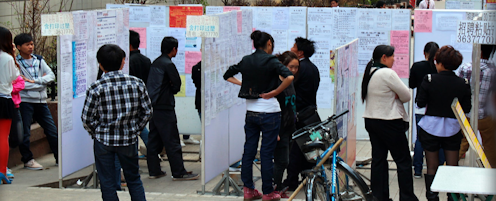
China's youth unemployment problem has become a crisis we can no longer ignore

Youth unemployment is a global problem, but in China the rate - 21.3%[1] - is particularly alarming, not just because it’s high, but because it could affect other economies and geopolitical relations.

The release of the rate, which more than doubled the pre-COVID rate of May 2018, coincided with China’s National Bureau of Statistics announcing it would no longer report age specific data because it needed to “improve and optimise labour force survey statistics[2]”.

Youth unemployment is a complex issue, but even more so in China as a result of government policy and society’s expectations.

Under the Hukou system, households in China are required to register, and authorities then determine where they live and work and which public services they can access.

The system often stops rural residents taking advantage of urban opportunities, which can limit their work prospects.

The stress and uncertainty experienced by this demographic is only worsened by the expectations that come with being the only child in the family as a result of China’s one child policy, which was abandoned only seven years ago.
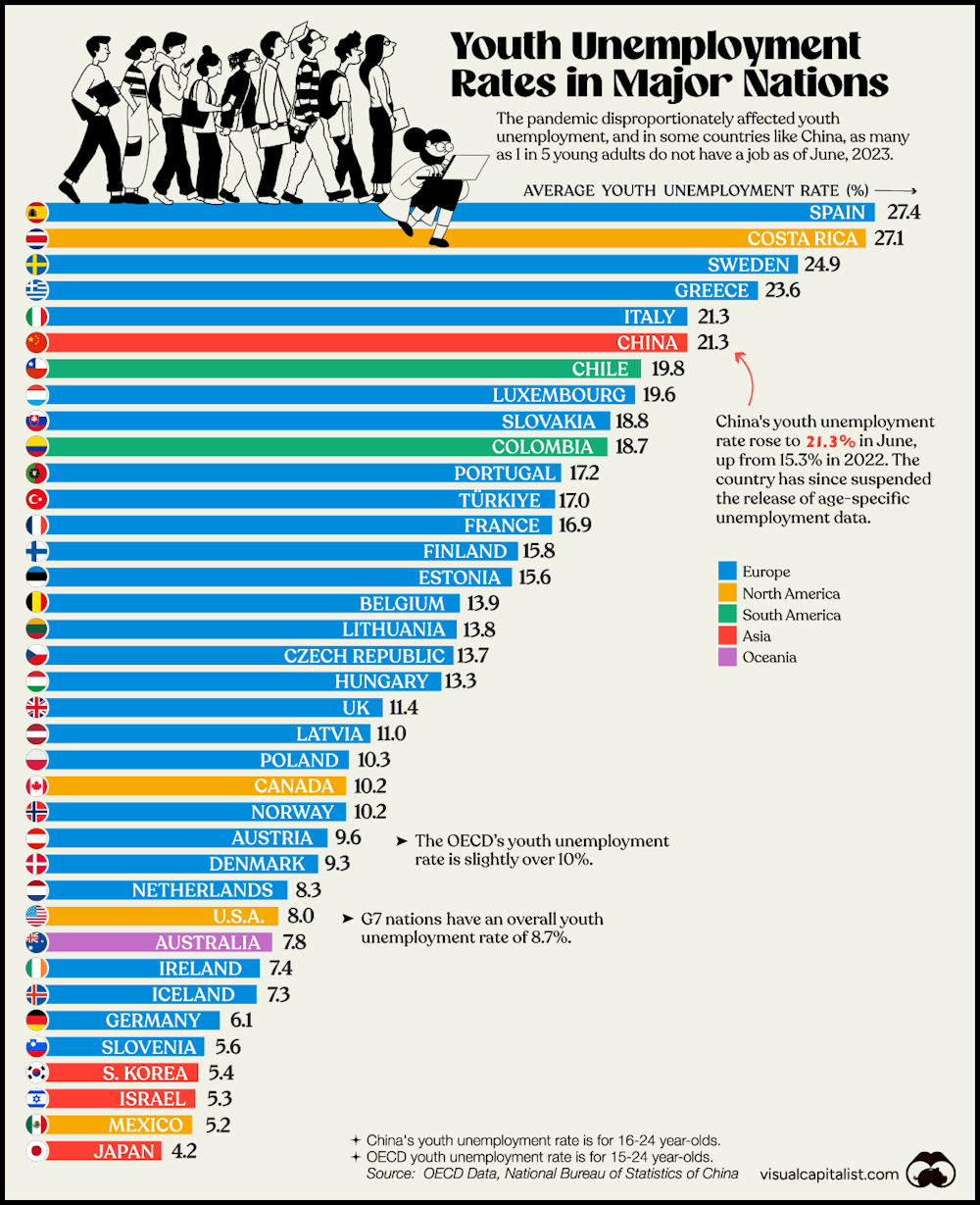
Visual Capitalist[3] The “Ant Tribe” phenomenon The term “Ant Tribe” was coined in 2009[4] by sociologist Lian Si to describe highly educated young people stuck in low-paying, temporary jobs that hinder skill advancement. These young people can’t accumulate social capital, leading to a negative cycle that’s hard to escape. This diminishes their return on their investment in education and highlights a breakdown in the career ecosystem. The “Ant Tribe” phenomenon is more than just a sign of a flawed economy. It also reveals a deeper emotional and psychological issue. Being over educated and underemployed causes significant emotional trauma[5], including anxiety, depression and hopelessness. This emotional toll is further complicated by societal shifts such as the “lying flat[6]” movement and the rise of “full time children[7]” in China. These trends challenge traditional markers of success and redefine family expectations, adding another layer to the psychological complexities faced by the younger generation. The impact can be long-lasting, leading to a less productive and innovative workforce[8]. Weaknesses in the education system Despite rapid expansion in higher education, a disconnect exists between university curricula and job market needs. Programs often favour theory over practical skills, leaving graduates ill-equipped for work. For example, engineering students might focus on equations and theories but miss out on real-world applications such as internships. Chinese students in a classroom taking notes Overqualified candidates flood the jobs market, forcing many to return to study. Shutterstock[9] Additionally, the market faces a glut of overqualified candidates, especially in the technology, finance and healthcare sectors. This imbalance drives many towards further studies. In 2023, a total of 4.74 million students took the postgraduate entrance exam, a staggering 135% increase[10] on the 2.01 million test takers in 2017. This cycle exacerbates youth unemployment and underemployment. The wider impact The ripple effect of China’s youth unemployment crisis is not to be underestimated. Drawing on warnings from UNICEF[11], high unemployment rates can lead to civil unrest[12], especially in nations with a large youth population. The Chinese Communist Party has long maintained its authoritarian approach[13] by securing a social licence based on economic stability and prosperity. If rising youth unemployment erodes this licence by fostering political disengagement or radicalisation, China could experience a significant internal power shift[14]. In a globally connected world, such turmoil could spill over into international relations. Civic unrest can make a country less stable and thus less attractive to foreign investment[15], especially among nations with close economic ties to China. Read more: Inside the world's largest higher education boom[16] Such an internal upheaval also threatens to destabilise supply chains globally, given China’s pivotal role in global supply chains[17]. Historical examples such as the Arab Spring[18] and Brexit[19] show internal dissatisfaction and social unrest can have ripple effects on a country’s international relations. The Arab Spring led to the overthrow of multiple governments, created regional instability, influenced global oil prices, and necessitated the resetting of foreign policy by Western countries. Large group of people carrying placards protesting against Brexit Instability in Britain caused by Brexit led to changes in foreign policy. Shutterstock[20] Similarly, Brexit impacted global trade agreements, led to political realignment, and caused the European Union to reconsider its future direction[21], affecting its collective foreign policy. While youth unemployment is a global dilemma, the extent of the problem in China and its potential broader impact on interconnected economies means we can’t afford to ignore it. What can China do to solve the problem? China can find policy inspiration from successful initiatives in other countries, such as Germany’s dual vocational training system[22]. This system ensures students are both academically prepared and practically skilled, better aligning education with labour market demands. Addressing the urban/rural divide is equally crucial. By offering financial incentives including tax breaks and grants, China could promote job growth in rural areas. Australia and the United States have adopted similar models to attract healthcare workers to less populated regions[23]. China also needs to do something to reduce the emotional toll of chronic unemployment which worsens the longer graduates are out of work. Post-COVID, the issue is exacerbated, with 40% of Chinese youth reported[24] to be susceptible to mental health challenges. This is where mental health services[25] such as those available in Australia that are tailored to young people[26] could help. Besides benefiting the individual, these programs contribute to a more engaged, productive workforce essential for national well being. Read more: Young, educated and underemployed: are we building a nation of PhD baristas?[27] The precarious nature of the gig economy can further deepen the unemployment crisis. Some European countries such as France[28] and the Netherlands[29] consider gig workers employees and offer social security benefits. A similar model could be implemented in China, providing benefits such as health insurance and retirement plans. Finally, the scale and complexity of youth unemployment requires a multi-pronged approach that extends beyond national borders. Countries should actively share successful employment strategies and cooperate on international initiatives to create job opportunities for youth. Collaboration is the key to developing a globally stable, productive young workforce. Investing in young people isn’t just good policy. It’s a moral imperative for global stability and shared prosperity. References^ 21.3% (www.visualcapitalist.com)^ improve and optimise labour force survey statistics (www.nytimes.com)^ Visual Capitalist (www.visualcapitalist.com)^ coined in 2009 (www.abebooks.com)^ emotional trauma (hbr.org)^ lying flat (www.bloomberg.com)^ full time children (edition.cnn.com)^ less productive and innovative workforce (pubmed.ncbi.nlm.nih.gov)^ Shutterstock (www.shutterstock.com)^ 135% increase (www.statista.com)^ UNICEF (www.unicef-irc.org)^ civil unrest (www.epi.org)^ authoritarian approach (theconversation.com)^ internal power shift (www.bloomberg.com)^ less attractive to foreign investment (onlinelibrary.wiley.com)^ Inside the world's largest higher education boom (theconversation.com)^ global supply chains (www.gmfus.org)^ Arab Spring (theconversation.com)^ Brexit (theconversation.com)^ Shutterstock (www.shutterstock.com)^ caused the European Union to reconsider its future direction (www.jstor.org)^ dual vocational training system (www.bibb.de)^ less populated regions (www.ruralhealth.org.au)^ reported (www.ncbi.nlm.nih.gov)^ mental health services (headspace.org.au)^ young people (www.headtohealth.gov.au)^ Young, educated and underemployed: are we building a nation of PhD baristas? (theconversation.com)^ France (www.reuters.com)^ the Netherlands (www.reuters.com)Authors: Christian Yao, Senior Lecturer, Te Herenga Waka — Victoria University of Wellington

Read more https://theconversation.com/chinas-youth-unemployment-problem-has-become-a-crisis-we-can-no-longer-ignore-213751

Find Out More. Get in Touch with The Times.

Whether you have a question, a news tip, a business enquiry or would like more information, we're here to help

Please complete the enquiry form and a member of The Times team will respond as soon as possible.

Product enquiries

News Tips

Advertising & Sponsorship

Business Enquiries

Editorial Feedback

Corrections

Media Requests

Partnership Opportunities.

Email us at editor@TheTimes.com.au or use our enquiry form.

The Weekend Times Magazine

Smart Lock: The Future of Home Security and Convenience

A smart lock has revolutionized the way people think about home security. Moving beyond traditional keys and mechanical locks, smart locks bring technology and convenience together, offering homeowners and businesses a new...

Why Car Sharing is dominating Car Renting

Sustainability, budget, urban living, lack of parking – these are just a few of the reasons that many people are choosing not to buy cars in today’s environment. ...

Rodent Control: Effective Strategies to Protect Your Home and Health

Rodent control is an essential part of maintaining a safe and healthy environment in both residential and commercial properties. Rodents, including rats and mice, are not only a nuisance but...

CHECK.CHECK.CHECK. The new ‘Slip, Slop, Slap,’ for a night out campaign

CHECK.CHECK.CHECK. The new ‘Slip, Slop, Slap,’ for a night out launched by the Night Time Industries Association A new campaign Check. Check. Check. encouraging punters to do their...

Creating a Custom Bathroom Vanity: Plan for These Things

Doing a bathroom reno and think a custom bathroom vanity could be just the thing? A custom vanity can completely transform the look and feel of a bathroom, from a...

Evaporative Cooling Cleaning Melbourne for Fresh Air and Reliable Cooling

Regular Evaporative Cooling Cleaning Melbourne is essential for maintaining clean air, consistent cooling performance, and the overall reliability of evaporative cooling systems. These systems are widely used across Melbourne due to...

Prime Minister interview with Karl Stefanovic and Alison Langdon, Today

KARL STEFANOVIC: Joining us now from Kirribilli House in Sydney. PM, good morning to you. Thank you for your time.    PRIME MINISTER: G’day Karl.   STEFANOVIC: The Premiers don't seem to be listening...

Year 12 Tutoring For Better Exam Preparation And Academic Confidence

The final year of high school is one of the most important periods in a student's academic journey. It is a time when assessment results, examination performance, and study habits...

Discover the Benefits of Lifestyle Awnings for Your Home

Image by evening_tao on Freepik Adding shade and style to your outdoor space is easier than ever with Lifestyle Awnings. Whether you want to enjoy your backyard comfortably, protect your...