Climate extremes make NZ’s supply chains highly vulnerable – it's time to rethink how we grow and ship food
- Written by: Alan Renwick, Professor of Agricultural Economics, Lincoln University, New Zealand
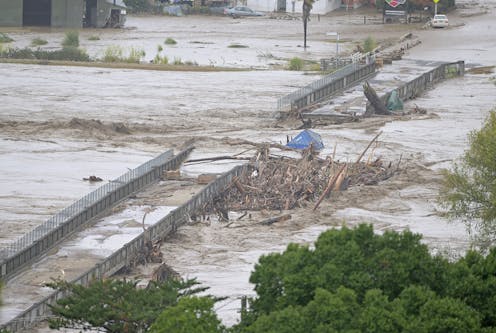
Supermarket customers around New Zealand are noticing gaps in the grocery aisles that have nothing to do with the global pandemic or Ukraine war. It’s clear domestic food supply chains have been increasingly challenged by natural disasters and the ongoing impact of climate change.
Countdown recently warned customers that certain foods would be in short supply due to flooding[1] on the East Coast. Time and again, we have seen such shortages and significant increases in the price of certain foods, particularly fresh produce.
The question is whether we have just been unlucky, or are these disruptions a result of deeper issues in the New Zealand food system? Are we more vulnerable than other countries, and if so, what does this mean for our food security?
Over the decades, New Zealand has centralised its food system and increased the risk that a single regional event could reverberate nationally. But it’s not too late to diversify and increase resilience across our food supply system.
Efficiency over resiliency
Modern food supply chains have largely been optimised for economic efficiency rather than resilience to supply-side shocks.
The agricultural sector has seen a process of increasing scale and specialised production – primarily to increase profitability. In part, this has been driven by land suitability.
The outcome is a relatively small number of large-scale processing factories and the concentration of enterprises in specific regions. For example, around 32% of New Zealand’s horticultural products come from the Bay of Plenty and Hawkes Bay.
Read more: How to make fragile global supply chains stronger and more sustainable[2]
At the retail end of the chain, large, centralised distribution centres and “just in time” delivery systems keep costs low for the two dominant supermarket chains, which account for between 80% and 90%[3] of the food we consume. Food is brought to just a handful of distribution centres before being dispersed across their networks of stores.
But disruptions in one region can affect the entire country. In the aftermath of the Christchurch earthquake[4], the distribution centres serving the entire South Island were damaged. Supermarkets were forced to ship supplies from their North Island hubs.
A recent study[5] from the Timaru District Council found that while South Canterbury describes itself as the food bowl of New Zealand, 95% of the commercially-bought food in the district comes from outside the region.
Over-dependence on roads
The current supply chain model is totally reliant on the uninterrupted movement of products across the country through our transport network – in theory, comprised of road, rail, sea and air links.
In practice, just under 93% of freight[6] goes by one mode – road. This compares with 72% in Germany.
Topography coupled with low population densities mean many regions are served by only one or, at most, two main roads suitable for freight trucks. We are nearly totally reliant on roads but our road networks are particularly vulnerable[7] to climatic events and other natural disasters.
Our food distribution system seems to be better set up to get exports out or imports in through ports and airports than to move food around New Zealand[8]. The vast majority of our agricultural products are exported rather than consumed in New Zealand.
Read more: Why your local store keeps running out of flour, toilet paper and prescription drugs[9]
Resilience in uncertain times
All the evidence suggests climate change is going to increase the challenges in our food system, with more frequent and intense weather events[10]. Projected sea-level rise will also put more strain on our already vulnerable food system at the farm and processing levels, as well as our ability to move it around the country.
Regional councils are clearly concerned[11], and there is increasing discussion of the concepts of food resilience and local food networks.
But what does a food system designed around resilience rather than optimisation look like? Does it simply mean less choice and higher prices? Or can it tackle other challenges, such as diet and health, environmental concerns and broader food security?
Two possible and compatible paths are evident. The first relates to local food networks[12] and involves diversification of the products produced within each region, at both the farm and processing and manufacturing levels.
Read more: The key to future food supply is sitting on our cities' doorsteps[13]
The idea of distributed manufacturing – basically mini-factories dispersed through the country – has been discussed in the forestry sector in New Zealand[14] but could equally be considered for food.
Some emerging technologies that reduce dependence on the local climate for production, such as vertical farming[15], could be important in local food networks. Aquaponics[16] (farming both fish and plants together), or algae production in ponds, could also diversify local food resources.
The idea of “circularity” could help reduce dependence on external inputs. Food waste products, for example, could be turned into energy as well as fertiliser.
From supply chains to systems
Alternatively, we could keep the potential benefits of national scale production, but invest to reduce the vulnerabilities in our transport networks. As recent research highlights[18], there could be multiple benefits to reducing reliance on roads.
And we don’t need to reinvent the wheel. Only 6% of freight is transported by rail – this could be increased to diversify shipping options.
There may also be opportunities to make more out of coastal shipping routes. At the moment, this largely comprises the movement of bulk products such as fertiliser and cement.
However we tackle the increasing vulnerabilities in our food supply chain, we need to think of it as a food system and not simply a supply chain. The complex interactions in our food system mean changes to one part are likely to have wider economic, environmental, social and cultural impacts.
Tackling our potential vulnerability to climate change needs to be undertaken in the context of a wider strategy for the entire food system.
References
- ^ due to flooding (www.nzherald.co.nz)
- ^ How to make fragile global supply chains stronger and more sustainable (theconversation.com)
- ^ between 80% and 90% (comcom.govt.nz)
- ^ Christchurch earthquake (www.stuff.co.nz)
- ^ recent study (www.youtube.com)
- ^ 93% of freight (www.transport.govt.nz)
- ^ particularly vulnerable (www.stuff.co.nz)
- ^ move food around New Zealand (www.stuff.co.nz)
- ^ Why your local store keeps running out of flour, toilet paper and prescription drugs (theconversation.com)
- ^ more frequent and intense weather events (www.doc.govt.nz)
- ^ clearly concerned (www.stuff.co.nz)
- ^ local food networks (static1.squarespace.com)
- ^ The key to future food supply is sitting on our cities' doorsteps (theconversation.com)
- ^ forestry sector in New Zealand (www.scionresearch.com)
- ^ vertical farming (www.stuff.co.nz)
- ^ Aquaponics (www.doc.govt.nz)
- ^ Getty Images (www.gettyimages.com.au)
- ^ recent research highlights (www.rnz.co.nz)
Authors: Alan Renwick, Professor of Agricultural Economics, Lincoln University, New Zealand